Pirl Experimental Education & Consulting
How I Teach It · Injuries & Healing
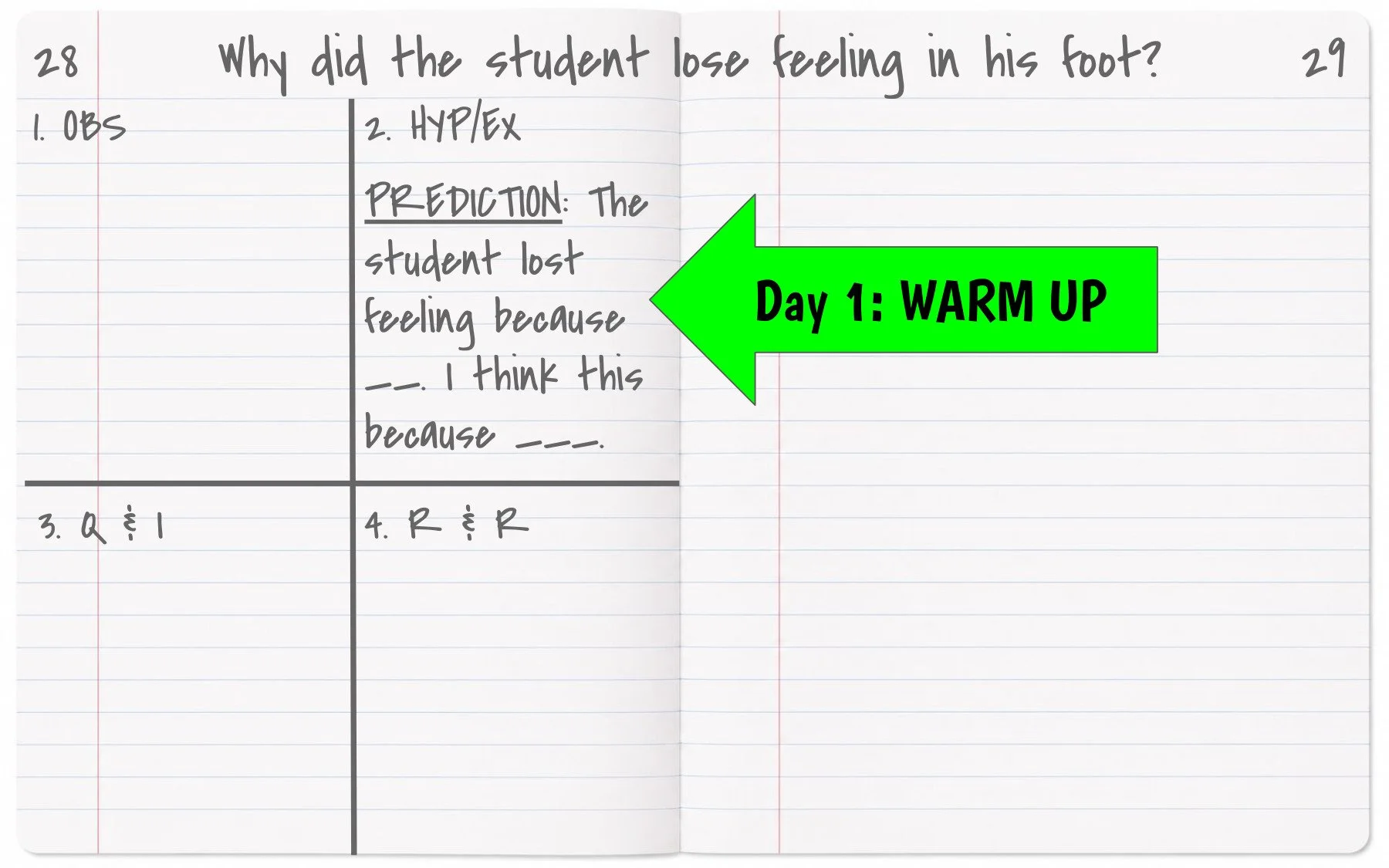
Why did the student
lose feeling in his foot?
A movement game, six condition stations, and a conversation about what happens when nervous-system communication changes.
A student can name the brain, spinal cord, and nerves without being able to explain why an injured foot feels numb. I want this lesson to close that gap. The question is not just where the parts are. It is how those parts communicate—and what changes when that communication is disrupted.
In this version of the lesson, I used a short visual mini-lesson, everyday examples, the University of Utah’s Manipulations game, and six nervous-system condition stations. The stations became a prominent part of the lesson because they gave students different ways to apply the same model. We then had a reason to return to the injured foot and to talk about movement, healing, and accessibility.
01 / THE TWO-DAY SEQUENCEThe two-day sequence
Day one
Build and use the pathway
Predict why the foot lost feeling. Introduce the six-part model. Trace familiar situations. Explore Manipulations and capture new thinking in the notebook.
Day two
Find where communication changes
Retrieve the model. Rotate through six condition stations at about five minutes each. Write independently, discuss the implications, and revisit the injured-foot explanation.
This fits the two-meeting structure I use with 66-minute periods. The mini-lesson is about ten minutes, and the station rotations take about thirty minutes before transitions. I protect time after the stations for students to make connections.
02 / START WITH THE FOOTStart with the injured foot
The notebook question is direct: Why did the student lose feeling in his foot? Students begin with a prediction in the Think Like a Scientist four-square. At this point, I am looking for their current explanation. Do they think the problem is in the skin? The blood supply? A nerve? Do they connect feeling with a message reaching the brain?
The prediction gives us something to revisit. Students do not need to be right immediately; they need an idea that later evidence can strengthen, change, or replace.
03 / BUILD THE PATHWAYBuild a model students can use
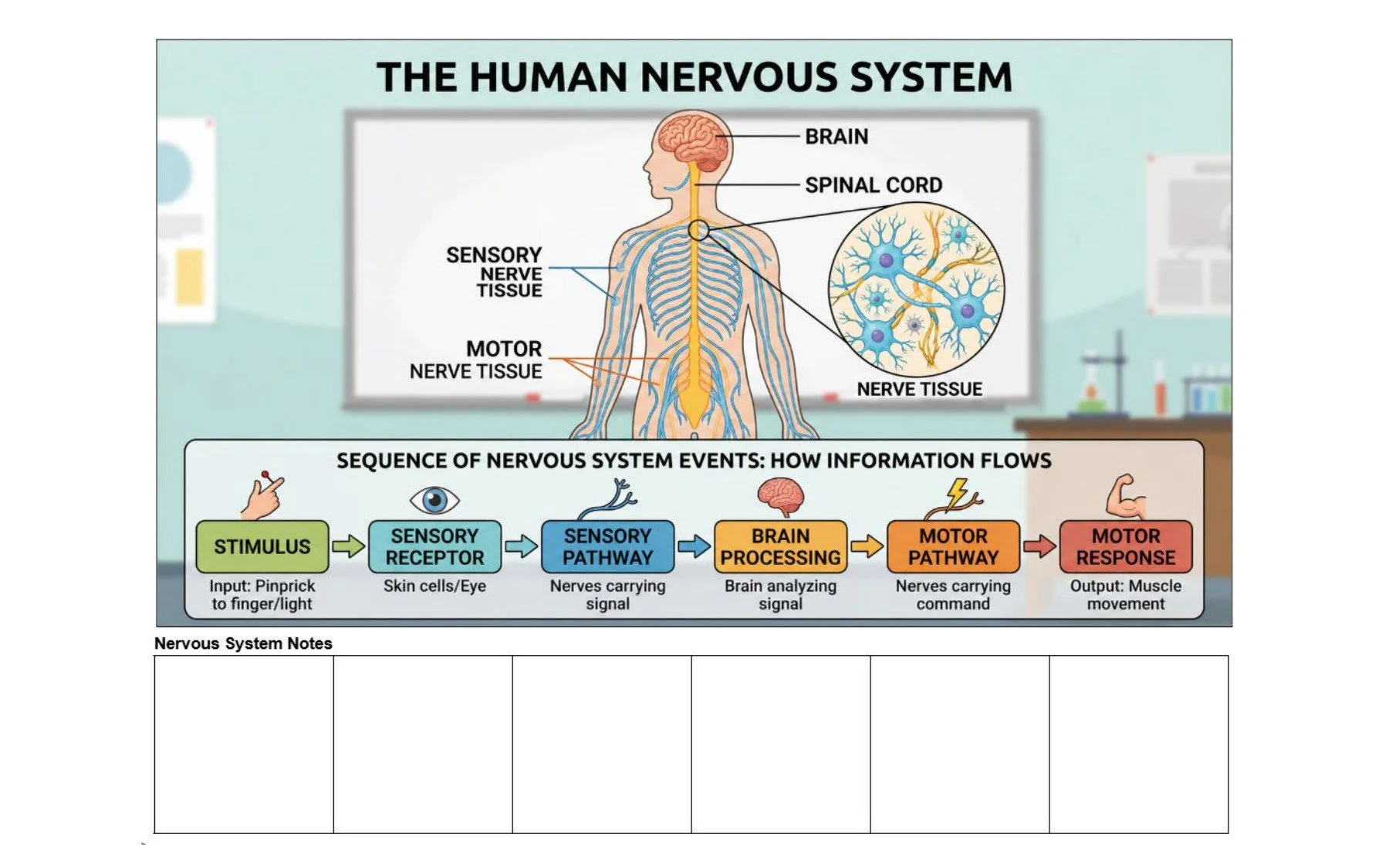
I keep the initial model visible and manageable: stimulus, receptor, sensory pathway, brain processing, motor pathway, response. In our explanations, I use sensory nerves and motor nerves so the direction of the information stays clear.
The whole-body view matters. A hand or foot is a long way from the brain, and the spinal cord helps carry information between the brain and much of the body. The nerve-tissue inset lets us shift scale without asking students to draw an entire nervous system from scratch. The printed notes leave their effort available for labels, arrows, and explanations.
Then I use familiar situations: seeing someone and waving, hearing a teacher, feeling a touch, or adjusting body position to balance. The broader set also includes taste, smell, hunger, thirst, and needing the bathroom. For each example, I ask what information comes in, what happens with it, and what response follows.
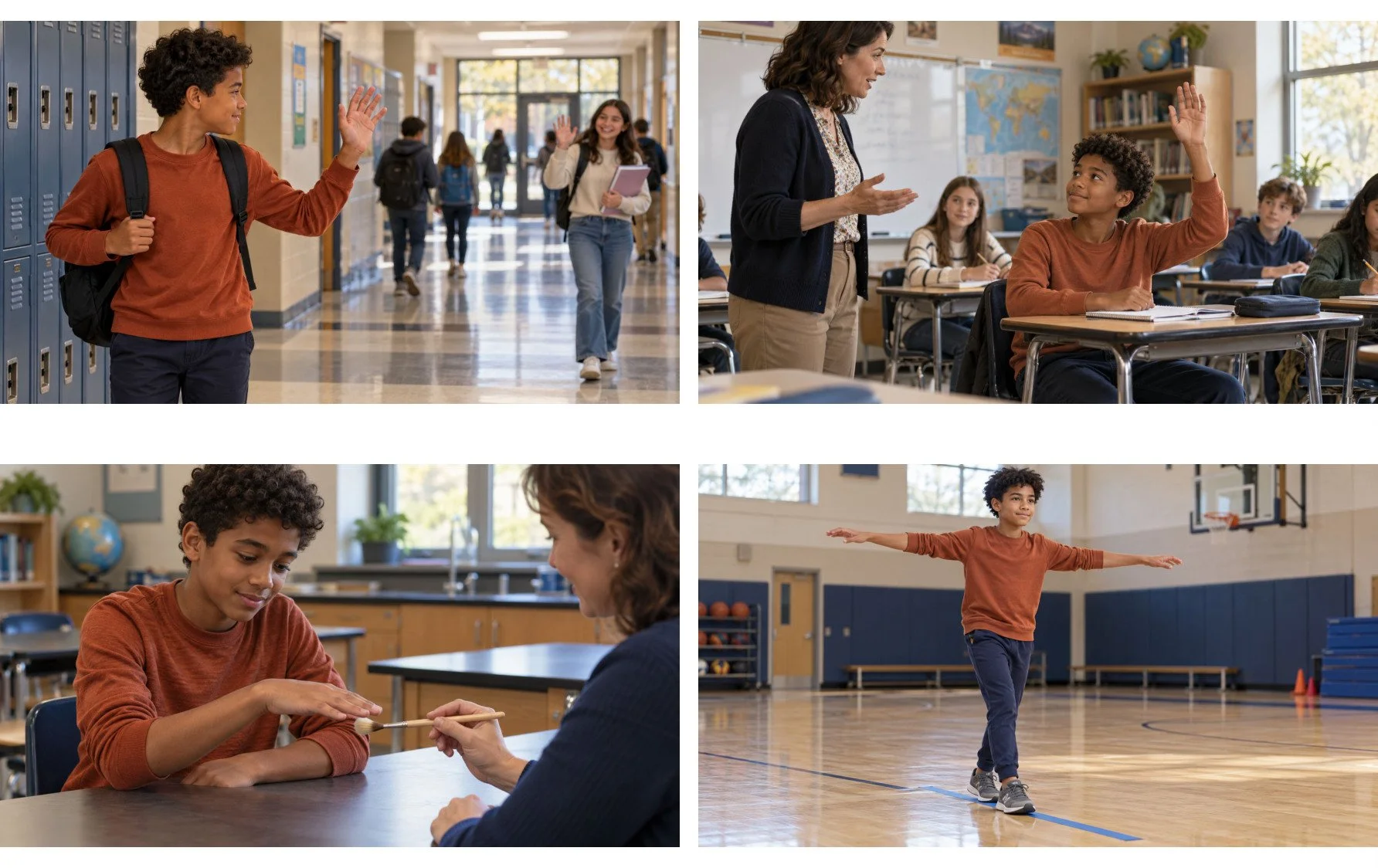
These examples also open the door to an important distinction: some responses are deliberate, while much of the nervous system’s work happens without a conscious decision. I keep the main explanation focused on signals and responses; the detailed chemistry of internal sensations can wait for an honors extension.
04 / GIVE THE GAME A PURPOSEGive the game a thinking job
Students enjoy Manipulations from the University of Utah’s Genetic Science Learning Center. I use it after the nervous-system mini-lesson so students have a model to bring to the experience. They are looking for connections among the structures they already know and the communication that makes movement possible.
Explore the systems before controlling the movement
I start students with the systems exploration. They revisit muscles and bones, then look at how nerves fit into the same working system. The connection matters: muscles create the pull, bones move, and signals help coordinate what happens. I want students to connect those jobs rather than treat each body system as a separate vocabulary list.
Next, students try the movement tasks. They have to work with the controls, watch what the hand and arm do, and adjust their next attempt. A task that would be quick with their own hand becomes something they have to manage deliberately. That contrast is what I want them to notice.
Keep the notebook beside the game
Students add at least one new idea to each Think Like a Scientist box while they play: Observe; Hypothesize & Explain; Question & Investigate; Revise & Refine. The notebook gives them somewhere to record what happened, offer a reason, raise a question, and reconsider an earlier idea. The writing keeps their attention on the system, not just on finishing the task.
Why do simple movements take so long in the game when they take only seconds in real life?
This is the question I use to bring the experience back to the science. Students compare the separate adjustments they make in the game with the coordination happening in their own bodies. Sensory information helps the nervous system monitor a movement, and motor signals help muscles respond. That feedback continues as we move; we do not consciously plan every muscle contraction.
The connection graphic below gives students three things to consider: the controls they adjusted, the feedback they used, and what might change if signals were delayed, missing, or poorly coordinated. It is the original teaching graphic from slide 15, created for this lesson.
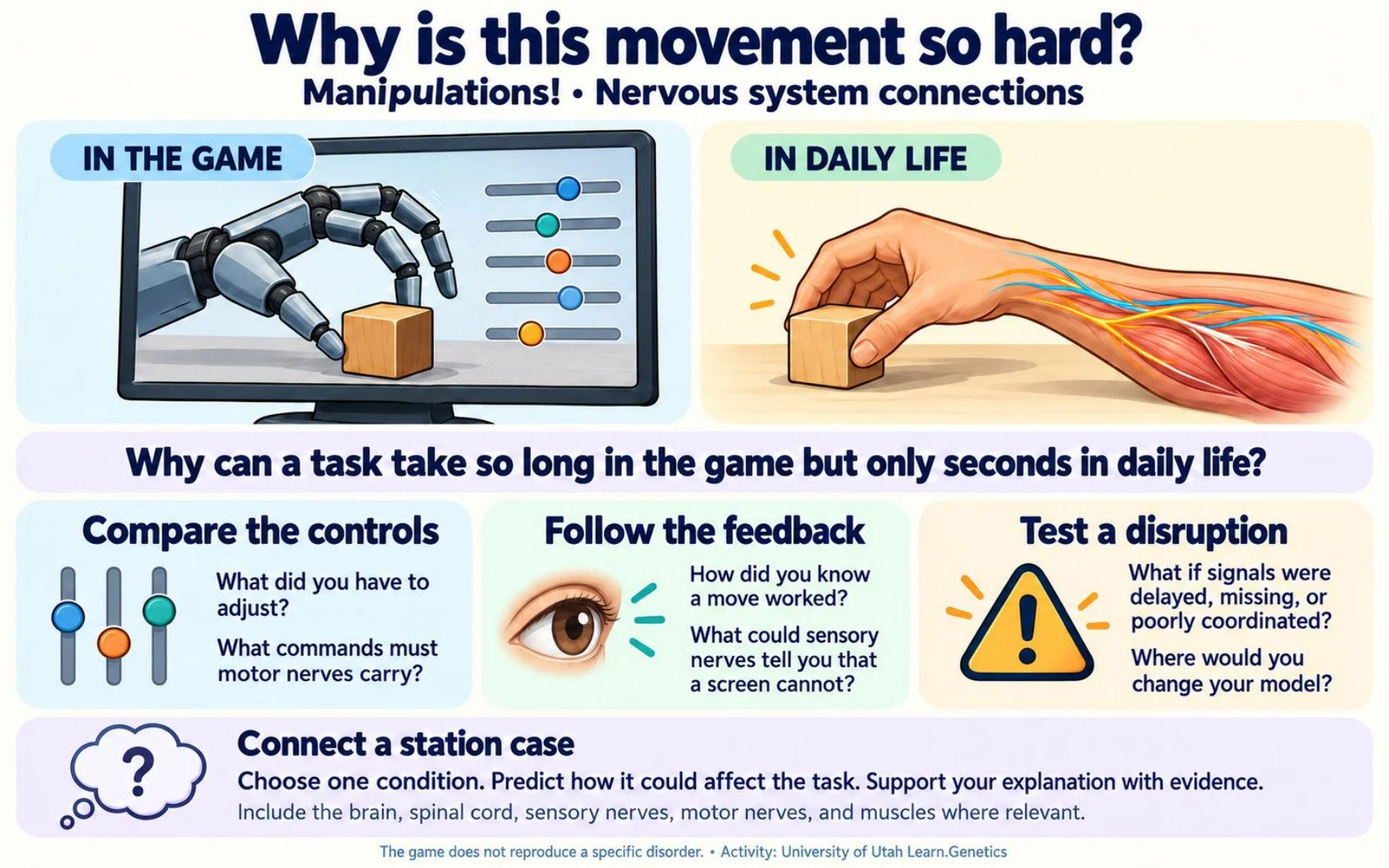
That thinking carries into the station work. Students can ask how a condition might change the information coming in, the processing, or the commands going out. Then, after the stations, the discussion graphic from slide 21 brings the game experience together with the patient cases, healing, and accessibility. We can make those connections without another round of gameplay.
I also keep the comparison bounded. A difficult game can help us notice demands on a system; it does not reproduce someone’s experience of living with a neurological condition.
05 / INVESTIGATE THE STATIONSUse the stations to test the model
Day two begins with retrieval. Before looking back at the notes, students recall as many parts of the pathway as they can and predict what could happen if one or more parts stopped working as expected.
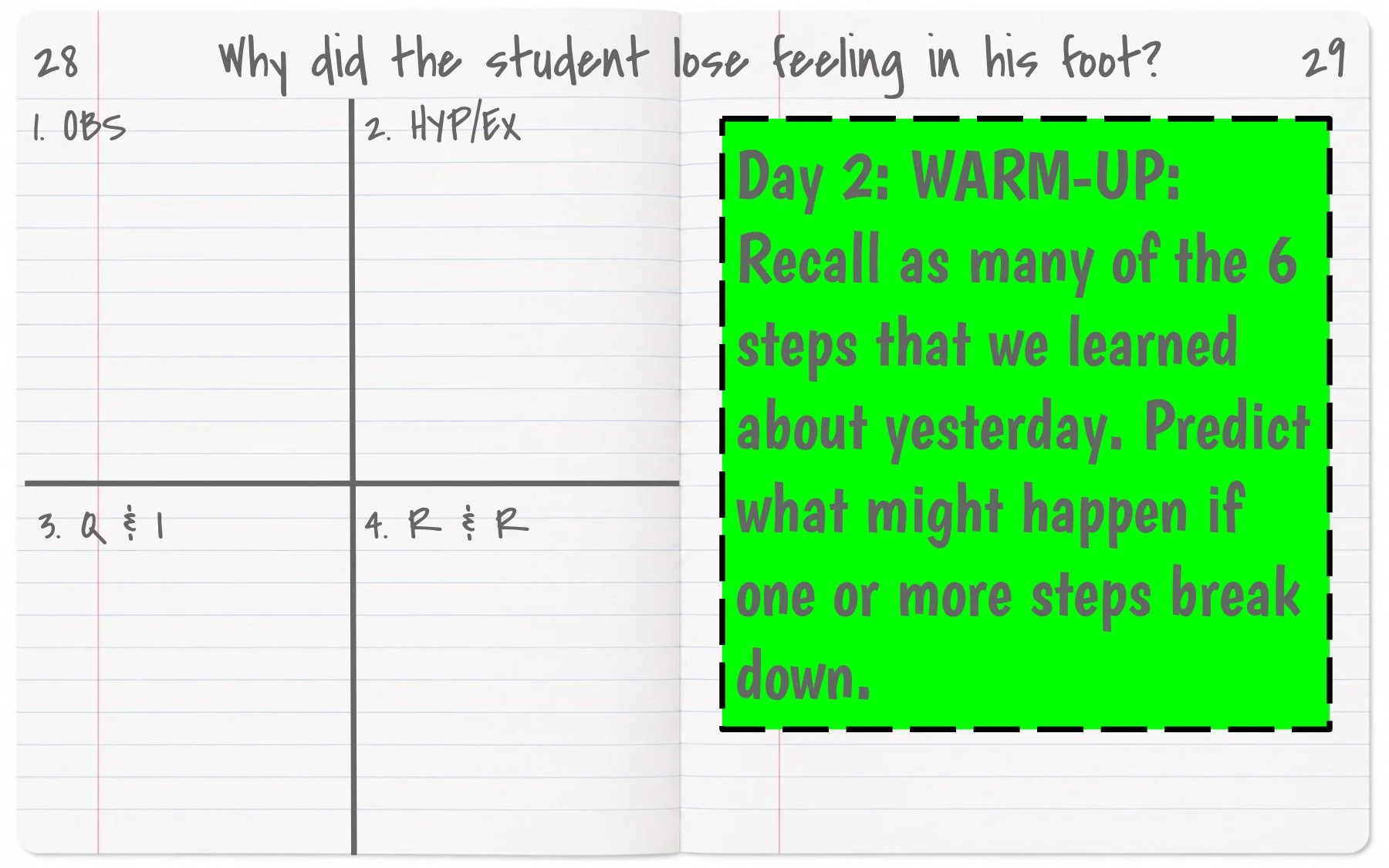
Then students rotate through six stations, spending about five minutes at each. Each case combines a person’s symptoms with information about what is happening inside the body. Students use the capture sheet to explain where communication is disrupted and how that disruption accounts for the person’s experience.
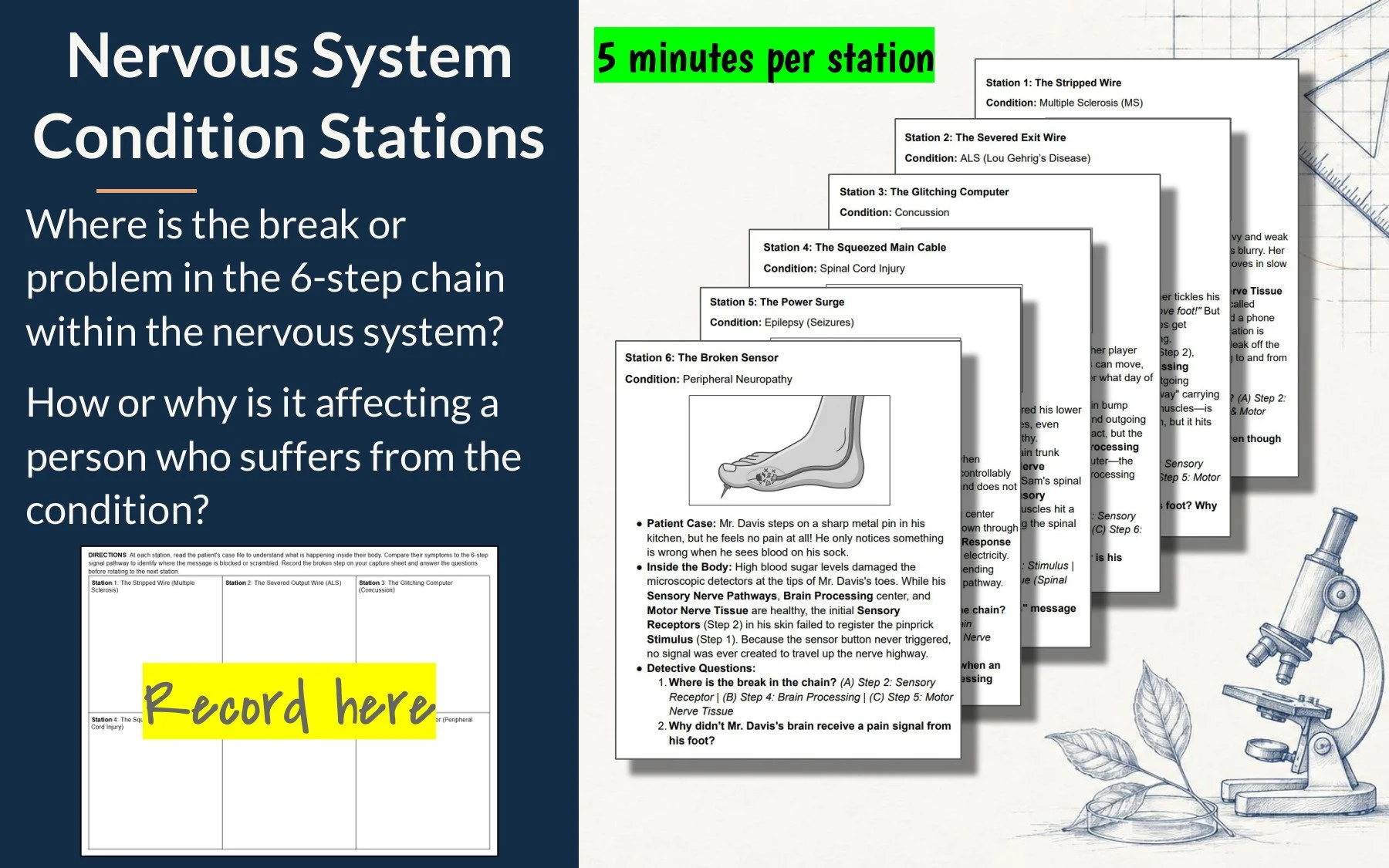
I want more than a condition name or a numbered step. “The nerves are damaged” is a starting point. Which nerves or part of the nervous system? What happens to the signal? How does that help explain what the person can—or cannot—do?
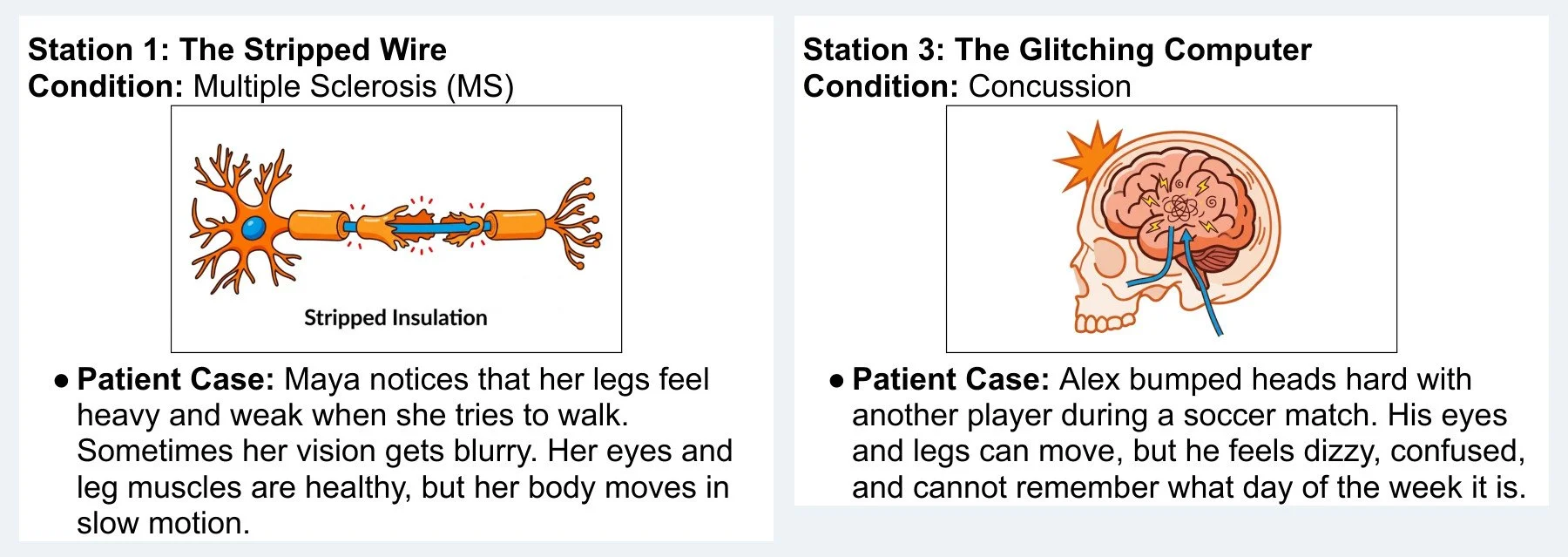
| Station | The explanation I am listening for |
|---|---|
| Multiple sclerosis | Damage to myelin in the brain or spinal cord can slow or disrupt communication, affecting movement or sensation. |
| ALS | Deteriorating motor neurons reduce the commands reaching muscles. In this case, feeling the touch does not guarantee being able to move in response. |
| Concussion | Brain function can be disrupted, affecting processing, memory, or coordination, even when the person can still see, hear, and move. |
| Spinal cord injury | Damage can interrupt information traveling toward and away from the brain. Effects depend on the location and extent of the injury. |
| Epilepsy / seizures | Abnormal patterns of brain activity can change awareness or produce movements the person did not choose. A seizure is not simply an absence of signals. |
| Peripheral neuropathy | Damage to peripheral nerve fibers or endings can reduce or distort sensation. The foot may send unreliable information even while the person can see the injury. |
Those are teacher-level destinations, not answers I want students copying before they investigate. The differences among the cases are the useful part. A processing problem, a weakened sensory message, and a disrupted motor command can lead to different outcomes.
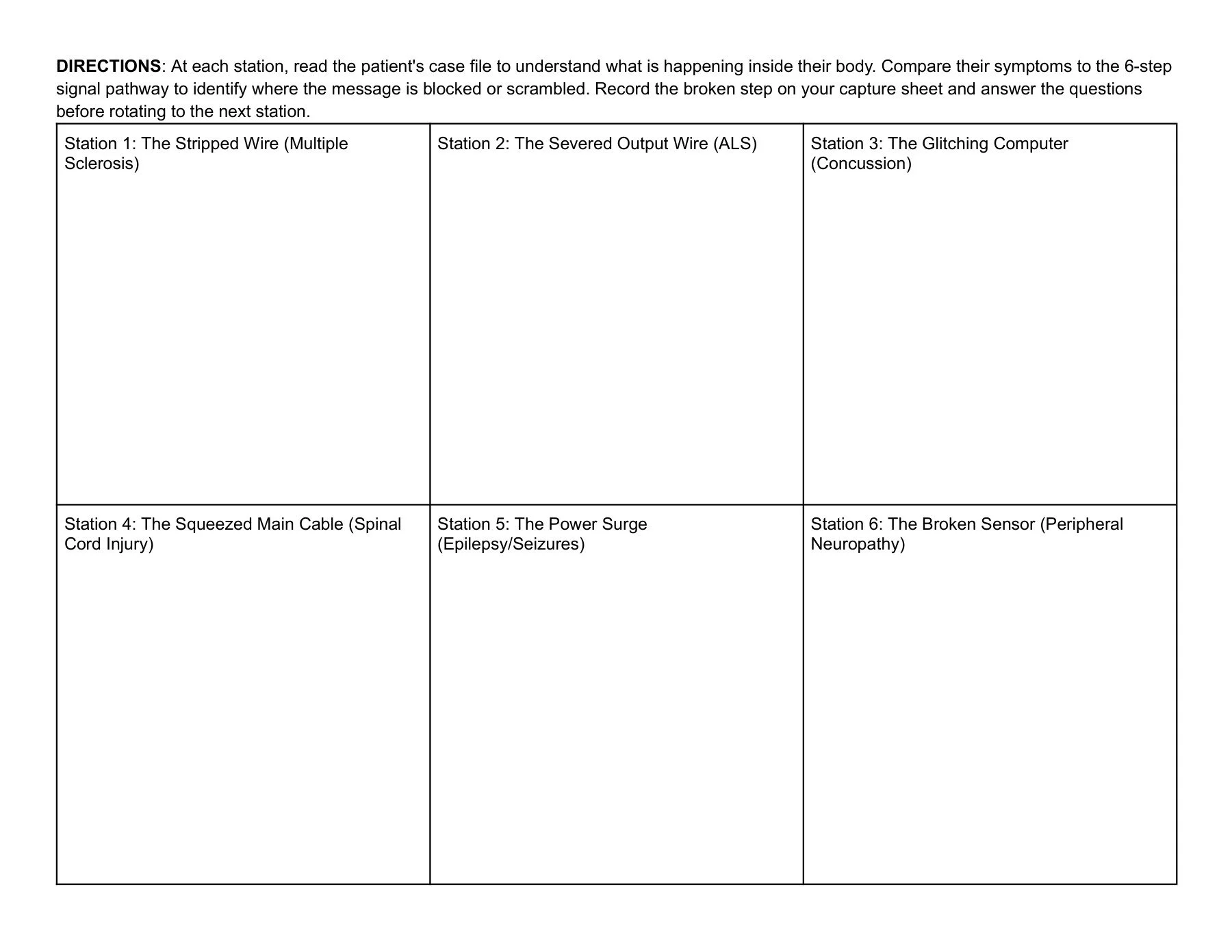
The capture sheet gives each station its own box. That visual chunking makes the work easier to organize and gives students room to explain. When I add support, I prefer a read-aloud, a word bank, or a chance to trace the pathway before writing. I am cautious about numbered hints that supply the very connection students are supposed to make.
06 / WRITE & DISCUSSWrite first. Then discuss what the cases mean.
After the rotations, I give students independent writing time before bringing their ideas together. The original discussion graphic from slide 21 connects the game, the condition cases, healing, and accessibility. Students have specific examples to reason from, and quieter students have time to prepare an idea.
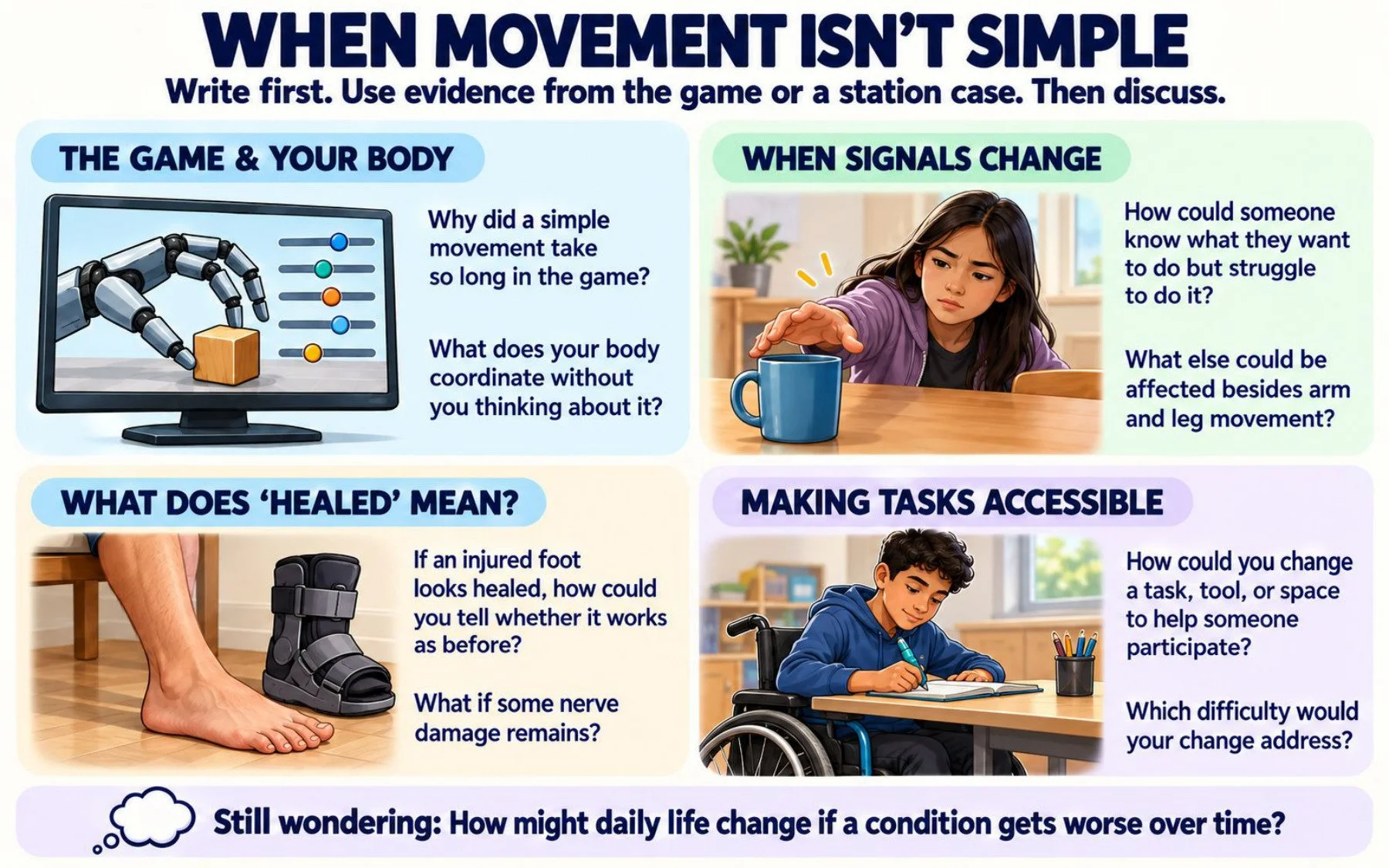
I use questions like these to move the discussion beyond a list of damaged structures:
- Coordination: What does your nervous system help you do during an ordinary task that you rarely have to think about?
- Signals: How could someone know what they want to do but have difficulty carrying out the movement?
- Healing: If the outside of an injured foot looks better, what would we still need to know before saying its function has returned?
- Access: How could we change a tool, a task, the time allowed, or the space so someone could participate more independently?
The healing discussion needs care. Some peripheral nerves can regrow, but recovery can be slow or incomplete. Regrowth in the brain and spinal cord is much more limited. A closed wound does not automatically mean that sensation and movement have fully returned. Treatment, rehabilitation, and adaptations can still improve function or participation.
I also make room for the fact that some neurological diseases, including ALS, are progressive and can be fatal. That is not true of every condition in these stations. The conversation should leave students with a more accurate understanding of different bodies and a reason to think about access, without asking classmates to disclose personal or family medical experiences.
Return to the question we started with
Finally, I bring the class back to the injured foot. I want an explanation that connects damaged structures to altered communication and then to reduced feeling, supported by the evidence available in the unit. We are building an explanation from evidence, not diagnosing the student from a single symptom.
A useful closing task is to revise the original notebook prediction and add a small model. The model should show the direction of the sensory information and identify where communication may have changed. The caption should explain why that change matters for feeling.
07 / OPTIONAL REACTION-TIME LABTurn the reaction test into an inquiry lab
We did not complete the reaction-time lab during this run of the lesson. It is an option for a future class: use it instead of the game segment to investigate a sensory-to-motor response, or give it a separate class period after the stations to collect data and develop a model.
The GSK reaction test offers three levels. Students select a lit target, respond to an odd/even instruction, or solve an arithmetic problem. That creates a useful question: How does adding a decision change performance when the input device stays the same?
Because I do not have enough mice for everyone, comparing the levels is the easiest starting point. Students can use the same laptop and trackpad throughout. A touchscreen, mouse, and trackpad comparison becomes an optional extension, with a phone only where classroom rules and access allow it.
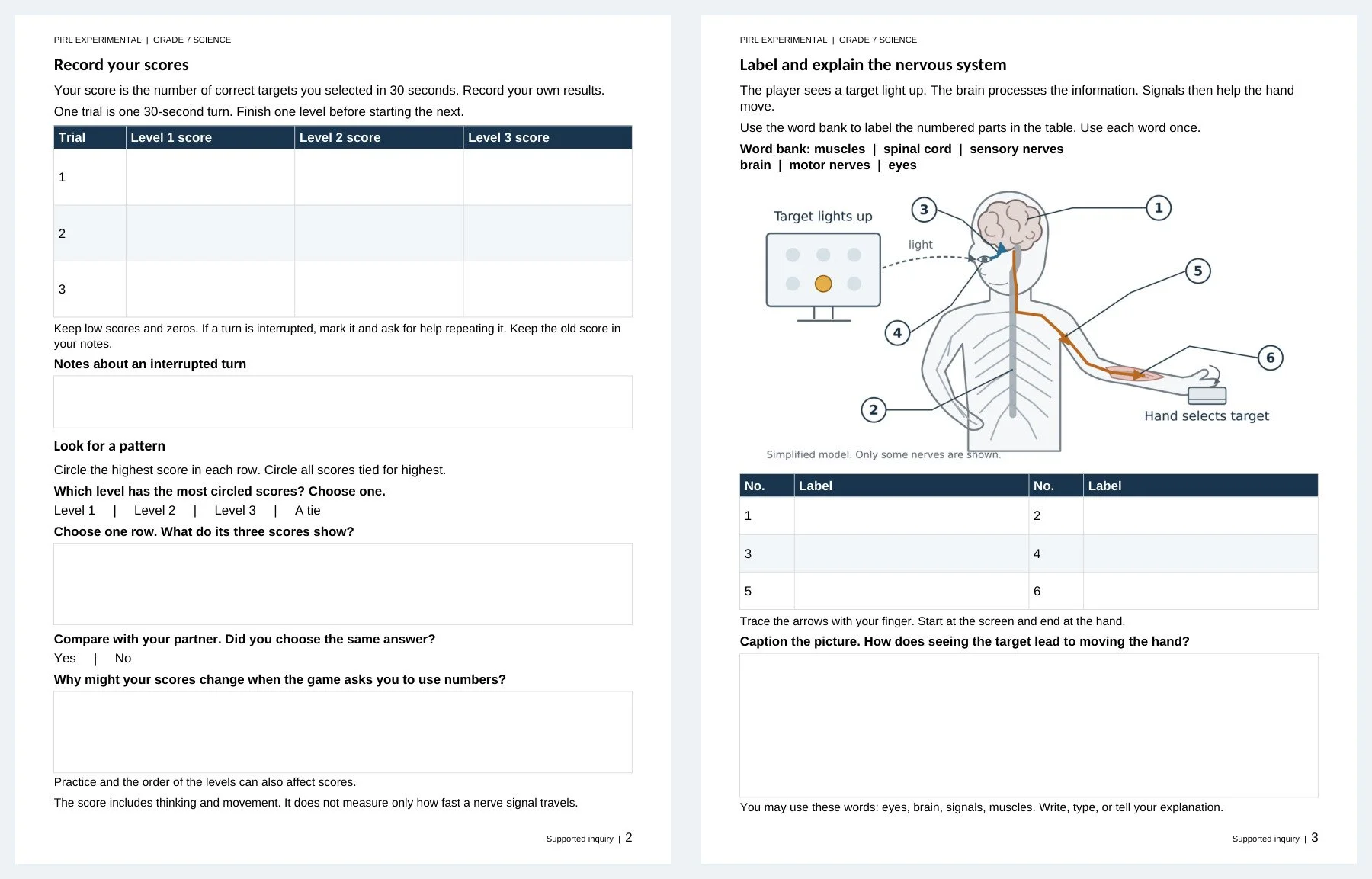
All four versions connect the results back to a nervous-system model. The guided version includes text students can turn into a model; the supported and resource versions provide a picture to label and explain.
Full inquiry
Honors
Students develop a question, plan a fair comparison, gather repeated data, analyze variation, and defend an explanation with a model.
Download honors lab · WordGuided inquiry
General education
A shorter investigation with a defined comparison, organized data tables, and a passage students translate into a labeled model.
Download guided lab · WordMore structure
Supported
Compare the three levels, record repeated scores, and label a nervous-system picture. Large boxes leave room to write or type.
Download supported lab · WordMost simplified
Resource
One turn per level, a small data table, and a simplified labeling task. Students can write, draw, point, or explain orally.
Download resource lab · WordThe extension earns its place when students explain the pathway and the limits of their evidence. A score alone cannot tell us which part of the system took more time.
08 / LESSON RESOURCESLesson links and references
Open Manipulations · Open the GSK reaction test · Browse classroom resources
Science references and image credits
The station explanations are classroom models. These sources provide more detail about the conditions and the limits of healing.
- NINDS: Multiple Sclerosis
- NINDS: Motor Neuron Diseases
- CDC HEADS UP: Concussion Basics
- NINDS: Spinal Cord Injury
- NINDS: Epilepsy and Seizures
- NINDS: Peripheral Neuropathy (PDF)
- NIH: Research on spinal nerve repair and regeneration
- NINDS: Updates on ACT for ALS
Images are from my INB 28–29 lesson slides, Nervous System Notes & Stations Capture Sheet, station printouts, and supported reaction-time lab. Slides 15 and 21 are original instructional graphics created for this lesson; their illustrated computer screens are conceptual drawings. Manipulations is linked to its creator, the University of Utah Genetic Science Learning Center. Illustrated people in the lesson visuals are instructional illustrations, not photographs of students. Patient cases are classroom scenarios. This article describes my classroom adaptation of OpenSciEd Unit 6.6.
