Pirl Experimental
Browse Curriculum Resources
Practical tools for adapting, teaching, and improving curriculum without losing the learning that matters.
8 resources
Curriculum Adaptation · Science Literacy
Extract → Organize → Apply
Use one flexible workflow for scientific reading: select the information that matters, make the relationships visible, and apply the learning. Choose tools such as Reciprocal Teaching, text structure, visual reading, QAR, and CER to match the text and task.
Includes New Jersey standards connections, sample organizers, and an OpenSciEd Unit 6.6 medical-imaging example.
Read the articleUnit Support · Enrichment & Intervention
Ecosystem Dynamics Enrichment and Intervention
A four-page guide with 11 linked videos, simulations, readings, and case studies. Each entry pairs a focused intervention with an enrichment option and a short recheck for middle school science.
Includes an MS-LS2-2 comparison checkpoint and credited Core Knowledge curriculum references.
Open the PDF guide (opens in a new tab)
Curriculum Adaptation · Lesson Planning
How I Boil Down an OpenSciEd Lesson Plan
Find the biggest ideas, review the student materials, and protect the activity that deserves the most time. Includes a two-block planning example and the free First-Pass Lesson Checklist.
Read the article
Teaching & Learning · Student Engagement
Give Curiosity Something to Do
Turn medical supplies, models, and X-rays into six hands-on science stations. Explore classroom photos, student prompts, and notebook routines that help students capture and revise their thinking.
Explore the stations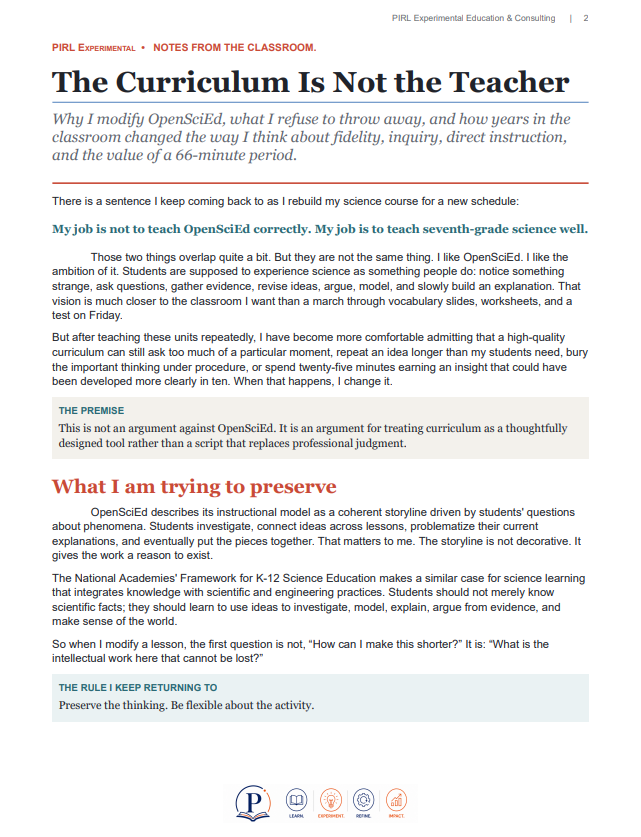
Curriculum Adaptation
Modifying OpenSciEd Unit 6.6: All Lessons
Follow the process of preserving the learning goal while adapting an already-strong unit for a real schedule, real students, and a real classroom.
Explore the series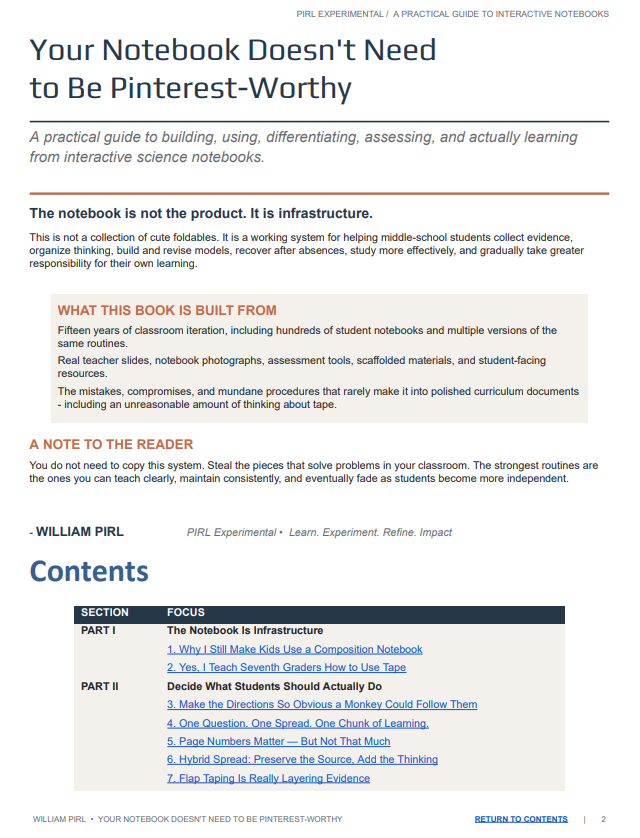
Notebook System
Interactive Notebook eBook
A practical guide to building science notebooks that help students organize thinking, recover from absences, study, revise, and show what they know.
Explore the guide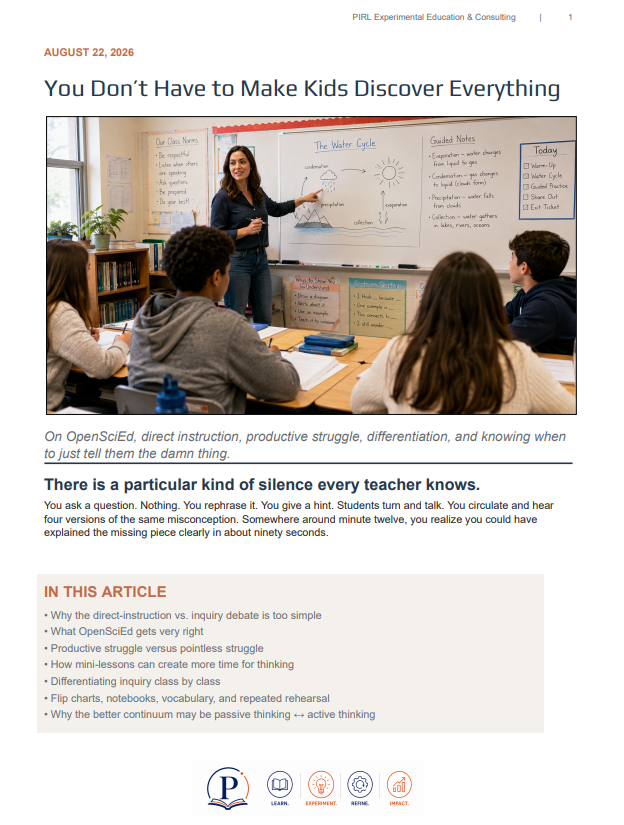
Teaching & Learning
You Don’t Have to Make Kids Discover Everything
A classroom-grounded look at when inquiry serves learning, when direct explanation helps, and how to use productive struggle without leaving students stuck.
Read the articleAssessment Design · PDF Guide
Create an NJSLA-Style Science Assessment
Give this guide and your existing assessment to an AI tool to help build interactive science clusters with evidence, technology-enhanced items, constructed responses, and a separate scoring key.
A classroom design guide inspired by NJSLA Science—not an official state assessment.
Open the PDF guide (opens in a new tab)No resources match that search yet. Try a broader word or choose All Resources.