You Don’t Have to Make Kids Discover Everything
There is a particular kind of silence every teacher knows.
You ask a question. Nothing. You rephrase it. You give a hint. Students turn and talk. You circulate and hear four versions of the same misconception. Somewhere around minute twelve, you realize you could have explained the missing piece clearly in about ninety seconds.
- Why the direct-instruction vs. inquiry debate is too simple
- What OpenSciEd gets very right
- Productive struggle versus pointless struggle
- How mini-lessons can create more time for thinking
- Differentiating inquiry class by class
- Flip charts, notebooks, vocabulary, and repeated rehearsal
- Why the better continuum may be passive thinking ↔ active thinking
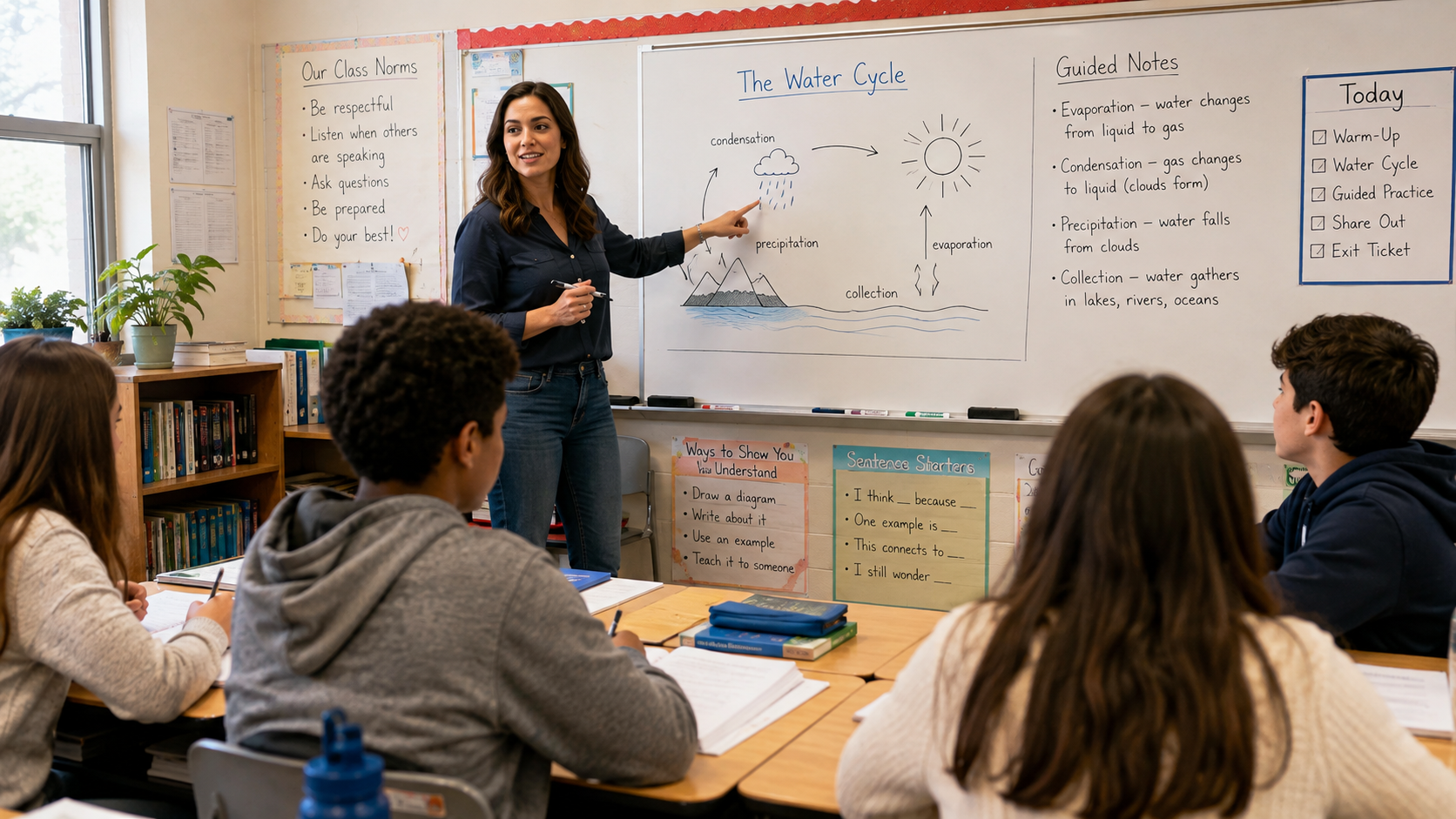 Direct explanation
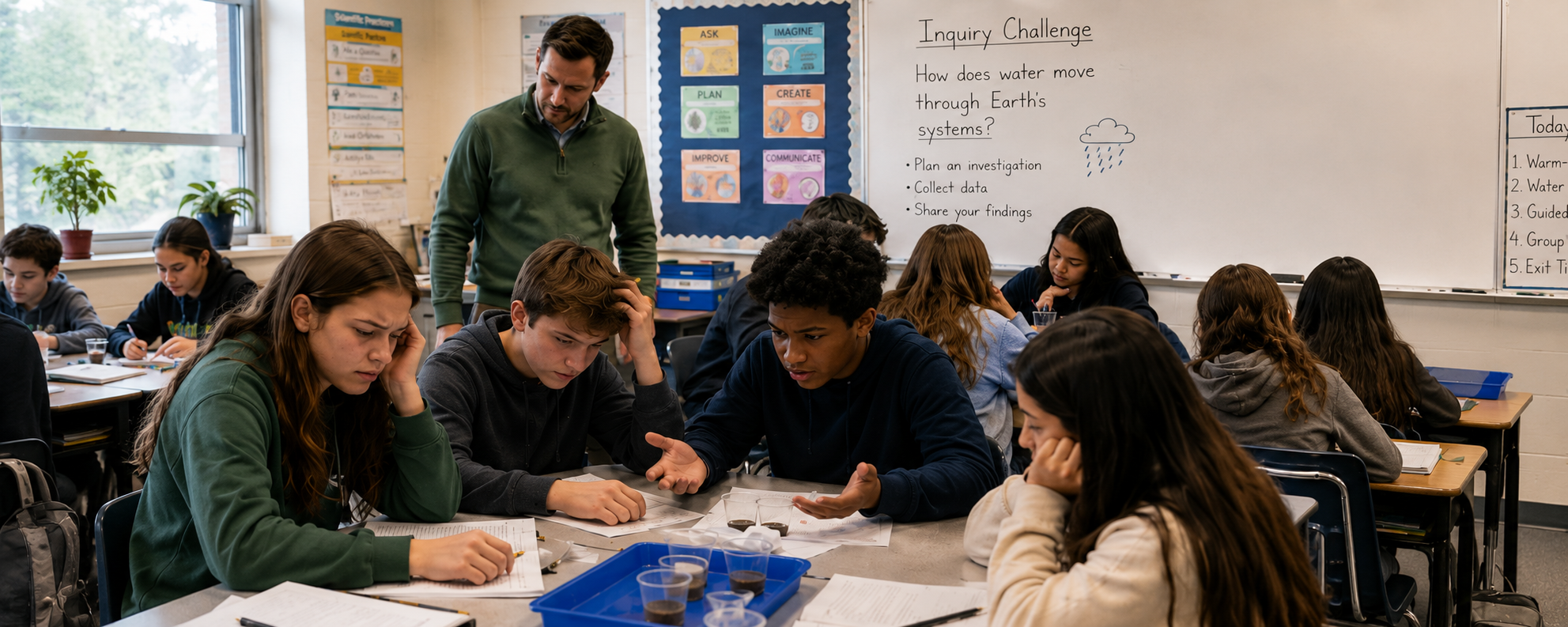 Student investigation
The Silence
There was a time when I might have considered those twelve minutes evidence of good inquiry-based teaching. I wasn’t telling students the answer. I was facilitating. They were constructing meaning. We were engaged in an inquiry. Now, sometimes, I look around the room and think:
That change has not made me less committed to inquiry. If anything, years of teaching OpenSciEd have made me more committed to the parts of inquiry that matter most: anchoring learning in phenomena, letting questions drive instruction as often as possible, using evidence, revising models, arguing from data, and asking students to figure things out rather than memorize somebody else’s explanation. If you are constantly asking kids to memorize, you are just setting them up to forget. Let kids figure it out and then use it.
OpenSciEd organizes learning around a storyline: a logical sequence of lessons motivated by student questions that arise from phenomena. Its five recurring routines - anchoring phenomena, navigation, investigation, problematizing, and putting the pieces together - are built to keep the class moving through a coherent process of sensemaking. [1]
I think there is tremendous value in that. I also think there are moments when following that philosophy too rigidly can make science instruction slower, less accessible, and occasionally less intellectually demanding than it needs to be.
Education loves pendulums. We discover something useful and, rather than adding it to the toolbox, immediately begin using it to beat the previous idea to death.
- Direct instruction becomes bad. Inquiry becomes good.
- Teacher-centeredness becomes bad. Being student-centered becomes good.
- Memorization becomes bad. Critical thinking becomes good.
- Lectures become bad. Facilitation becomes good.
Except those things are not nearly as opposite as they sound. You cannot think critically about a subject you know nothing about. You cannot analyze evidence if you do not understand what the evidence represents. You cannot construct a meaningful model if every component of that model is unfamiliar.
What OpenSciEd Gets Very Right
I want to be careful not to turn this into an argument against OpenSciEd, because it isn’t. OpenSciEd made me better.
Its greatest strength may be that it keeps asking a deceptively simple question: Why are students learning this right now? A storyline makes the sequence visible from the students’ perspective. They encounter something puzzling, ask questions, gather evidence, build and revise explanations, and use gaps in their current thinking to motivate the next investigation. [1]
That is much richer than: Chapter 6. Read the section. Define the words. Label the diagram. Test Friday.
I want students saying, “Wait. That doesn’t make sense.” I want them arguing over where an arrow belongs in a model. I want evidence to force them to revise something they thought they understood.
What Is the Intellectual Work?
This may be the most useful planning question I have learned to ask: What is the intellectual work I actually want students to do?
- Recognize a relationship.
- Discover a pattern in data.
- Realize that an existing model cannot explain new evidence.
- Compare competing explanations.
- Predict what happens when one part of a system changes.
- Apply familiar knowledge to an unfamiliar case.
Those are places where the struggle itself has value. But sometimes the supposed intellectual work amounts to finding a fact, copying a fact, or spending twenty-five minutes being guided toward a piece of established information I can explain accurately and clearly in five.
The Research Is Less Ideological Than the Debate
The research does not require us to pick a team. Kirschner, Sweller, and Clark argued that minimally guided instruction can be inefficient for novices because beginners do not yet possess the knowledge structures experts use to navigate complex problems. [2]
At the same time, a meta-analysis by Furtak and colleagues found a positive overall effect for inquiry-based science teaching. [3] Lazonder and Harmsen later examined 72 studies of inquiry-based learning and found that guidance improved learning activities, task performance, and learning outcomes. [4]
That sounds much less like direct instruction versus inquiry and much more like inquiry plus appropriate guidance.
Give Them the Vocabulary. Save the Thinking for Something Better.
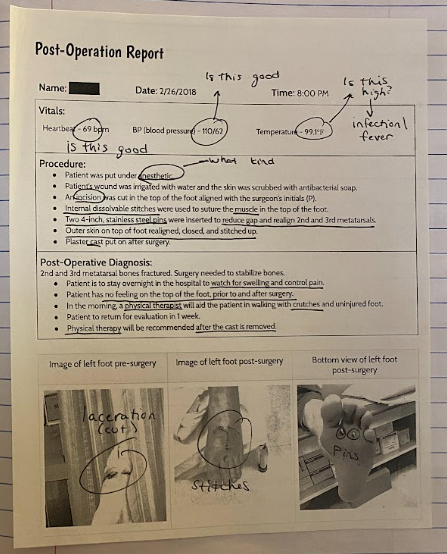
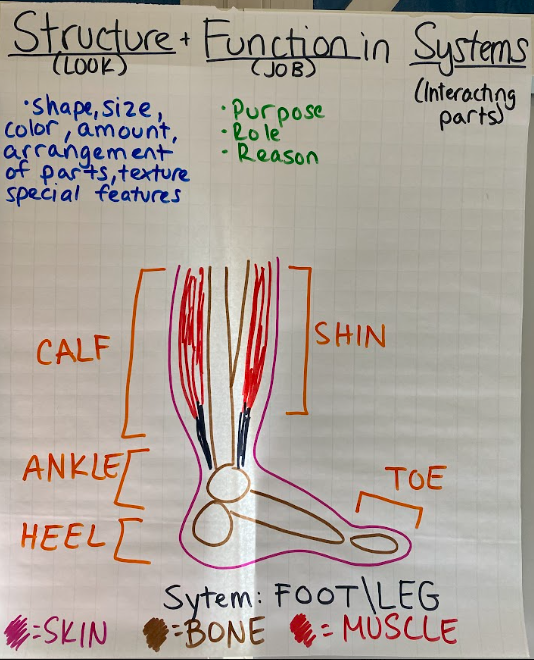
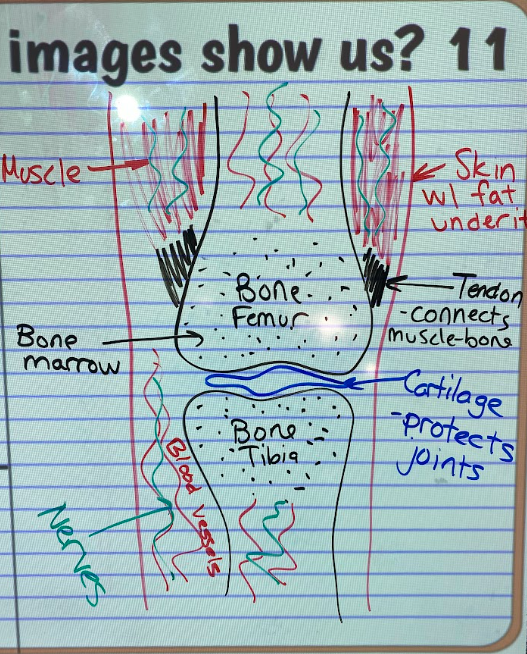
Early in our injuries and healing unit, students need to understand ideas like system, subsystem, interaction, cross-section, tendon, cartilage, bone, marrow, skin, and muscle.
Some of the source images in the flip chart below come from OpenSciEd Unit 6.6. I use those materials, then build a much more explicit visual teaching layer around them: student-friendly definitions, arrows, sketches, relationships, and the language students will need later. Sometimes the flipcharts and vocabulary go up first because the content is very tricky or I’m trying to speed up. Sometimes they go up after the learning has occurred to promote a common language.
I’ll tell students, “We’ve worked with this information enough where you should feel very comfortable with it. I’m putting this up but it is your turn to go home, study them, and really start to master command of them.”
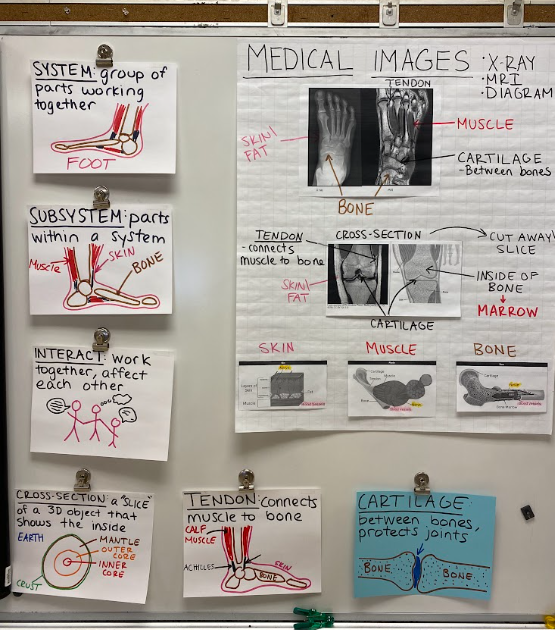
I could attempt to have every one of those concepts emerge completely through discussion. But the definition of tendon is not where I want to spend most of my intellectual capital.
Once students know what a tendon is, I can ask better questions: If the bone is fractured here, what other structures might also be affected? What kind of medical image would show that? Why can damage to one subsystem affect the whole foot?
Productive Struggle Is Not Just Struggle
I like the phrase productive struggle. But the first word is carrying most of the weight.
Confusion is not automatically learning. Difficulty is not automatically rigor. Taking longer does not automatically mean students are thinking more deeply.
Sometimes students are struggling because they are working through a genuinely difficult relationship. Good. I may stay quiet. They have the pieces. They need to assemble them.
Other times, students are struggling because they are missing a piece entirely. That is different.
A Five-Minute Explanation Can Buy Thirty Minutes of Thinking
My digestion lessons are a good example. Eventually, students need to reason about nutrient molecules, absorption, cells, fat storage, energy, and weight loss. Before they can do that, however, they need a basic model of digestion.
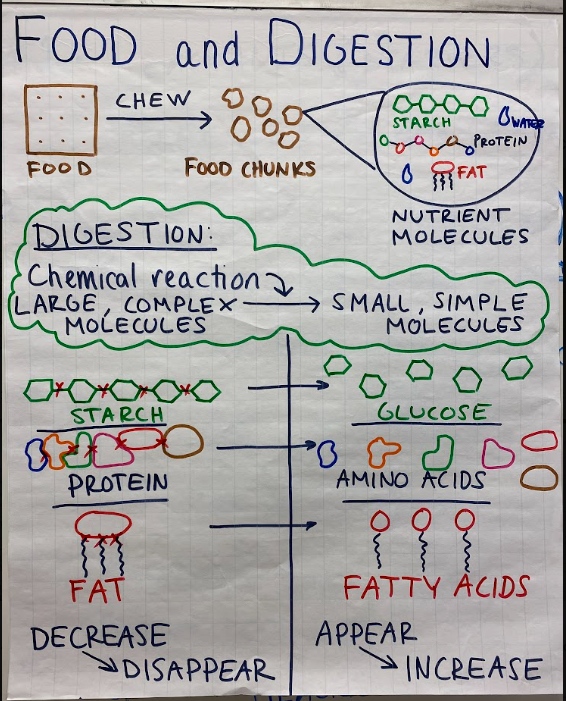
Food begins as large, complex molecules. Digestion breaks large molecules into smaller molecules. Starch can provide glucose. Proteins are broken into amino acids. Fats are broken into smaller components such as fatty acids.
I can draw that in a few minutes. Then I can ask: Where do those smaller molecules go? Why do they need to become smaller? What happens if they are not absorbed? How could that affect body mass?
Sometimes I Teach It First; Sometimes I Don’t Teach It at All
This is where differentiation makes the whole direct-instruction-versus-inquiry debate almost useless to me. I do not teach an abstract creature called the seventh-grade learner. I teach this group of seventh graders during this period on this day. Furthermore, the same class might need different support on different days based on the topic, the students’ mood, our pacing, or even where we are in the school calendar. Focus can be difficult to maintain before Christmas break and immediately before summer.
Advanced Classes: Let Them Run
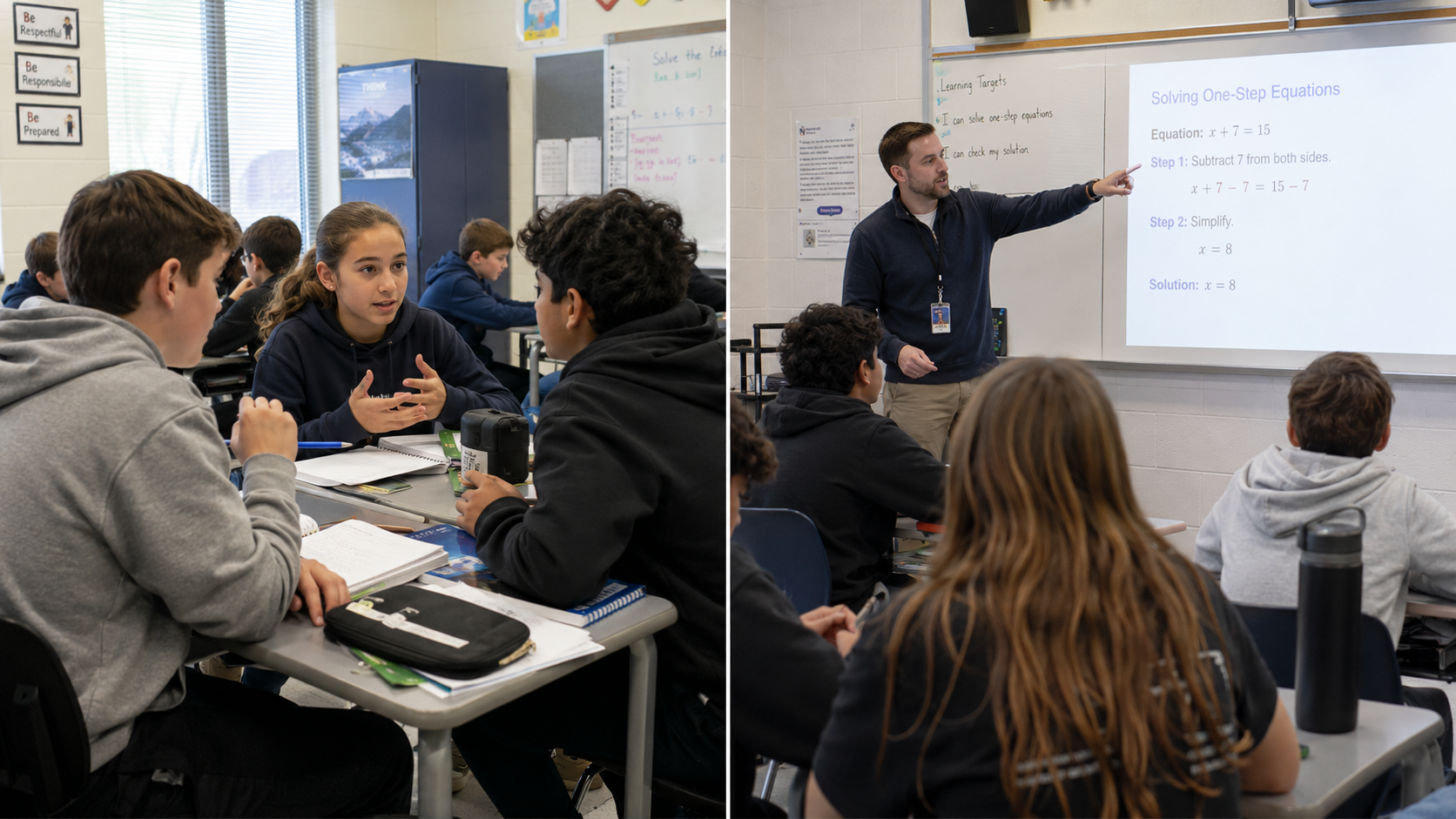
An advanced class may be perfectly capable of encountering a phenomenon, examining evidence, discussing it, and developing most of the important conceptual relationships before I say much of anything.
If they are figuring it out, I do not interrupt them because my lesson plan says “mini-lesson.” The mini-lesson can shrink to a three-minute clarification, move to the end as a summary, or disappear entirely.
General Education: Make the Decision at Game Time
A general education class may be less predictable. I give them a chance first. Launch the investigation. Ask a question. Let them talk. Walk around. Listen. Look at models. Ask a student to explain what the group thinks is happening.
That is an assessment. It does not have to be a quiz.
- If they are getting there: keep going.
- If they are close: ask another question, give a hint, or point to evidence.
- If several groups share the same misconception: stop and address it.
- If everyone is missing the same prerequisite knowledge: get the marker.
The mini-lesson becomes a game-time decision.
Same Destination. Different Ramp.
A class that needs more support may require a different structure from the beginning.
I still want the phenomenon. I still want students to predict. I still want them to notice something before I explain it. But I may intentionally shorten the investigation.
Maybe they get ten or fifteen minutes instead of thirty-five. Enough time to encounter the problem. Enough time to develop an initial idea. Enough time for the missing information to have a reason to exist.
Then I stop and teach the concrete relationship. Here is the vocabulary. Here is the diagram. Here is what we know.
Providing more direct instruction to a struggling class does not have to mean giving them less rigorous work. Sometimes it gives them more access to rigorous work.
Sometimes Differentiation Is Just Filling In Some Blank Space
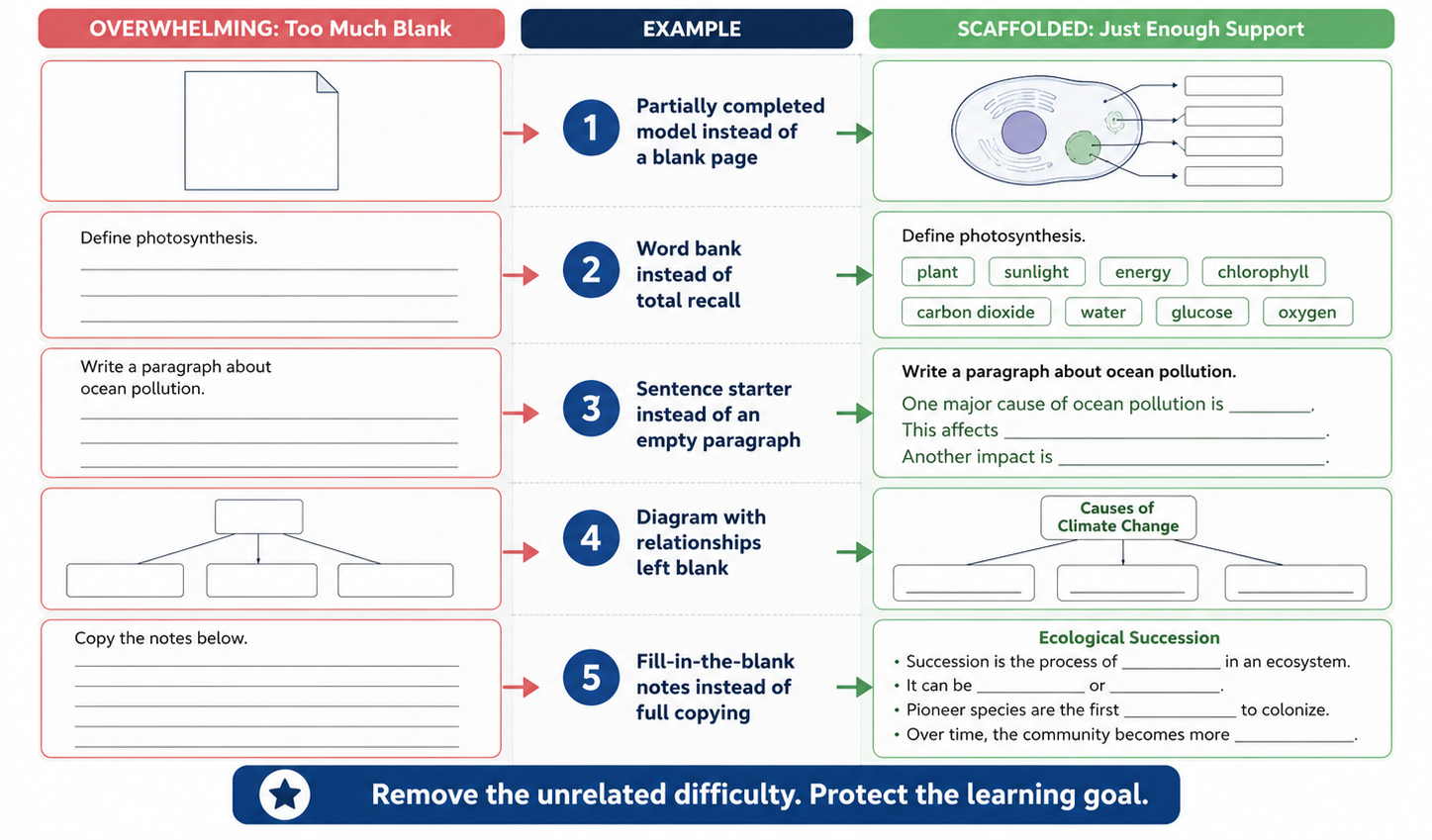
Not every accommodation requires a separate lesson. Sometimes the difference between productive independence and complete frustration is surprisingly small.
- A partially completed model instead of a blank page.
- A word bank instead of total recall.
- A sentence starter instead of an empty paragraph.
- A diagram with the relationships left blank.
- Fill-in-the-blank notes that preserve the thinking but remove unnecessary copying.
From Digestion to Chemistry to Cells
Later, we take the digestion model and add another layer.
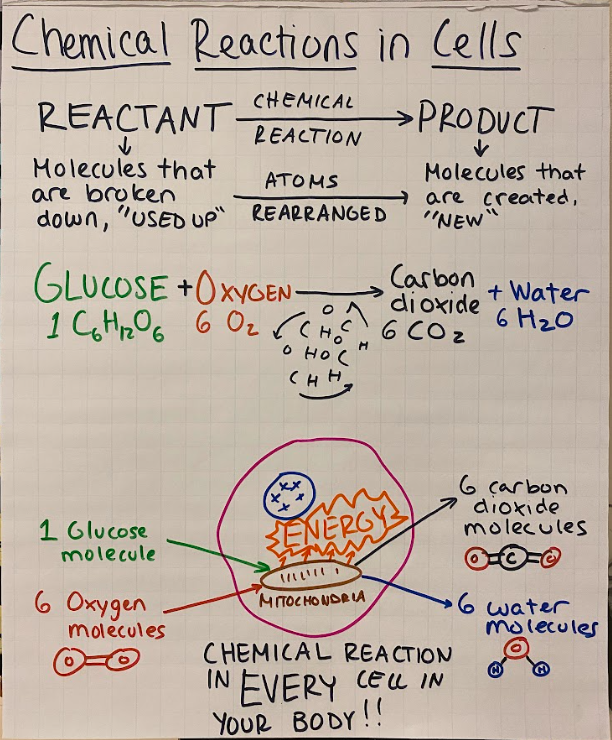
Now students have a simple structure: reactants → chemical reaction → products. Atoms are rearranged. Glucose and oxygen participate in a reaction that produces carbon dioxide and water while making energy available for cellular processes.
I can spend a tremendous amount of time coaxing every component of that representation from students. Or I can decide that better thinking happens afterward. I also know from many painful experiences that chemistry is just hard for middle schoolers. What's more, I'm not confident that I've found the best way to teach it. I have found a way to teach it. But because chemistry is not my primary content area—and because I am condensing a very large unit into a one-week mini-unit—it remains a work in progress, despite the fact that I have taught it numerous times.
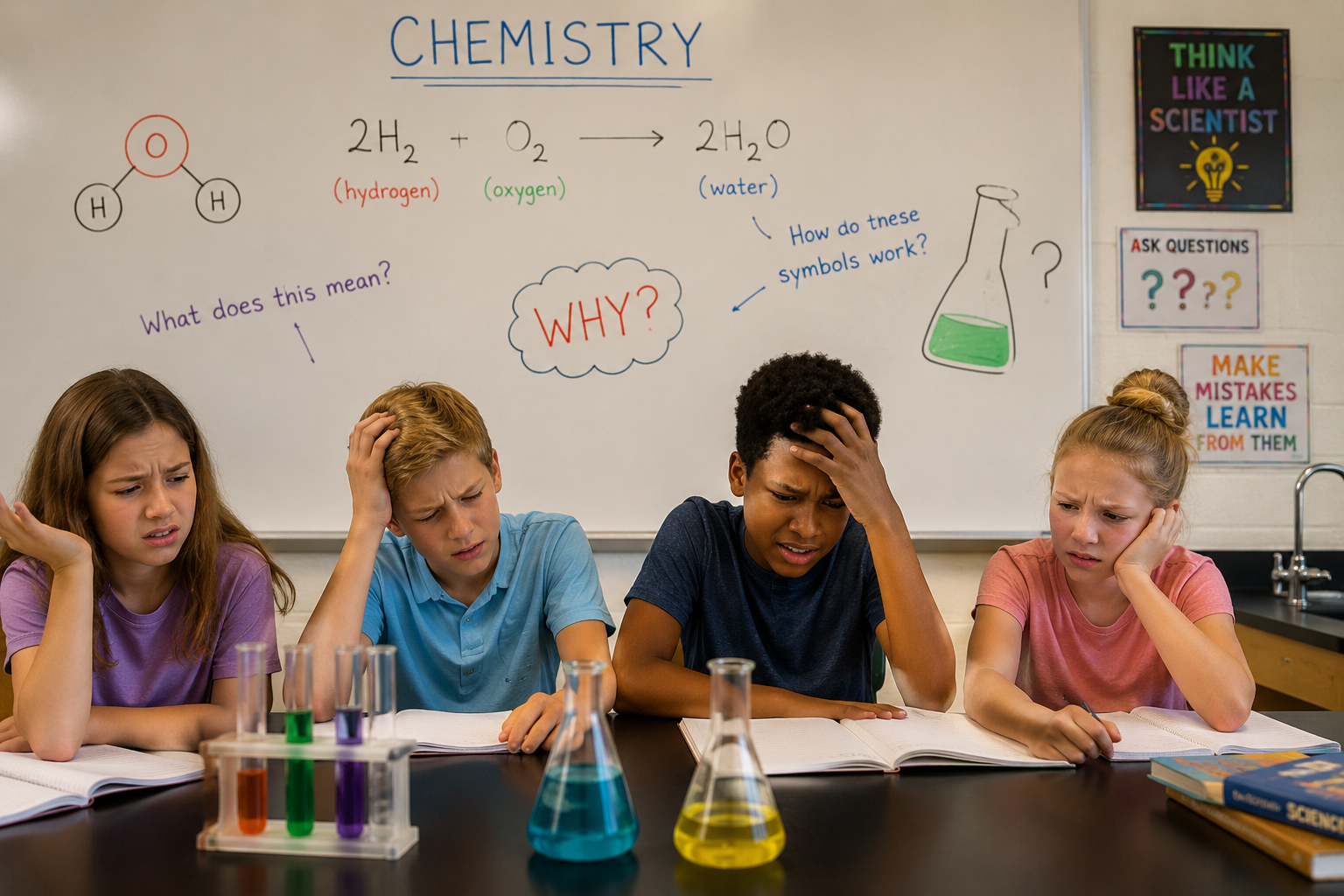
- Where does the glucose come from?
- Where does the oxygen come from?
- How do those reactants reach a cell in your toe?
- How does carbon dioxide leave?
- Which body systems have to cooperate?
- What happens when blood flow is interrupted?
Tell Them Less. Ask Them to Do More With It.
If I teach students that platelets help blood clot and then ask, “What do platelets do?” I have created a memory question.
If I teach the same fact and then present a patient with an extremely low platelet count and ask students to predict what might happen after an injury, the knowledge becomes a tool.
This Is Where the Pieces Pay Off
Eventually we reach a much more interesting question: Why is M’Kenna losing weight?
Now students have to put pieces together. Fat is digested into smaller components. Those molecules are absorbed. They can enter cells. Excess fat can be stored. Stored fat contributes to body mass. Fat also plays roles in growth, cellular structures, development, and energy.
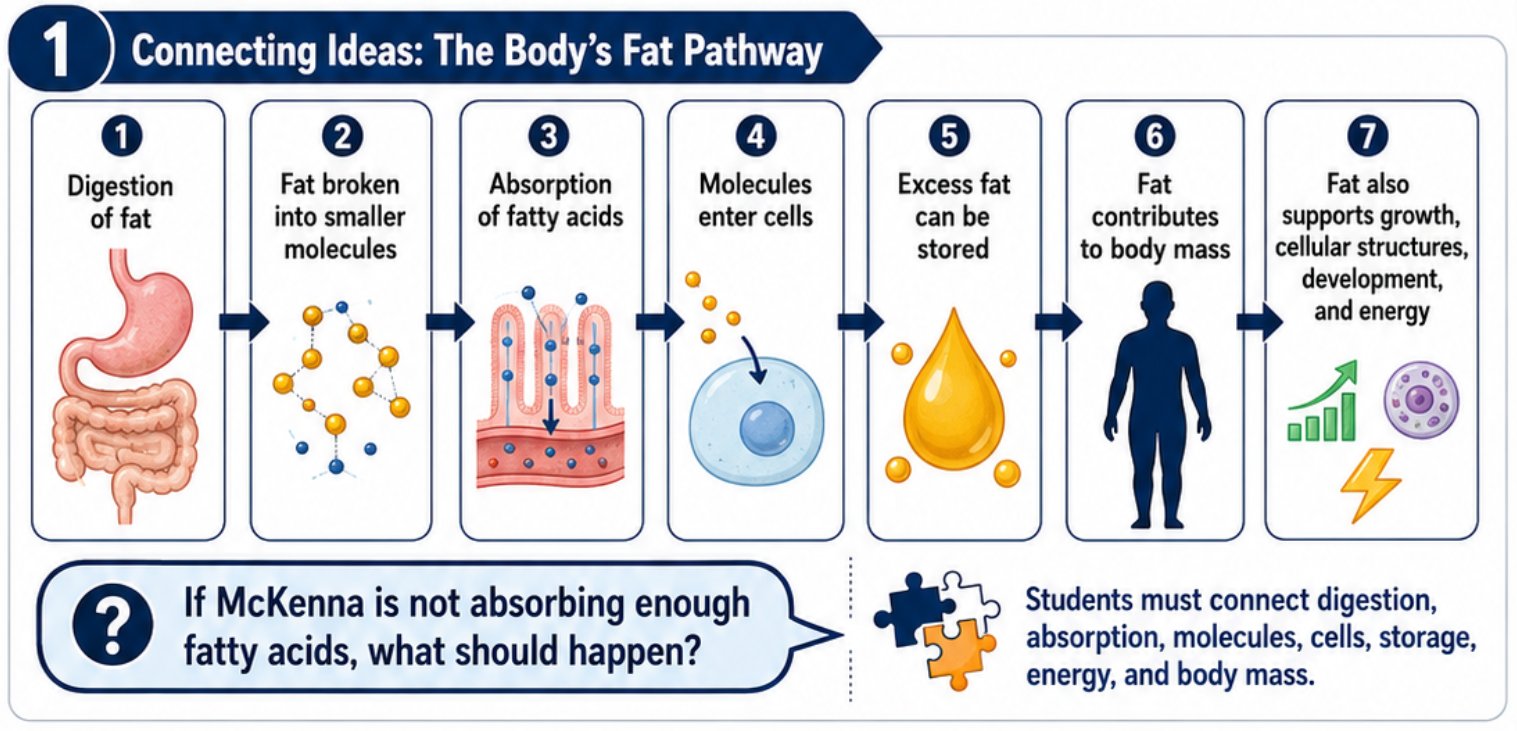
That question demands something very different from “Define fatty acid.” Students have to connect digestion, absorption, molecules, cells, storage, energy, and body mass.
Knowledge Doesn’t Kill Curiosity
Tell students that bone is living tissue. That sounds like direct instruction. It also creates better questions.
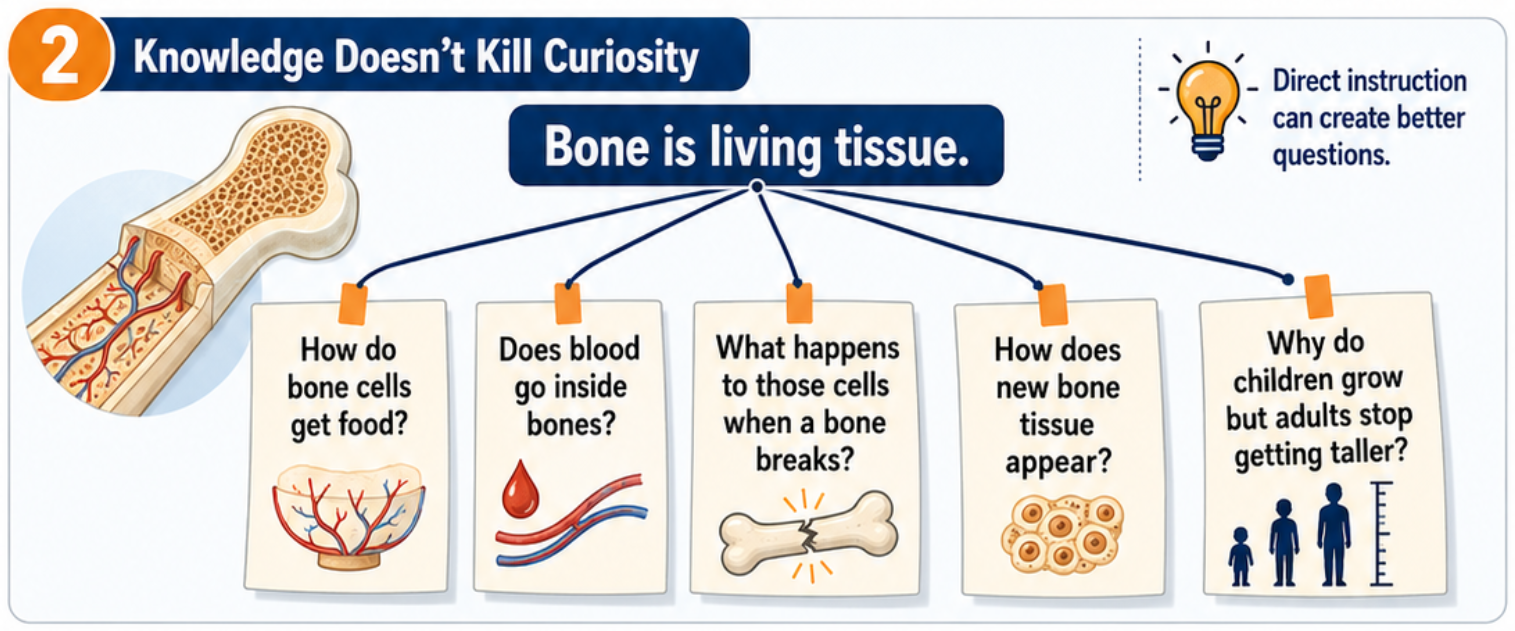
- How do bone cells get food?
- Does blood go inside bones?
- What happens to those cells when a bone breaks?
- How does new bone tissue appear?
- Why do children grow but adults stop getting taller?
Notes Don’t Have to Look Like Notes
My flip charts also changed the way I think about note-taking. I draw constantly: arrows, cells, molecules, feet, blood vessels, bones, cartoon-level anatomy, whatever gets the idea across.
A finished textbook diagram appears all at once. A flip chart unfolds. Students watch the model develop in real time, often because of the questions and observations happening in the room.
When class ends, I can photograph it. Now the flip chart becomes highly visual teacher notes.
- Post the photo online.
- Print it for a student who was absent.
- Use it as an accommodation for students who struggle with copying.
- Pair it with written notes - or let it stand alone.
- Reuse it later when the class needs to retrieve an earlier idea.
I Keep the Notebook Too
I also maintain an interactive notebook alongside my students. I tape in many of the same pages, complete diagrams, add definitions, sketch models, and organize the work as we go.
That notebook becomes a continuously evolving teacher exemplar. It can be photocopied for an absent student, used as a model for someone who needs note-taking support, or shown to a parent trying to help at home.
When I Have Time, Typed Notes Are Even Better
When time allows, I create typed notes with carefully selected images, headings, diagrams, and concise explanations. Those are probably the strongest standalone study resources. But teaching happens inside time constraints. Sometimes the best notes are polished. Sometimes they are a photograph of yesterday’s flip chart.
Vocabulary Has to Hang Around
Science vocabulary matters because precise language makes more precise thinking possible. But introducing a word once is not teaching it.
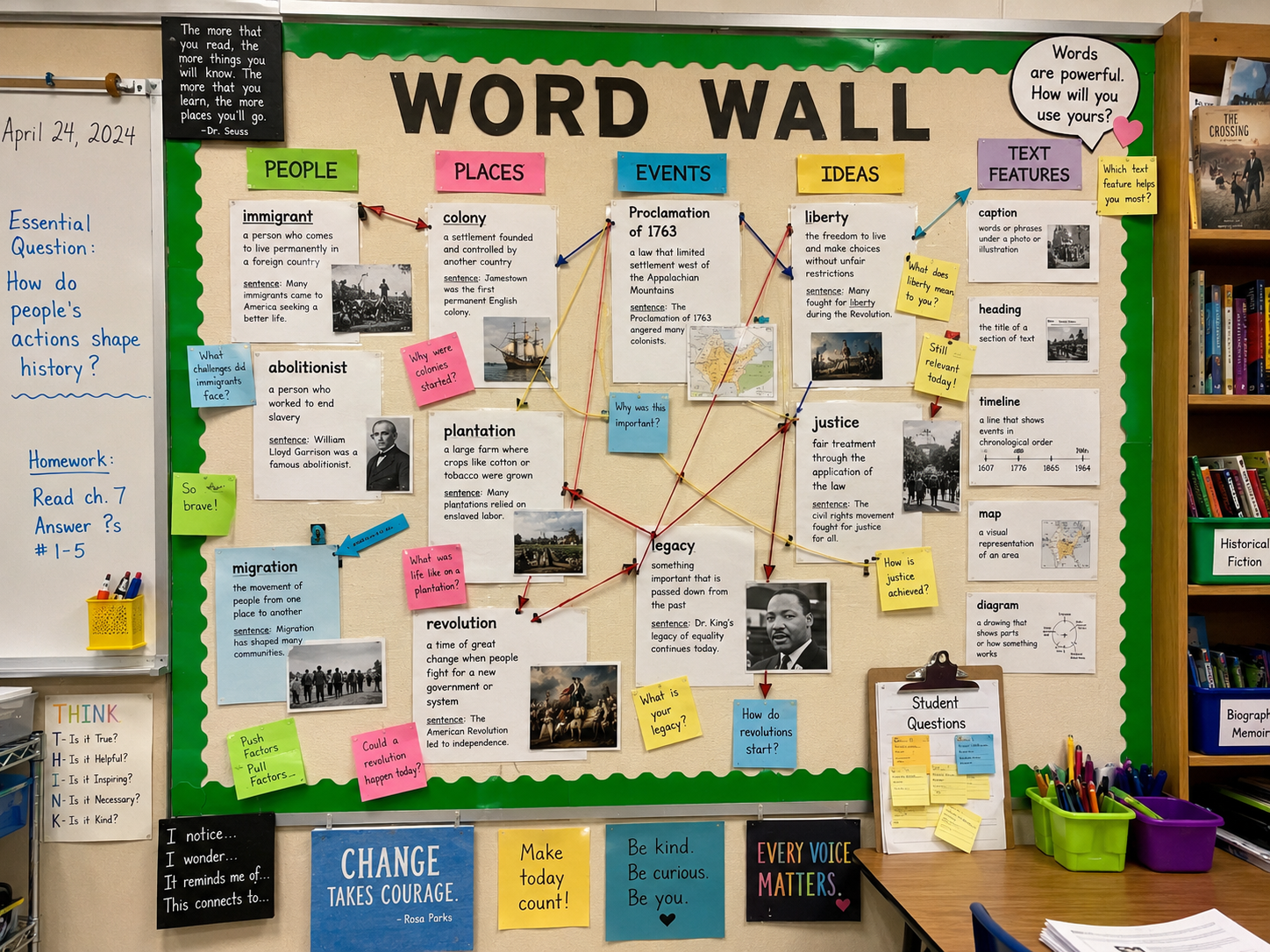
So important words stay visible. I use physical word-wall cards, virtual dictionaries, notebooks, flip charts, discussions, readings, models, assessments, and long-term dictionary and study-guide assignments.
A word can move from: I’ve seen that word → I recognize it → I can define it → I can explain it → I can actually use it while solving a problem and writing about it.
Repetition Is Not a Dirty Word
Students forget things. Adults forget things. Important ideas need repeated encounters. A term introduced during an investigation may appear later on the wall, in the notebook, in homework, in discussion, and finally inside an unfamiliar transfer problem.
Those longer-term dictionaries and study guides can also be differentiated. Some classes need rehearsal. Others need less. A student may need fewer terms, a word bank, sentence frames, or a reduced essential-content version.
AI makes this increasingly practical. I can begin with one resource and rapidly create scaffolded, shortened, simplified, or extension versions without building six separate assignments from scratch.
AI should not decide who needs which version. That is still teacher judgment. But it can dramatically reduce the labor required to act on that judgment.
A word wall can be a useful, living, breathing part of class. Keep a stack of blank cardstock and it can be added to on the fly, in the context of what you are learning, complete with pictures and definitions students propose and agree on.
Differentiation Is Really a Set of Dials
- How much do I tell them?
- How much do I ask them to discover?
- How long do I wait before intervening?
- How much of the page is blank?
- Do they create the model or complete it?
- Do they need additional rehearsal outside class?
- Does the mini-lesson happen before, during, after - or not at all?
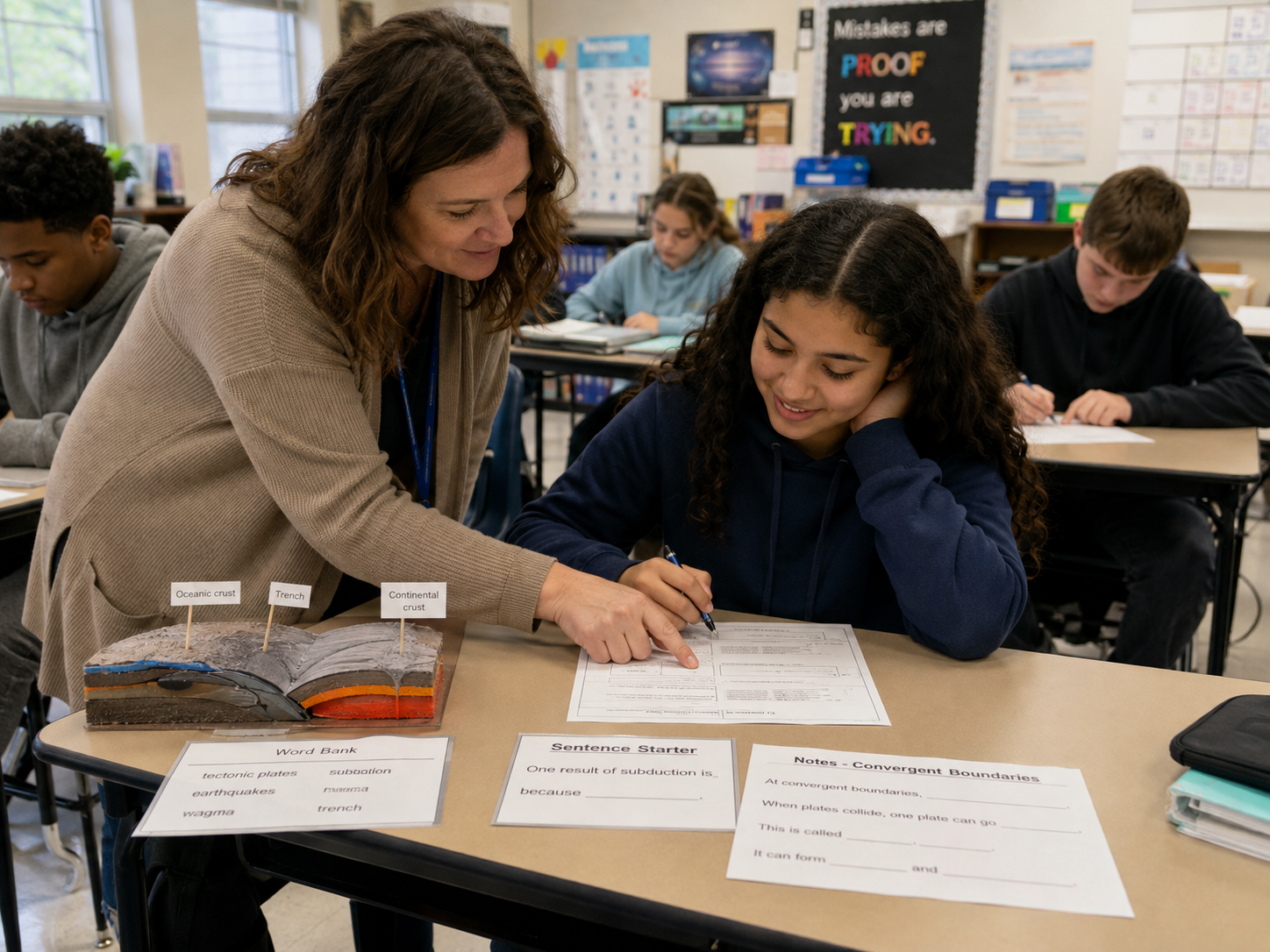
Differentiation does not always have to be a secret.
To be clear, I will bend over backward to protect a student’s private information; that is both a legal responsibility and a personal moral requirement. But I have also presented students with different ways to engage in the work and asked, “Which option do you think will help you engage with this idea? Are you sure you’re challenging yourself? Let’s go with that one.”
Some of the proudest moments my co-teacher and I have shared have come from watching students with IEPs select more challenging options because we told them we believed they were capable of more.
Fidelity Is Not the Same Thing as Quality
OpenSciEd’s storyline deserves respect. The sequence is intentionally designed as a trajectory through students’ questions and developing explanations rather than a random collection of activities. [1]
But a curriculum is still a tool.
The people who designed it cannot see the students sitting in front of me. They do not know that one class mastered something immediately. They do not know that another group just developed a misconception I have never seen before. They do not know who was absent, what students retained from last year, or which activity will take thirty minutes with one group and twelve with another.
I do.
Activity Is Not the Same Thing as Thinking
Students can spend an entire period cutting, taping, highlighting, scanning QR codes, rotating through stations, sorting cards, opening documents, and filling boxes. Everyone is exhausted. But what did they actually think about?
Activity is visible. Thinking is not.
Sometimes the most intellectually demanding moment of a lesson is completely still: a student looks at evidence, looks back at a model, erases an arrow, moves it, and stares again.
Maybe We Have the Wrong Continuum
A lecture can be passive, but it does not have to be. An investigation can involve deep reasoning, but it does not automatically do so. Students can passively follow a lab procedure, and they can actively listen to a six-minute explanation because they know the information is about to help them solve a problem.
Scientists Don’t Rediscover All of Science Either
Scientists investigate, model, collect data, revise explanations, and argue from evidence. They also read. They attend lectures. They consult references. They learn from experts. They inherit enormous amounts of accumulated knowledge.
Scientists learn what humanity already knows so they can spend their effort investigating what humanity does not know. That strikes me as a useful model for seventh graders too.
What I Would Keep
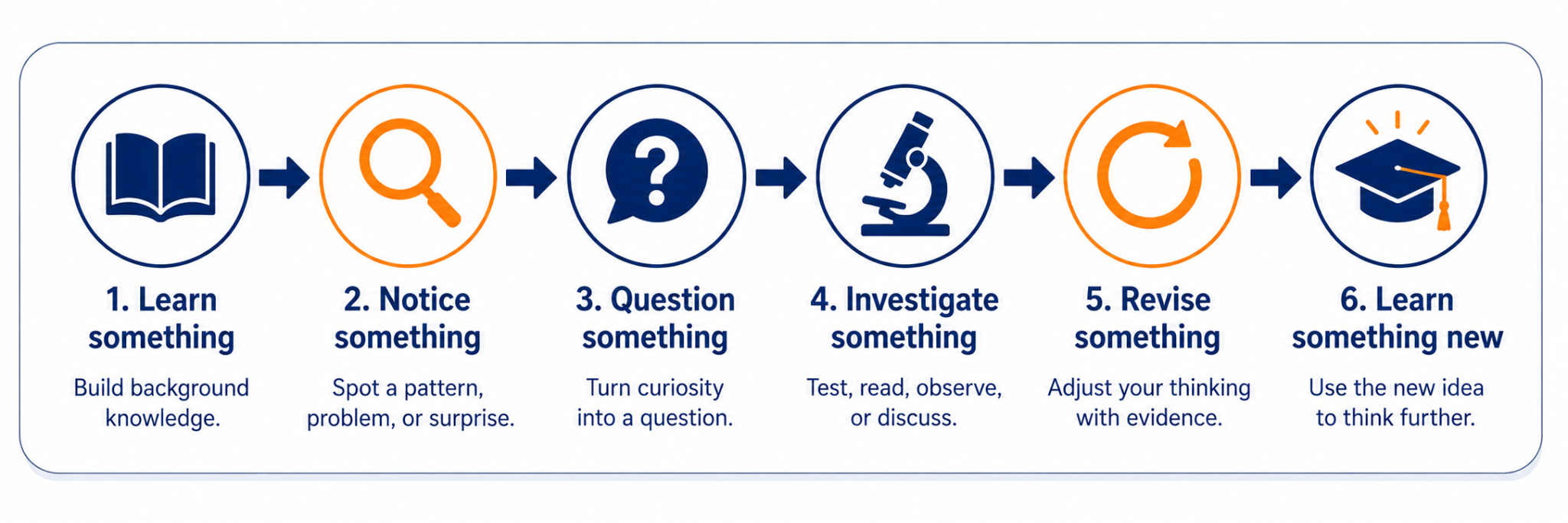
- The phenomena and coherent storylines.
- Student questions and the Driving Question Board when it earns its place.
- Modeling, revision, evidence, argument, and investigation.
- The moments when the current explanation fails.
- Genuine uncertainty and productive struggle.
- The question: What do we need to figure out next?
What I would reject is the idea that direct explanation somehow contaminates the process. It does not.
Give Them the Pieces. Then Make Them Build.
After all these years, this may be the simplest version of my teaching philosophy.
Do not build the whole thing for students. That creates dependence.
But do not dump a pile of raw materials on the table, refuse to help, and congratulate yourself for promoting discovery.
Give them pieces they cannot reasonably create themselves. Teach the vocabulary when they need it. Give them background knowledge. Model a difficult process. Draw the diagram. Fill in some blanks.
Let the advanced class run. Let the general education class show you how much support it needs. Give the struggling class a shorter runway and a more concrete launch.
Then hand the problem back.
- Let them argue.
- Let them predict.
- Let them build.
- Let them revise.
- Let them be wrong.
- Let them sit in uncertainty when the uncertainty is doing useful work.
And when the next missing piece is simply a piece of information? Give them the damn piece. Then make them do something with it.
References & Attribution
View source
View source
View source
View source