Your Notebook Doesn't Need to Be Pinterest-Worthy
A practical guide to building, using, differentiating, assessing, and actually learning from interactive science notebooks.
The notebook is not the product. It is infrastructure.
This is not a collection of cute foldables. It is a working system for helping middle-school students collect evidence, organize thinking, build and revise models, recover after absences, study more effectively, and gradually take greater responsibility for their own learning.
WHAT THIS BOOK IS BUILT FROM Fifteen years of classroom iteration, including hundreds of student notebooks and multiple versions of the same routines. Real teacher slides, notebook photographs, assessment tools, scaffolded materials, and student-facing resources. The mistakes, compromises, and mundane procedures that rarely make it into polished curriculum documents - including an unreasonable amount of thinking about tape. |
|---|
A NOTE TO THE READER
You do not need to copy this system. Steal the pieces that solve problems in your classroom. The strongest routines are the ones you can teach clearly, maintain consistently, and eventually fade as students become more independent.
- WILLIAM PIRL PIRL Experimental • Learn. Experiment. Refine. Impact
PART I • THE NOTEBOOK IS INFRASTRUCTUREPART IThe Notebook Is Infrastructure
Introduction: The Notebook Is Not the Lesson
I have probably spent an unreasonable amount of my teaching career thinking about composition notebooks. Tape. Page numbers. Whether a seventh grader can fold a piece of paper in half without leaving three inches hanging out of the notebook. Whether four pieces of tape are necessary. Whether two will hold. Whether five will turn into twelve because a kid discovers that tape is apparently the most entertaining substance ever manufactured.
These sound like tiny decisions. Some of them are. But the tiny decisions determine whether the notebook becomes useful instructional infrastructure or an elaborate arts-and-crafts project.
A beautiful notebook that a student cannot use is decoration. A messy notebook that helps a student retrieve, revise, catch up, and explain is doing its job.
Over the course of a school year, my students may put roughly 150 to 175 pages of science into one composition notebook: questions, readings, models, lab data, diagrams, progress trackers, vocabulary, observations, predictions, notes, and a tremendous amount of taped-in paper. Some pages are carefully designed. Some begin blank. Some preserve a complicated image. Some are handwritten in real time. Some are ugly. Some look like learning happened there.
That last kind is usually my favorite.
What the Notebook Is Actually Doing
At its best, the notebook is doing several jobs at once.
It gives students a stable place for the course.
It preserves evidence from investigations, readings, images, and discussions.
It provides space for student thinking, not just teacher information.
It allows models and explanations to be revised instead of replaced.
It gives students somewhere to go when I say, “Didn't we figure something out about this three weeks ago?”
It makes an absence recoverable.
It gives me a visible record of what students were asked to do.
It becomes a study tool only if students are taught how to return to it.
It provides enough structure for students who need it while still leaving room for independence.
That is why I keep coming back to the word infrastructure.
Infrastructure is not usually the interesting part of a system. Roads are not the destination. Pipes are not the water. Electrical wiring is not the television show. But when the infrastructure is poorly designed, everything that depends on it becomes harder. The notebook works the same way.
I do not want students spending class thinking about page numbers, tape placement, where a paper belongs, or whether they were supposed to copy the heading in blue. I want those decisions to become predictable enough that they disappear. The organizational system should eventually require very little attention because the student's attention should be on the science.
Structure Should Free Up Thinking
That means I am willing to be almost comically explicit at the beginning.That level of direction can look controlling if you isolate it from its purpose. The purpose, though, is not permanent compliance. It is a temporary structure in service of later independence.
1. Why I Still Make Kids Use a Composition Notebook
For someone who uses technology and AI as much as I do, my classroom
is surprisingly physical. We draw. We write. We annotate. We tape
things. A pencil and a piece of paper remain astonishingly low-friction
technologies.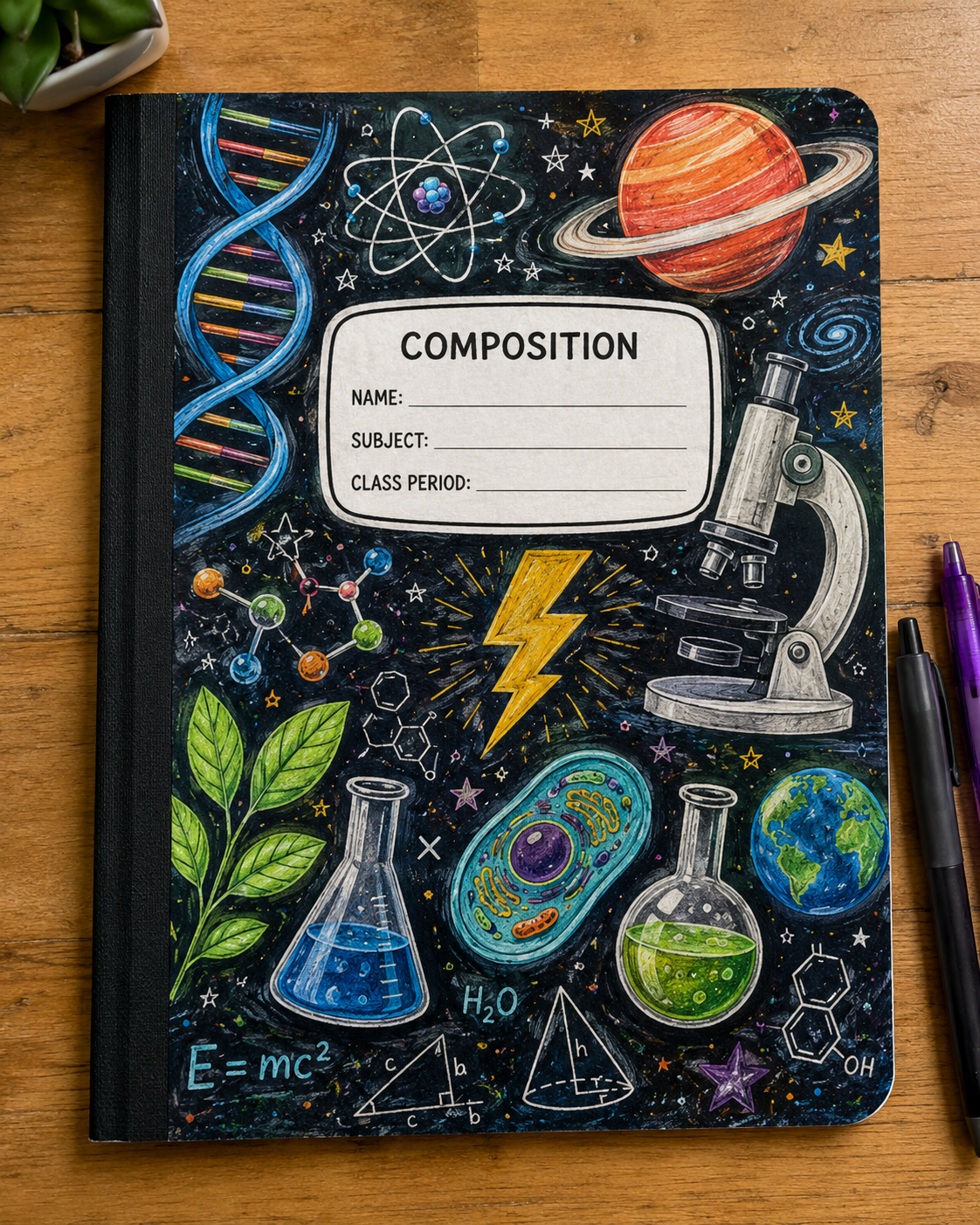
Why composition notebooks?
DURABLE • COMPACT • HARD TO LOSE PIECES FROM
Durability, mostly. I have used spiral notebooks, binders, folders, and digital systems, and composition notebooks are simply the most likely to survive an entire school year. Spirals lose covers and pages, binders invite papers to disappear, and folders eventually become archaeological sites. Composition notebooks are compact, inexpensive, difficult to dismantle accidentally, and sturdy enough to handle ten months of use. Most students can fit the entire course into one if they use the space reasonably, and if they fill it, they start another and keep both. I like that the whole course can live in one physical place without requiring the notebook to remain perfectly neat or perfectly synchronized.
THE PRACTICAL TEST
| Spiral | Binder | Composition Book |
|---|---|---|
| Pages escape | Papers escape | Usually survives |
| Wires bend | Organization drifts | One contained record |
| Cover disappears | Parts separate | Toss it in the backpack |
Why not go fully digital?
I have used digital notebooks, and there is a lot I like about them. They are searchable, impossible to leave at home if students have access to their device, easy to distribute, easy to duplicate, and much easier to recover after an absence. For some kinds of work, like quizzes and tests, digital is absolutely better. The problem is that science notebooks are not only collections of typed words. I want students drawing models, adding arrows, circling evidence, showing movement, revising relationships, annotating images, and sometimes building a visual explanation while we are talking through it together.
Drawing digitally is a skill of its own. On a touchscreen with a stylus, that can work very well. On a Chromebook with a trackpad or mouse, it can become an exercise in fighting the software. Suddenly the student who is supposed to be thinking about how oxygen moves through a body system is spending five minutes trying to drag an arrow into the correct position. I do not want to teach a separate graphics skill every time I ask students to simplify a model. Pencils and paper remain remarkably efficient for that kind of thinking: draw the arrow, cross it out, move it, label it, add another idea in the margin, and keep going.
That does not mean I reject digital tools. I actually prefer a hybrid system. The physical notebook is where much of the student's day-to-day thinking lives; the digital classroom becomes the backup, reference library, absence-recovery system, and searchable shadow of the notebook. I get the flexibility of digital without giving up the speed and simplicity of putting a pencil directly onto a page.
THE ONE THING I WISH EXISTED A full-size composition notebook. I routinely reduce handouts to fit the smaller format. When image quality is central, I keep the source full-size or use a flap rather than shrinking it into oblivion. |
|---|
2. Yes, I Teach Seventh Graders How to Use Tape
I teach taping explicitly. There is a slide. There are pictures. There is a rule. There is something dangerously close to a performance.
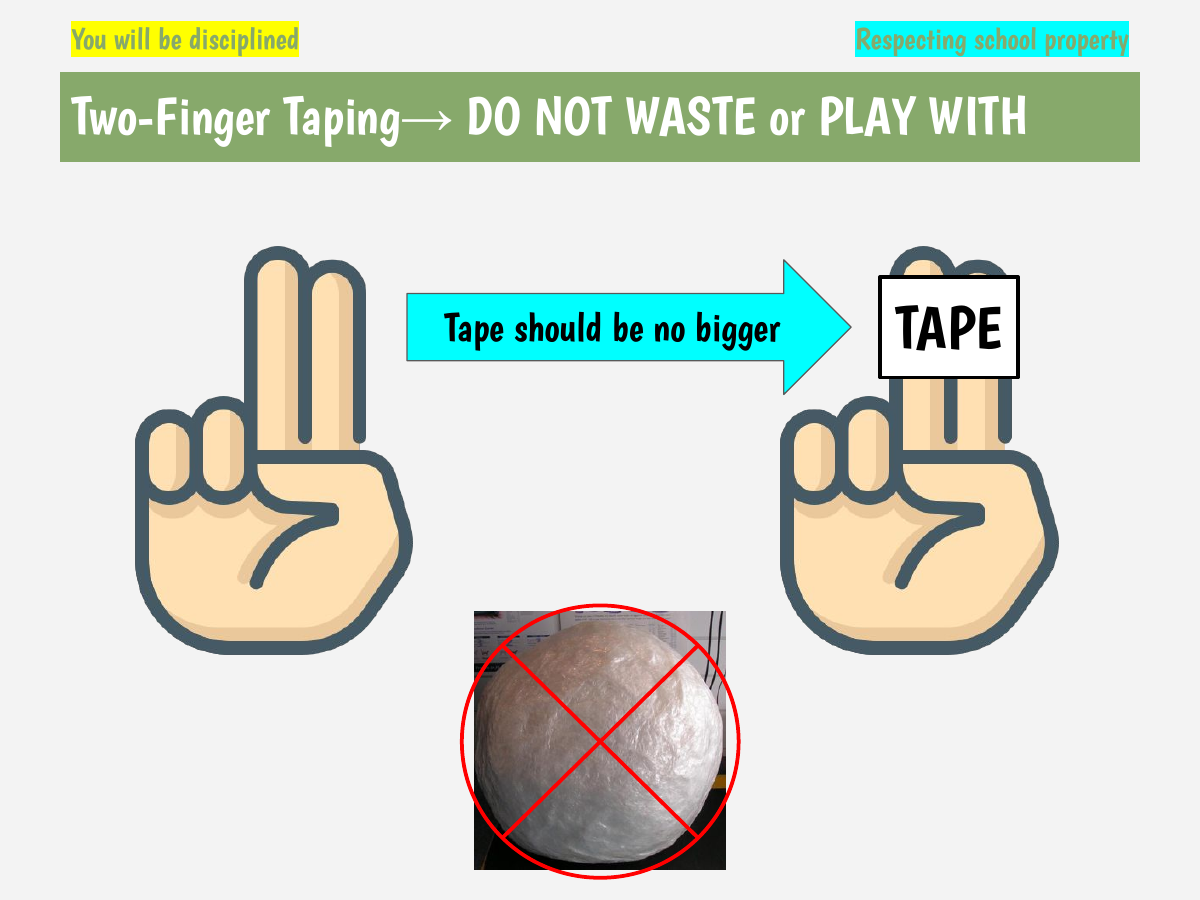
The two-finger taping rule: enough tape to hold the page, not enough to create a sculpture. Teacher-created slide.
I call it two-finger taping. Students hold up two fingers. The piece of tape should not be dramatically larger than those fingers. Before I taught this, there were tape balls, tape sculptures, tape wrapped around pencils, and pieces long enough to restrain wildlife.
Why tape instead of glue?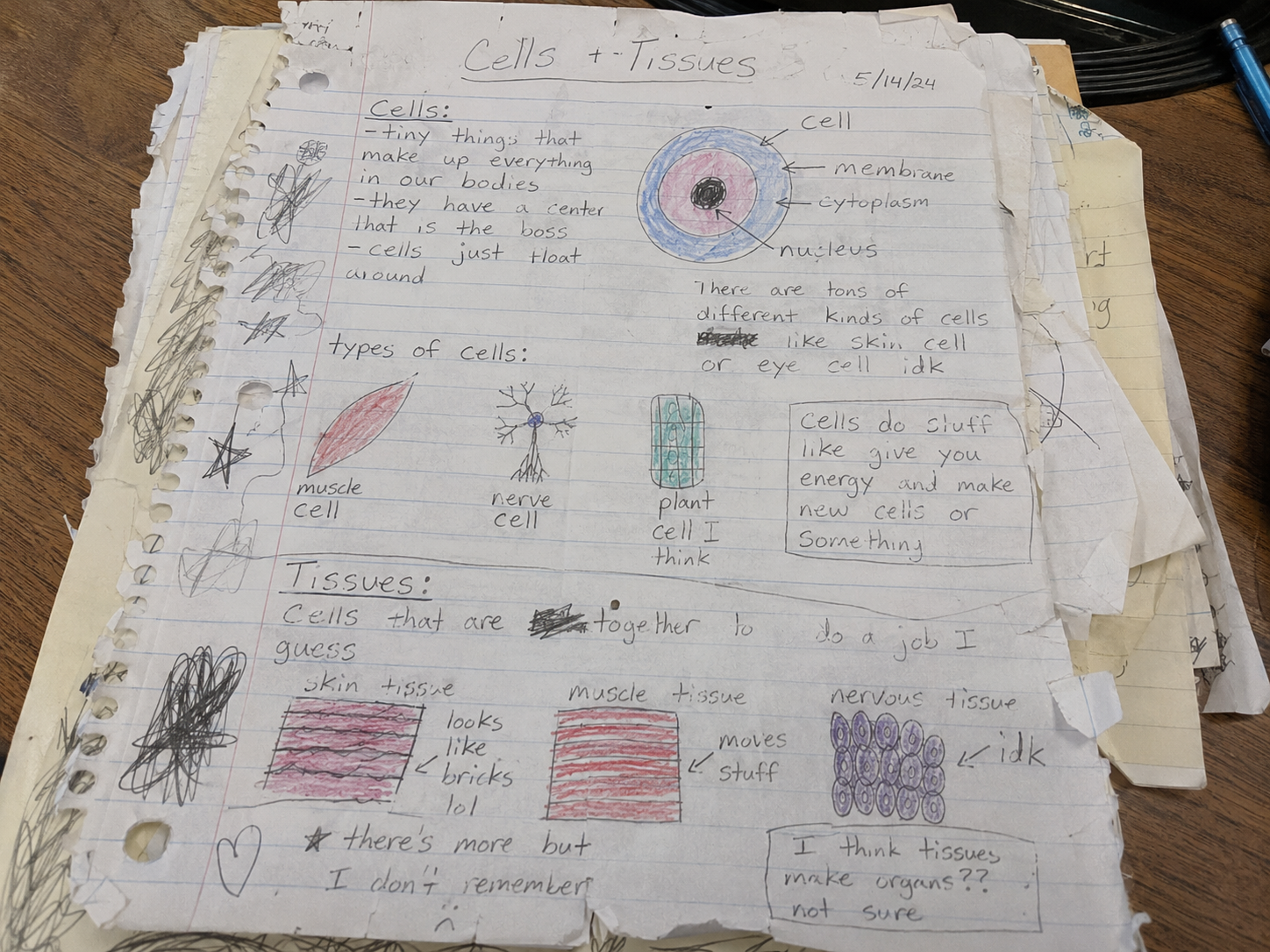
Glue sticks dry out. Pages peel. Paper sticks together. Tape costs money, but properly taped pages tend to last and I hear from teachers and students that some kids will bring their 7th-grade notebook to freshman biology. The more common failure is not the tape (other than using too darn much); it is the student folding the paper carelessly and leaving half of it hanging out of the notebook like an educational porcupine, cue page right. I also feel like glue would not allow for one of the most used features on my notebooking routine… the flap tape. When we flap tape (taping on only one side of the insert/resource), we preserve the space beneath for additional thinking and recording. Call me crazy but I cannot imagine a glue stick supporting that routine. I would also predict that it would be tricky to make an insert double sided while using a glue stick to hold it in the notebook; not to mention the constant lifting of the flap. It feels like you're asking that piece of paper to fall out and get lost.
A good routine does not eliminate teacher support. It concentrates teacher support where it is actually needed.
PART II • BUILD THE SYSTEMPART IIBuild the System
3. Make the Directions So Obvious a Monkey Could Follow Them
The specificity in my slides did not start entirely with students. Early in my career, grade-level teams often shared planning responsibilities. When I was the person pushing out a lesson, I wanted colleagues to be able to personalize it if they had time - or simply open the materials and teach if they did not.
My private standard became: make the lesson so obvious that a monkey could follow it. The point was not to insult colleagues. It was to take care of them.
The pandemic pushed the same instinct further. If students were absent or learning remotely, I wanted the slides, photographs, models, videos, and notebook directions to recreate as much of the classroom experience as possible.
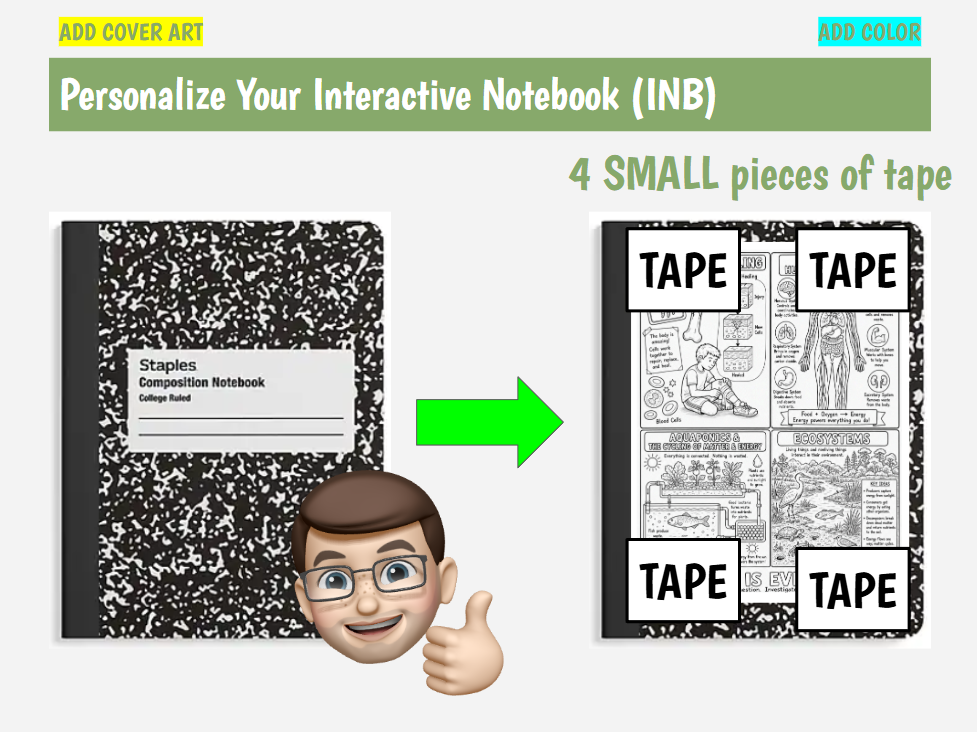
A notebook-preparation slide. Tiny procedural decisions are externalized so students do not have to hold them in working memory.
That same level of detail now helps far more than the student sitting in front of me during the original lesson. It gives absent students a realistic way to reconstruct what happened, gives co-teachers a clear picture of the intended setup, gives parents something concrete to reference when helping at home, and gives future-me a record of what I actually did rather than what I vaguely remember doing. In that sense, a well-designed slide becomes more than a presentation tool. It becomes part of the classroom's infrastructure—a visual memory for the course. The slide remembers the procedure so the student does not have to.
4. One Question. One Spread. One Chunk of Learning.
When possible, each meaningful instructional chunk begins on a fresh left-right spread and is organized around a question rather than a topic label.
Compare “Digestion” with “How do digestive organs work as a system?” The topic names information. The question gives the information a reason to exist.
A question-driven digestion spread. |
A question-driven skin-healing spread. |
|---|
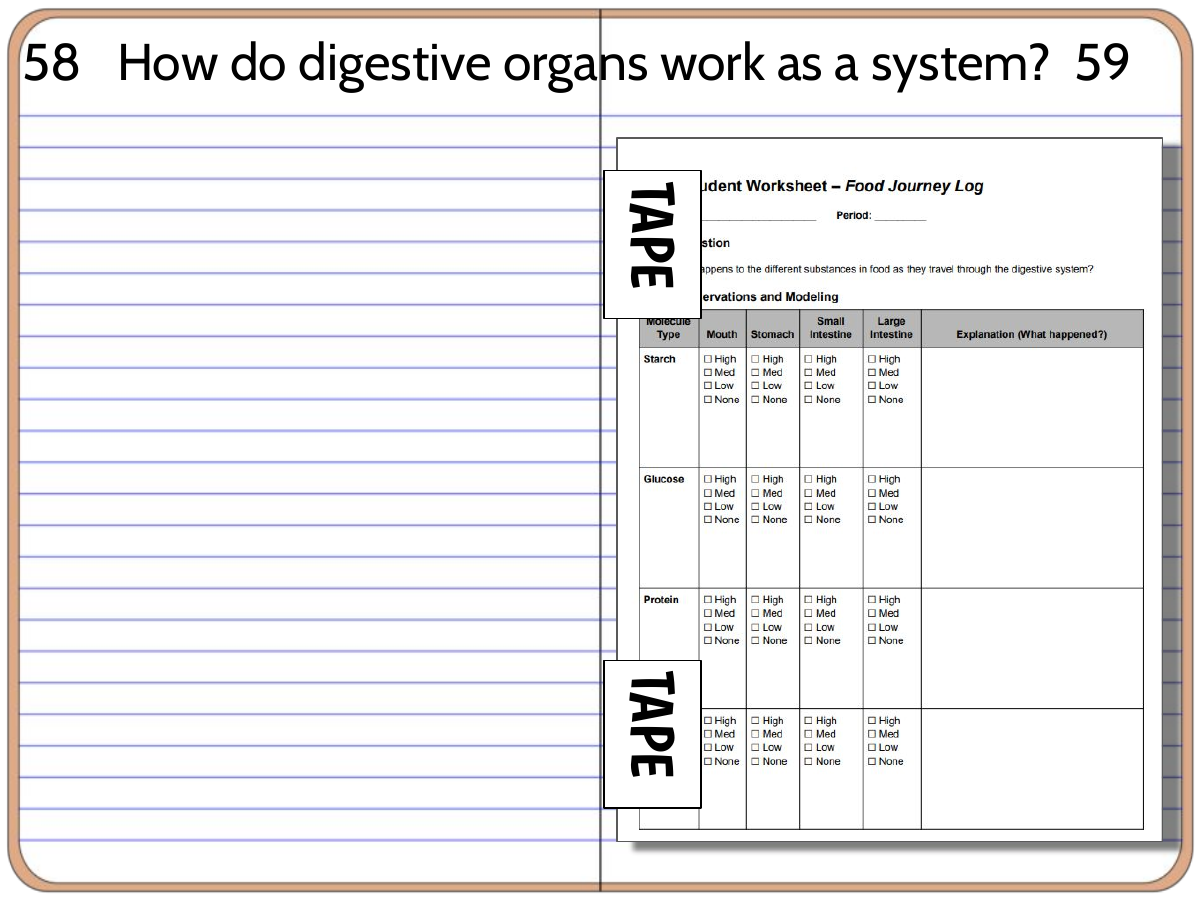
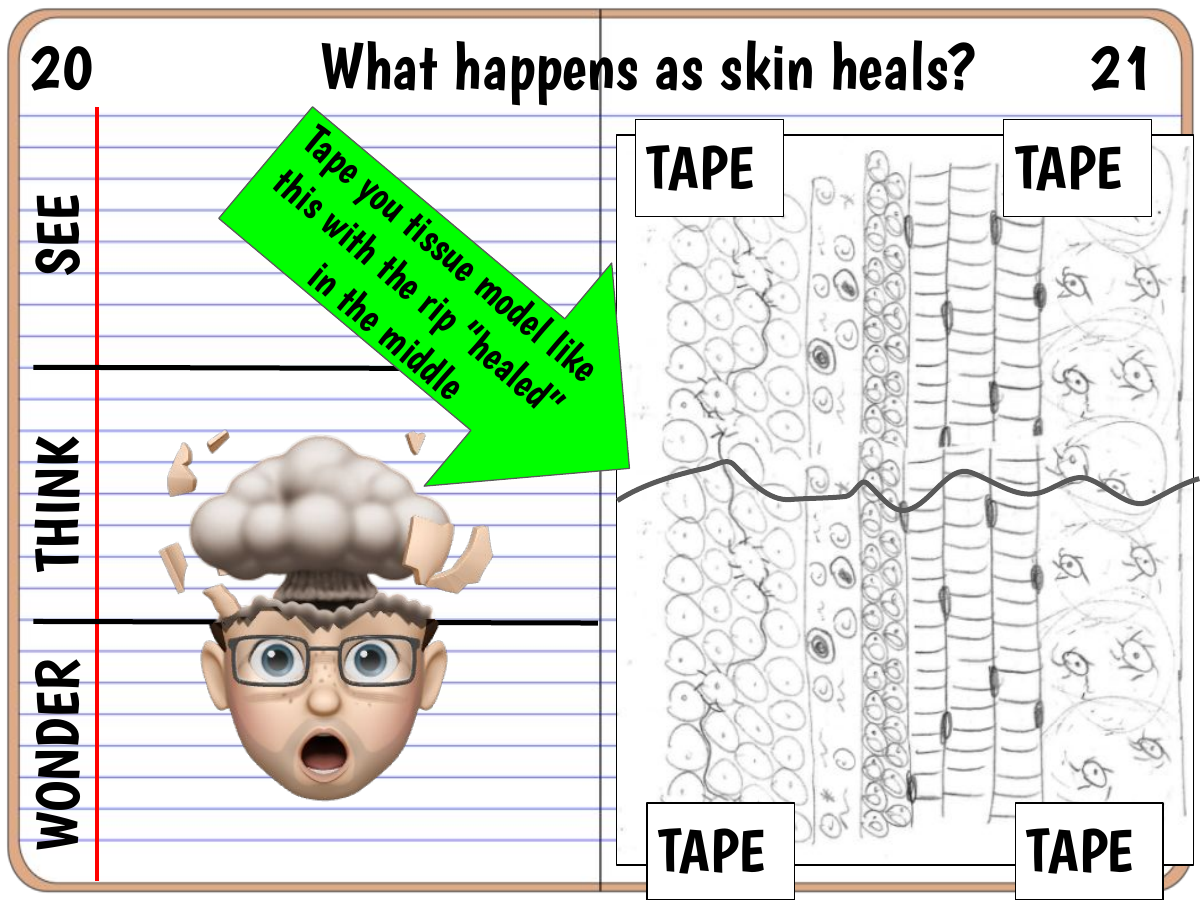
The ideal hybrid spread
My preferred page often contains one preserved artifact and one student-generated thinking space. A reading, image set, data table, or lab sheet gets taped in because recreating it would add little value. The notebook paper around or under it remains available for models, explanations, hypotheses, evidence, or questions.
Left Side / Right Side: A Useful Pattern, Not a Rule
A traditional interactive notebook often divides an open spread into two complementary jobs: the right side holds input—notes, readings, diagrams, data, teacher models, or other information students encounter—while the left side is reserved for output, where students process that information through summaries, diagrams, questions, connections, models, or explanations. I like the logic of that structure because, when it works, a student can open the notebook and see information beside thinking about that information. I do not follow the rule religiously. But when I can, I like preserving that basic relationship: one side gives students something to think with; the other gives them somewhere to do the thinking.
| LEFT: PROCESS / OUTPUT | RIGHT: INPUT |
|---|---|
| Explain it | Reading or source |
| Modify or extend it | Teacher model |
| Interpret it | Lab data |
| Annotate it | Diagram or image |
| Summarize or connect | Notes |
| Build an explanation | Evidence |
Print what would lose value if students had to recreate it. Leave blank what would lose value if you created it for them.
5. Page Numbers Matter - But Not That Much
I try to keep page numbers consistent across classes because it keeps Google Classroom simple. If every class is answering the same general question on pages 58-59, I can create one post and assign it to everyone.
But I do not design the notebook months in advance. I may know roughly where the next week is going. I save previous years resources, so I know that a lesson that landed around page 75 last year will probably land somewhere nearby this year. But I leave room for reality. Sometimes Tuesday goes horribly wrong and Wednesday needs a lesson I had not planned. If the entire notebook were pre-engineered, that structure would make me less willing to respond to what students actually need.
WHEN THE NUMBERS DRIFT If one class gets one or two pages off, I usually reset the class at the next clean spread instead of fighting the notebook for weeks. If an individual student has wandered far ahead, I tell them to write the current class page number at the next fresh spread so the rest of the year can be synchronized. The road map is there. Students still have responsibility for following it. |
|---|
 |
|
|---|
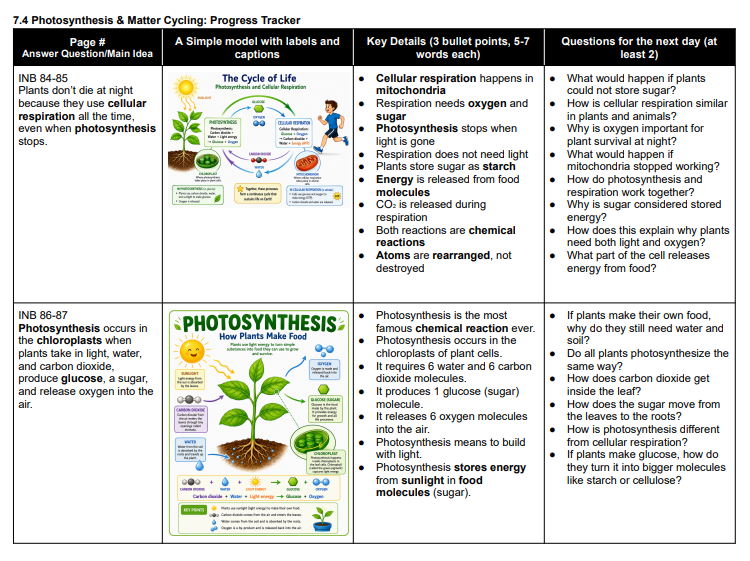
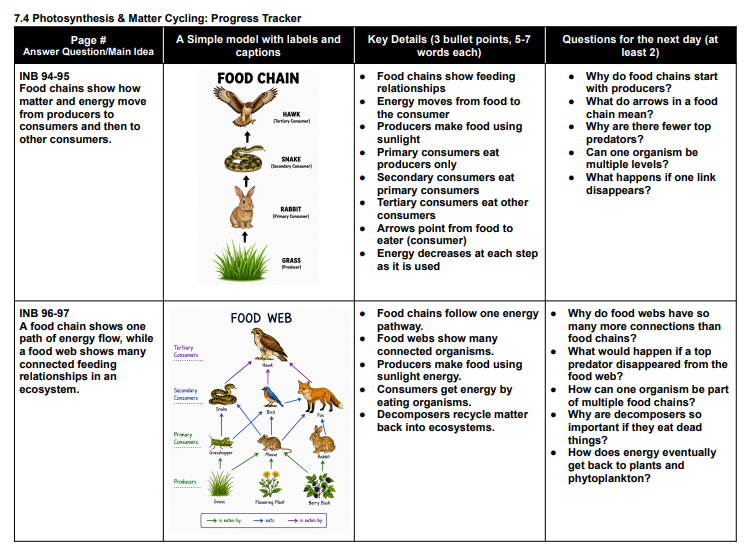
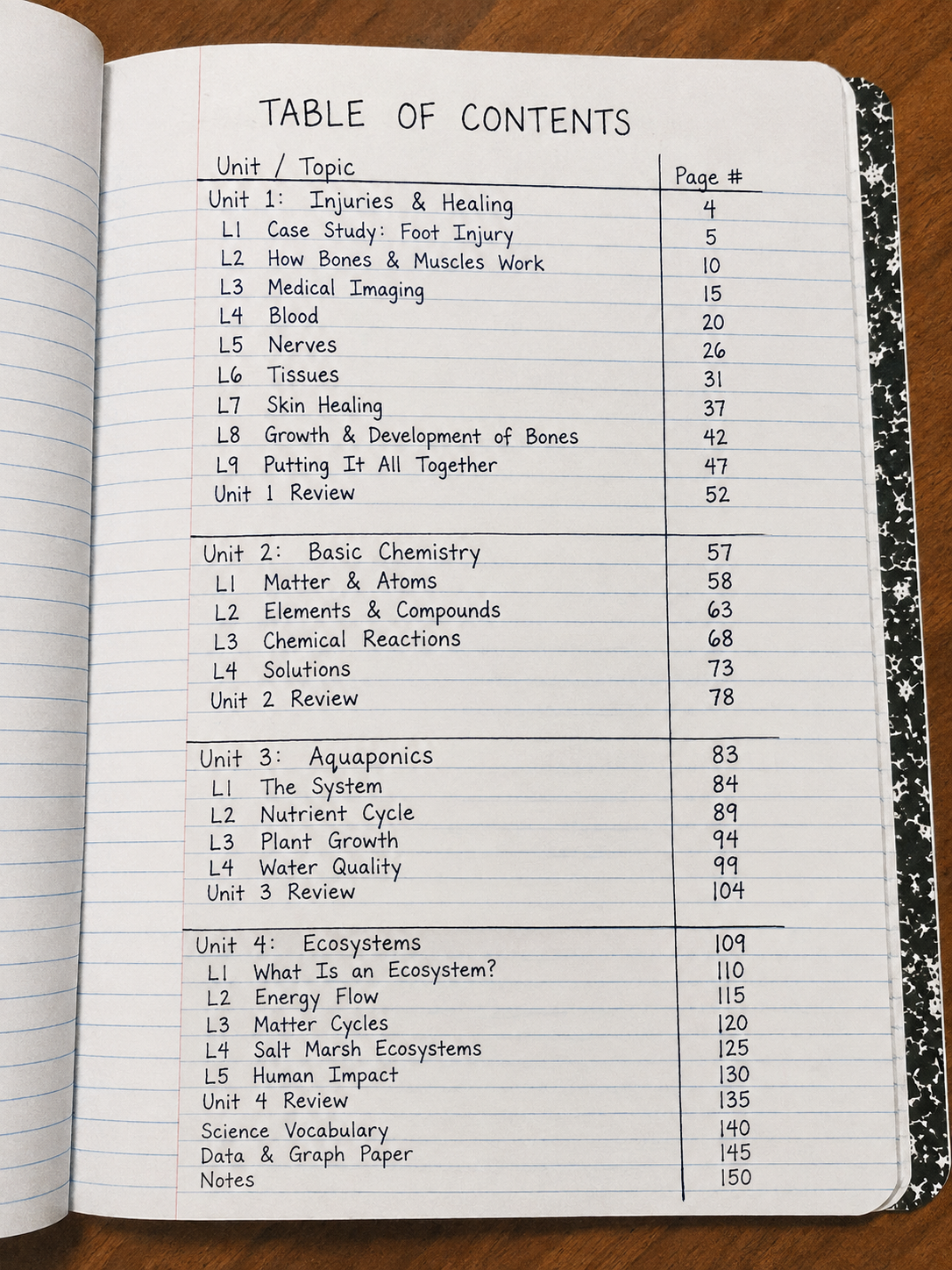
I used to rely more on a traditional table of contents, but over time I found that a progress tracker gave students more useful information about their learning. A table of contents tells students where something is; a progress tracker asks them what happened there, what mattered, and what they should remember. I still value organization, but I would rather have students spend that time summarizing, identifying a main idea, or building a small model than simply recording page titles. In my system, Google Classroom now handles much of the navigational work, while the progress tracker does the more important job of turning the notebook into a tool for retrieval, reflection, and studying.
6. Hybrid Spread: Preserve the Source, Add the Thinking
A printed artifact is not the enemy of an interactive notebook. The problem is when the notebook becomes a cemetery of worksheets that students never transform.
A strong hybrid spread gives students the original evidence and enough physical space to do something intellectually useful with it.
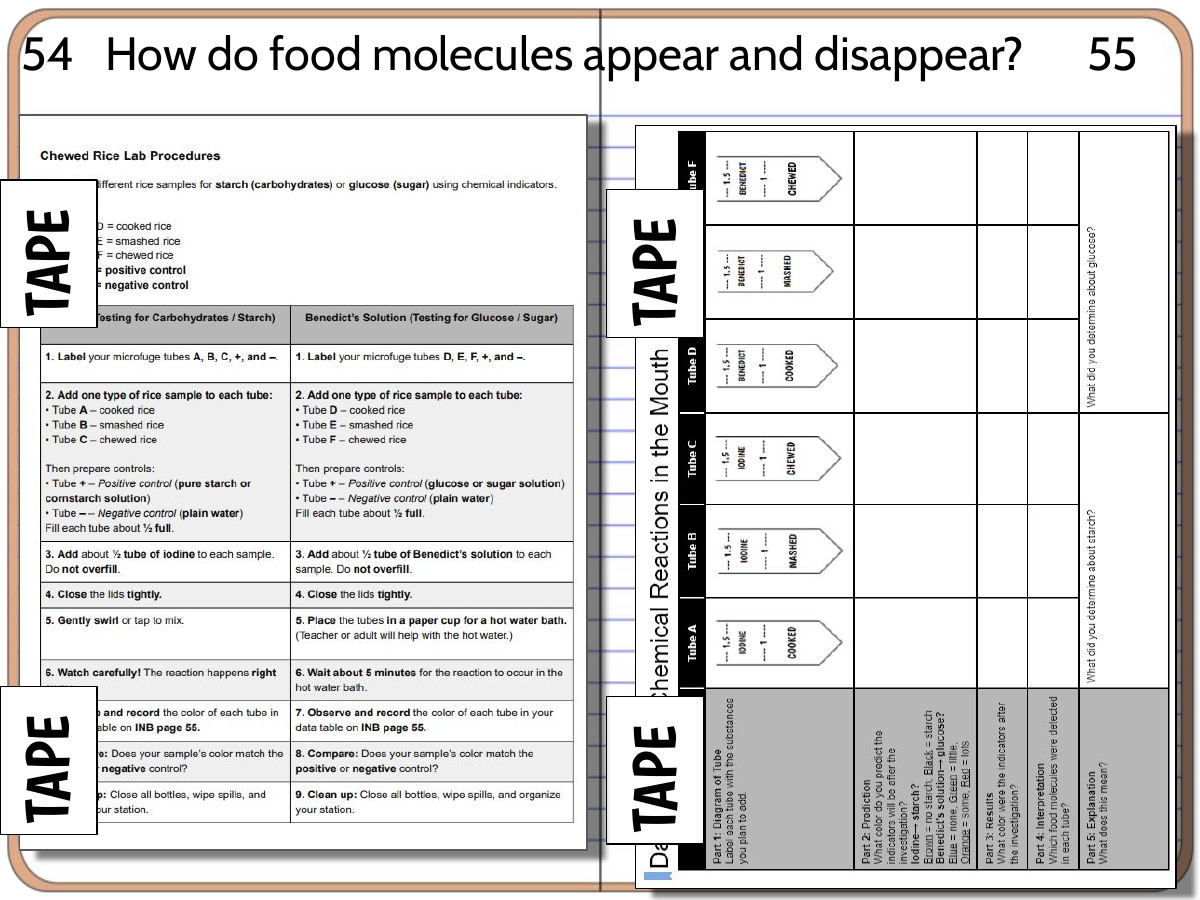
A food-molecule spread: preserved source material is combined with space for student-generated work.
Flap taping
Sometimes the source is too useful to shrink, but I still want the notebook paper underneath. Tape one edge. Lift the document. Annotate the source above; model or explain underneath. This is my highly technical invention called flap taping.
Flap taping is one of the simplest ways I have found to make a small composition notebook hold much more thinking. Instead of taping all four corners of a handout to the page, students attach it along just one edge so it can be lifted like a flap. The printed material remains available on top—a reading, diagram, data table, medical report, image, or other source—but the notebook paper underneath remains usable. Students can annotate the source directly, then lift it to record observations, explanations, models, questions, or other thinking beneath it. Multiple materials can even be layered when a lesson requires students to move among several sources of evidence. Students can essentially make booklets within their notebooks. I try to avoid more than one page but sometimes it is warranted.
The real advantage is not just saving space. Flap taping allows the evidence and the thinking about the evidence to coexist without one replacing the other. A student might highlight symptoms in a medical report, lift the report to compare those symptoms with a body-systems diagram, and then lift that diagram to reveal a student-created model underneath. The original evidence is always available for students to return to as their explanation develops. In that sense, the physical structure of the notebook mirrors an important scientific habit: move back and forth between what the evidence actually shows and what you think the evidence means.
7. Flap Taping Is Really Layering Evidence
Flap taping is one of the simplest ways to make a small composition notebook hold more thinking without sacrificing the original source. A reading, diagram, image, or data table can stay visible on top while the notebook space underneath remains available for annotations, models, explanations, or revisions. The real value is not just saving space; it is keeping evidence and interpretation physically connected so students can move back and forth between what the source shows and what they think it means. It also keeps all the thinking around one topic on a single set of pages, visible side-by-side.
Layer 1: doctor note and interview transcript remain intact and annotated. |
Lift the first layer: students connect symptoms to body systems. |
|---|
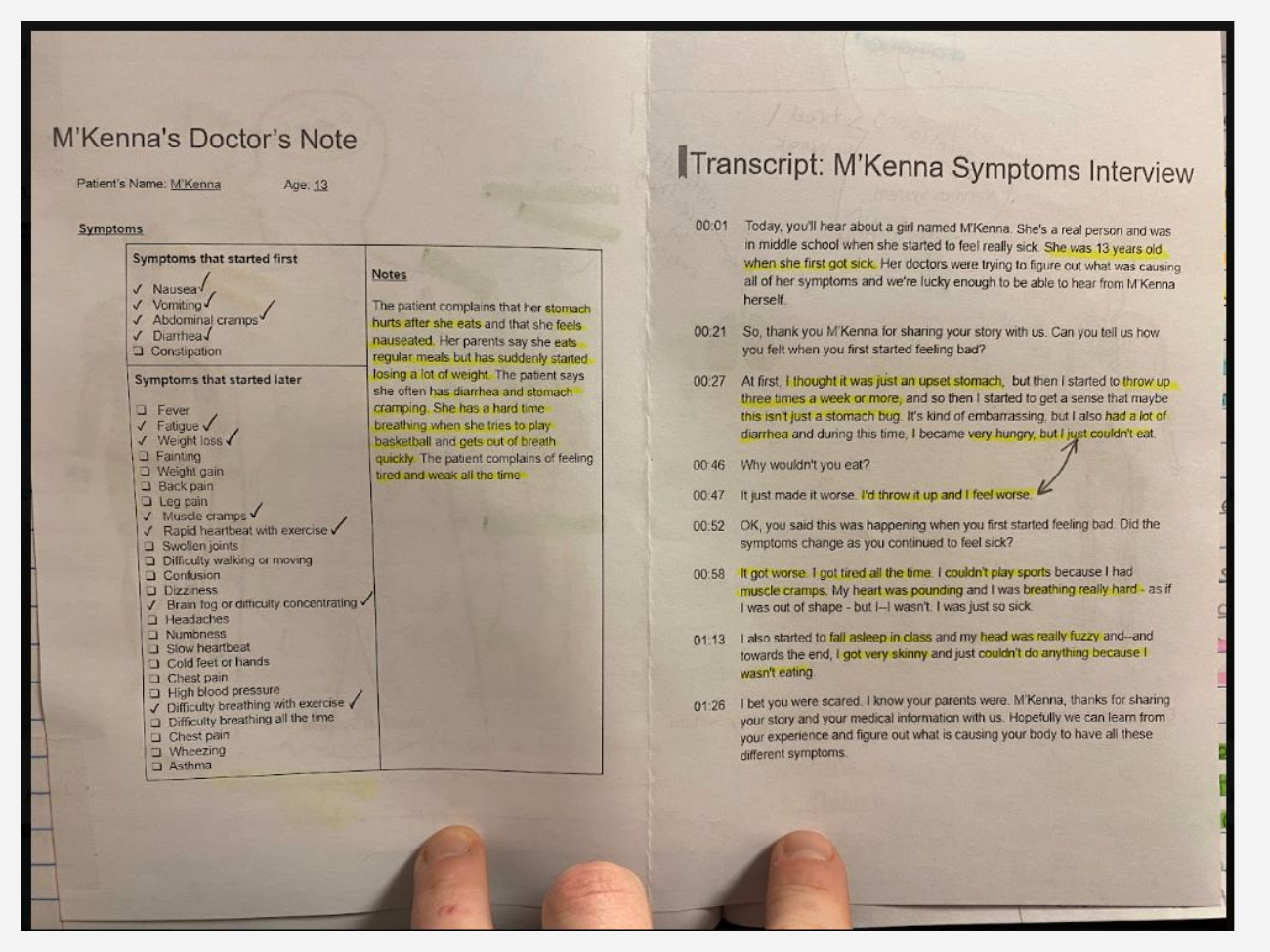
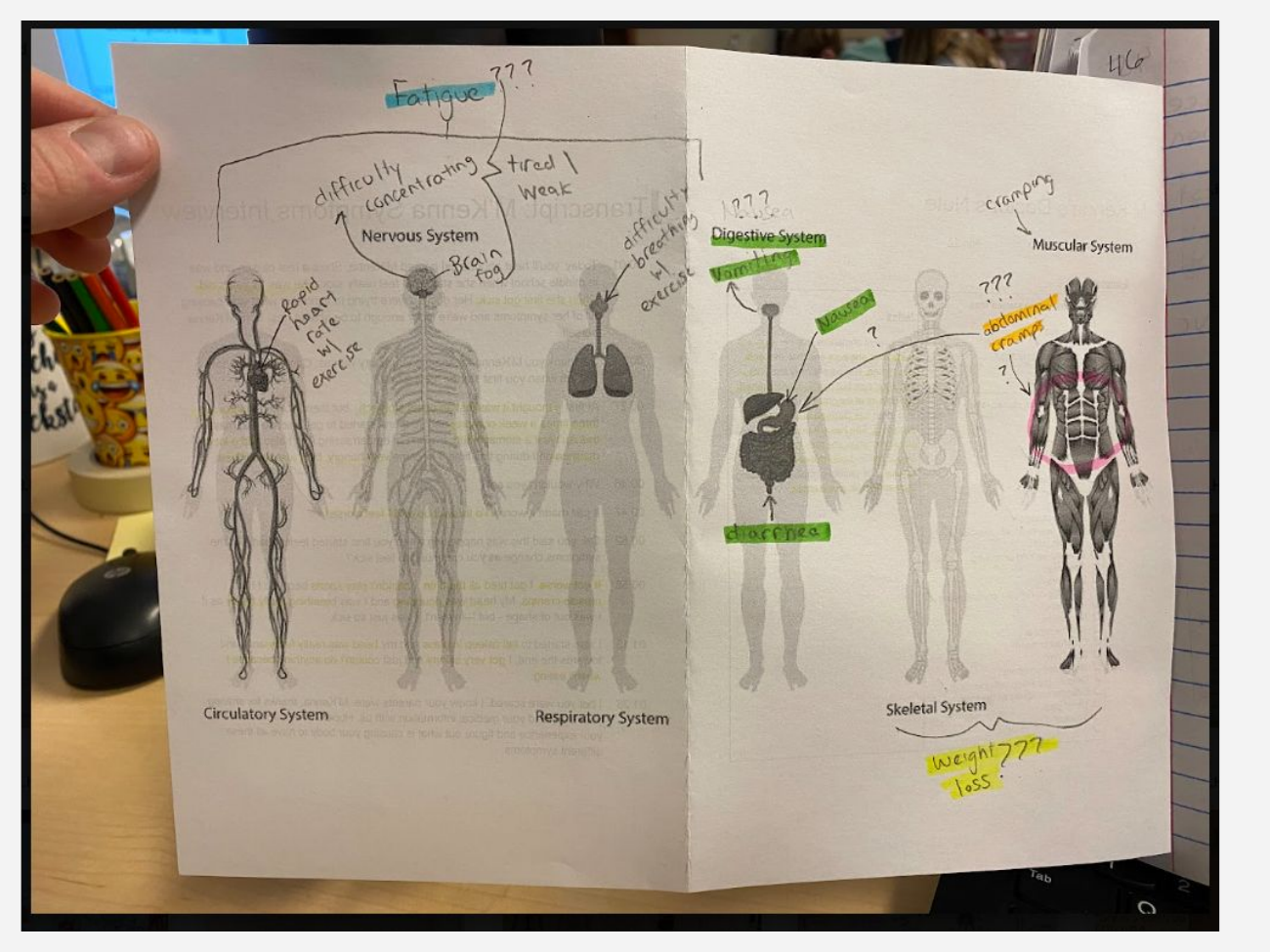
Notebook paper underneath holds a student-generated whole-body model. |
A separate notice/wonder record preserves observations and questions. |
|---|
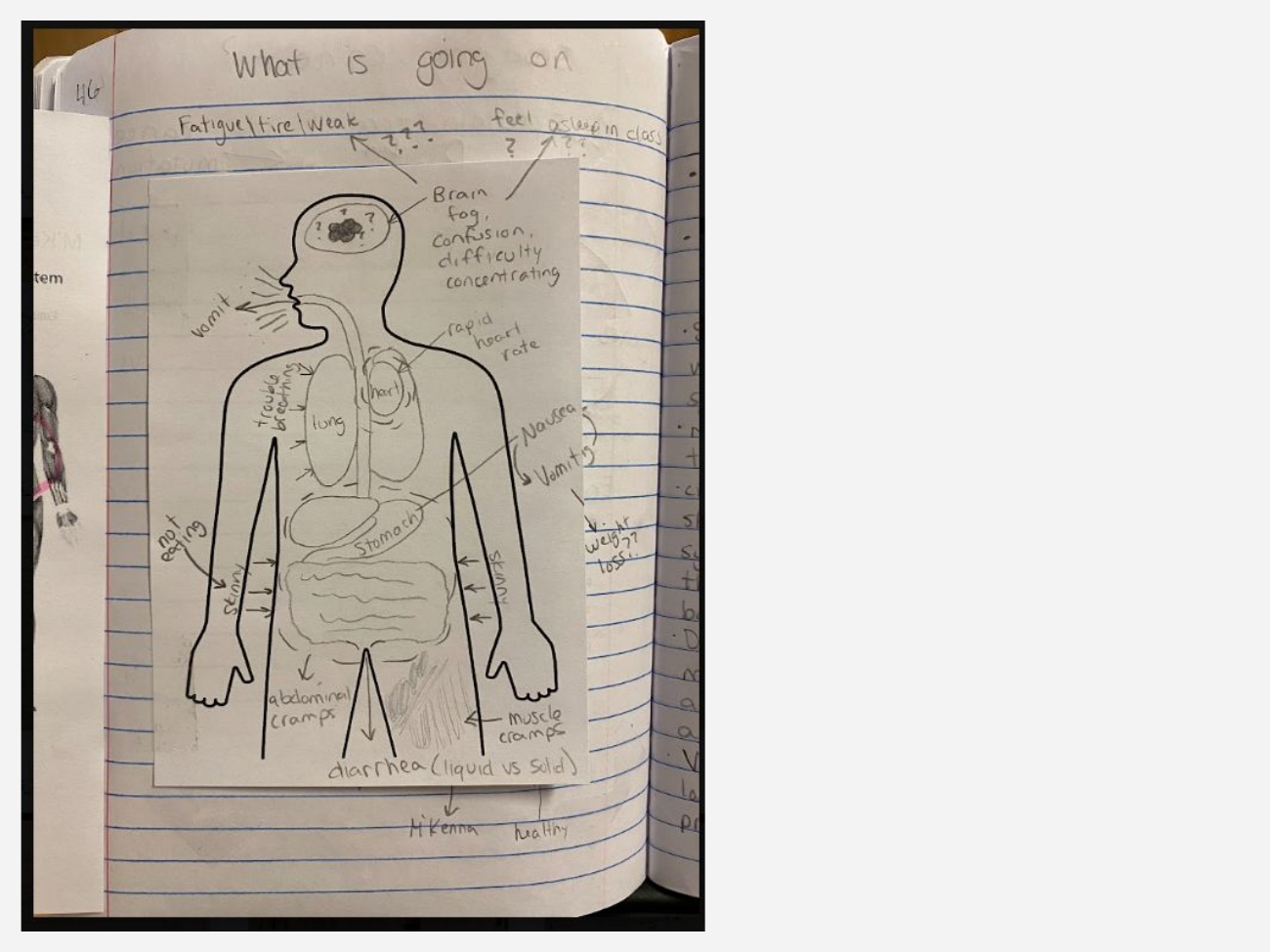
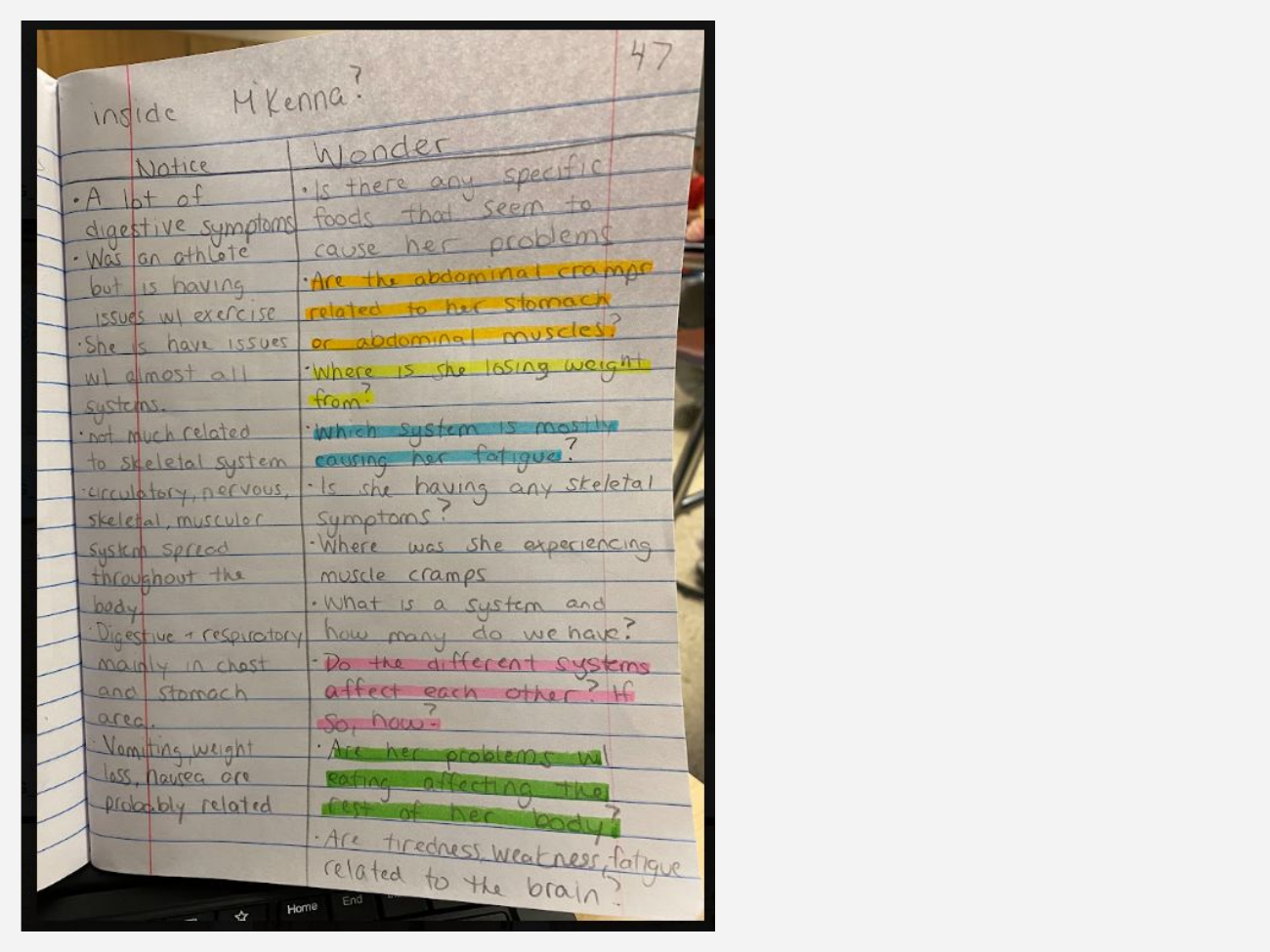
OpenSciEd connection: Adapted from materials in OpenSciEd Unit 7.3, Metabolic Reactions (McGill & Novak, 2022).
The physical structure mirrors the intellectual structure: source evidence, interpretation, synthesis, and uncertainty remain accessible at the same time.
Students can literally lift the evidence and return to the interpretation . That is a pretty good habit for science.
PART III • DECIDE WHAT STUDENTS SHOULD CREATEPART IIIDecide What Students Should Create
8. Blank Page, Graphic Organizer, or Just Give Them the Damn Notes?
This is where the notebook gets interesting. The difficult decision is not where the handout goes. It is what the student should have to generate.
Three pressures
• Learning value: does creating the structure help students understand how the information is organized?
• Time: is drawing the organizer worth ten minutes of a 66-minute class?
• Access: are motor, processing, writing, or executive-function demands obscuring the science I actually want to see?
A student who cannot make a straight line to save their life can lose the science inside the mechanics of building a table. A perfectionist can spend ten minutes erasing the same line. Sometimes the correct pedagogical decision is: give them the table.
The goal is not to remove difficulty. It is to remove difficulty that has nothing to do with the learning target.
9. The Four Levels of Notebook Support
| LEVEL | WHAT I PROVIDE | WHAT STUDENTS GENERATE |
|---|---|---|
| 1 • Blank canvas | Question + sources | Organization, evidence selection, model, explanation |
| 2 • Structured canvas | Question + headings/boxes | Most content and relationships |
| 3 • Scaffolded capture | Organizer + sentence starts + partial model | Scientifically important choices and reasoning |
| 4 • Reference copy | Complete or nearly complete notes/model | Application, prediction, practice, transfer |
Level 4 is not automatically less rigorous than Level 1. If I give students a completed model and then ask them to use it to explain a new phenomenon, they may do more sophisticated thinking than a class that spent thirty minutes drawing a graphic organizer and had no time left to use it.
DECISION RULE What would lose value if I created it for them? What would lose value if they had to create it themselves? |
|---|
Print what would lose value if students had to recreate it. Leave blank what would lose value if you created it for them.
10. Why I Still Make Students Copy Some Things
I am not opposed to copying. I am opposed to copying that serves no purpose.
Sometimes I deliberately ask students to hand-draw a model I could easily print. Constructing a simplified scientific representation is a skill. Students need practice deciding what to include, what to omit, what an arrow represents, and how color can carry information.
A teacher-directed cellular-respiration model. Drawing it live slows the explanation down and makes modeling decisions visible.
I tell students: you are not coloring this to make it beautiful. You are using color to make it easier to understand. Hot can be red and cold blue because those conventions communicate. Skin may be pink because it is recognizable in a model, not because every person’s skin is literally pink. Drawing live slows me down too. I cannot click through twelve finished diagrams in thirty seconds. The model unfolds at the same pace as the explanation.
But copying a model can be different from copying a paragraph. When I build a scientific model live, students get to watch the explanation develop. I draw a structure, explain why it matters, add an arrow, discuss what the arrow represents, and gradually construct the model with them. Drawing also forces me to slow down enough for students to process what I am saying. I also want students to practice simplifying complicated systems. A scientific model does not need to be beautiful or anatomically perfect. A rectangle can represent a blood vessel. A circle can represent a cell. An arrow can represent the movement of oxygen. The important question is whether the model helps explain the science.
Over time, I want that support to fade: watch me build one, build one with me, try one with support, then build your own. The goal is not to make students good at copying my notebook. It is to help them become capable of creating useful scientific representations themselves.
Sometimes the value is not in reproducing the model. It is in watching the model get built.
11. Attempt + Clean Copy
One of my favorite compromises is simple. A student struggles to copy from the board, but I still want them to practice following and constructing a model.
THE ROUTINE Try the notes or drawing with us. Do not worry about producing a perfect final product. When we finish, I will give you a clean printed copy. Tape the clean copy over your attempt if you need it. |
|---|
Now both goals survive. The student practices the process and leaves with an accurate resource. Accommodation does not have to mean abandoning skill development. Practicing a skill does not require leaving a student with unusable notes.
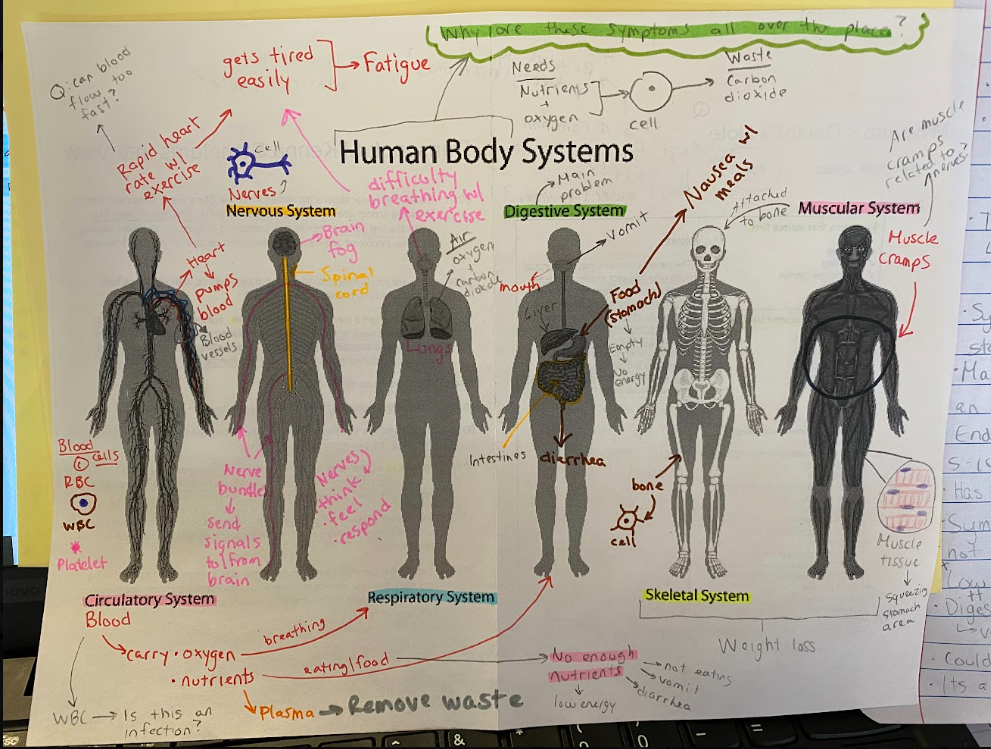
OpenSciEd connection: Adapted from materials in OpenSciEd Unit 7.3, Metabolic Reactions (McGill & Novak, 2022).
Consensus Modeling and Accessible Notes
Building a consensus model is an intentionally dynamic OpenSciEd routine. Students contribute observations, evidence, and ideas while the teacher facilitates discussion, challenges misconceptions, and gradually constructs a shared visual model in real time. That process can be powerful because students see the explanation develop rather than simply receiving the finished product—but it also creates significant demands on working memory, processing speed, visual attention, and note-taking.
A student receiving special education services may be trying to listen to the discussion, decide what information matters, locate where a new idea belongs on the page, copy words and drawings from the board, and understand the science simultaneously. By the time the student finishes copying one part, the class may already have moved on to the next. Having a clean copy of the teacher’s completed notes or model ready preserves access without removing participation. Students can still follow along, contribute ideas, and attempt the model during class, but they know they will leave with an accurate, usable reference afterward. The goal is not necessarily to eliminate the productive challenge of constructing meaning together; it is to prevent the mechanics of keeping up with the model from becoming a barrier to understanding the science.
PART IV • THE TEACHER NOTEBOOKPART IVThe Teacher Notebook
12. I Keep a Notebook Too
For years, I kept an interactive notebook alongside my students. Not a pristine exemplar. An actual working notebook.
If students were taping something in, I taped it in. If they drew a model, I drew it. If the page looked awkward, sometimes mine looked awkward too.
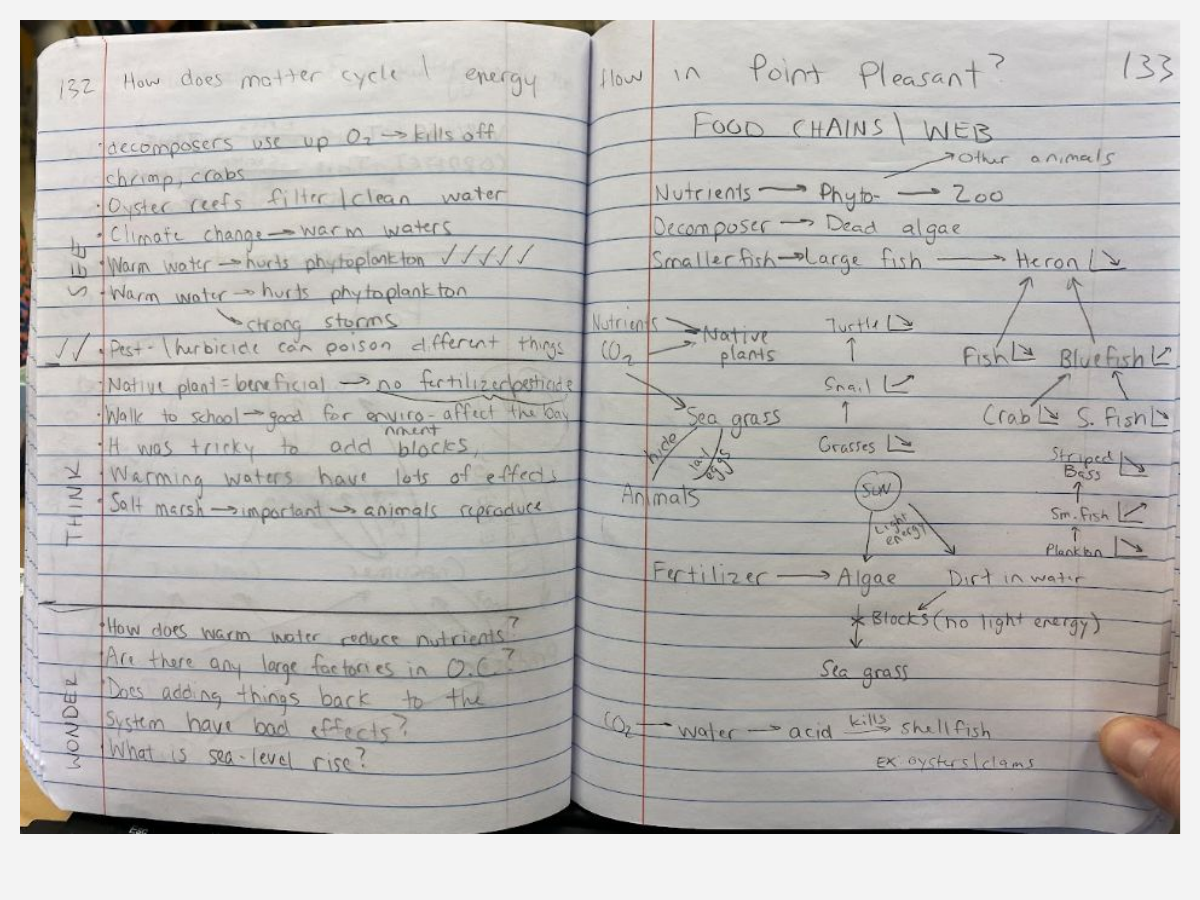
A real completed notebook spread. The point is achievability and usability, not publication-quality art.
The notebook became a moving exemplar. A student who struggled with task initiation could look at the actual page and think, “Oh. That is what this is supposed to look like. I can probably do that.”
Sometimes the teacher model should communicate “This is achievable,” not “Behold the unattainable standard.”
I keep an interactive notebook alongside my students because sometimes the most useful model is not a polished answer key—it is watching someone actually do the work. When students tape in a handout, build a model, organize information, or add notes from a discussion, I can work through the same process in my own composition notebook. That gives students an achievable example to reference during class and gives me an artifact I can photograph, post online, photocopy, or hand to a student who needs additional support. My notebook does not always need to be perfect; in fact, sometimes it is more useful when it looks like something a capable seventh grader could reasonably produce. Over time, it also becomes a record of the course itself: what we actually did, how we represented difficult ideas, where a lesson changed from the original plan, and what I may want to modify the next time I teach it.
13. The Co-Teacher as Expert Learner
Some co-teachers are expected to support students in science, math, social studies, and English. It is unreasonable to expect the same deep content knowledge in every course.
So I began giving the co-teacher a different role: keep a notebook right alongside the students and deliberately model the learning process.
• Follow the directions.
• Ask questions when something is unclear.
• Make visible mistakes and correct them.
• Let students see an educated adult encounter unfamiliar content productively.
• Become an additional concrete example students can compare against.
The classroom already has a content expert. Students also benefit from an expert learner: someone who visibly demonstrates rereading, checking, questioning, correcting, and persisting.
A co-teacher does not need to imitate the content expert. Sometimes the more powerful role is modeling how an effective learner behaves when the content is unfamiliar.
A co-teacher does not need to pretend to have the same content expertise as a teacher who has taught the curriculum for years. Instead, keeping a notebook alongside students allows the co-teacher to become an expert learner—modeling what capable people do when they encounter unfamiliar material. They can also experience the lesson from the learner's perspective, noticing confusing directions, excessive demands, or places where additional support may be needed.
What the expert learner might sound like:
Model genuine uncertainty.
“I'm not sure I understand why that arrow goes there yet. Can someone explain it to me?”Make rereading visible.
“I missed something. I'm going back to the evidence before I change my model.”Ask the question a student may be reluctant to ask.
“Can you explain that one more time? I understand the first part, but you lost me here.”Normalize mistakes and revision.
“I had these backwards. I'm going to cross this out and fix it rather than start over.”Model checking directions.
“Before I ask Mr. Pirl, I'm going to look at the setup slide again and see if I can figure out where this belongs.”Invite students to become the expert.
“I wasn't sure about this part. Show me what you did and explain why.”Notice a hidden barrier.
“I understand the science, but I'm having trouble listening while copying all of this. Could we pause for a minute?”Use the notebook as evidence.
“Didn't we learn something earlier that could help us here? Let's go back and find it.”Make learning strategies explicit.
“I don't know the answer yet, but I know what I can do next.”
The goal is not for the co-teacher to perform confusion. It is to make the normally invisible process of figuring something out visible. Students see an adult question, check, revise, persist, and use available resources—and learn that successful learners are not people who always know the answer; they are people who know what to do when they don't.
14. Photograph Everything
At some point, my physical notebook started becoming digital. The transition was not sophisticated. Take a picture. Upload it. Done.
I photograph essentially every page I create because I want students to be able to reconstruct missed learning. Over time, those images have become answer keys, absence supports, examples for parents, references for the next year, and source material I can now digitize or redraw with AI. That is curriculum development happening through the notebook.
THE EVOLUTION OF ONE MODEL Hand-drawn teacher model → student notebook example → phone photograph → Google Classroom archive → cleaned/digitized version → printable scaffold for a future class. |
|---|
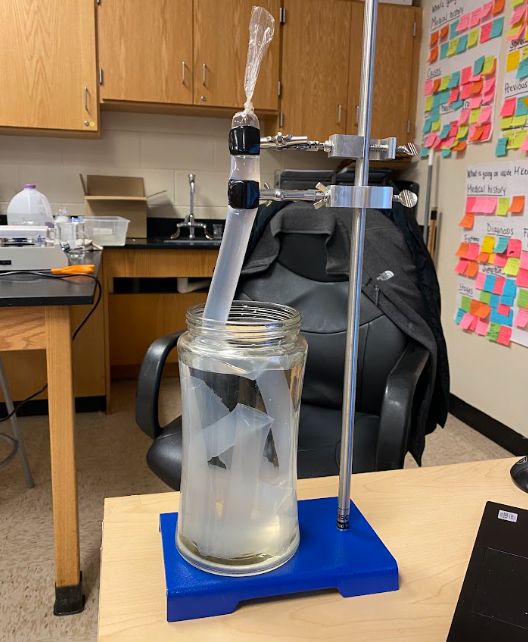
A lab setup |
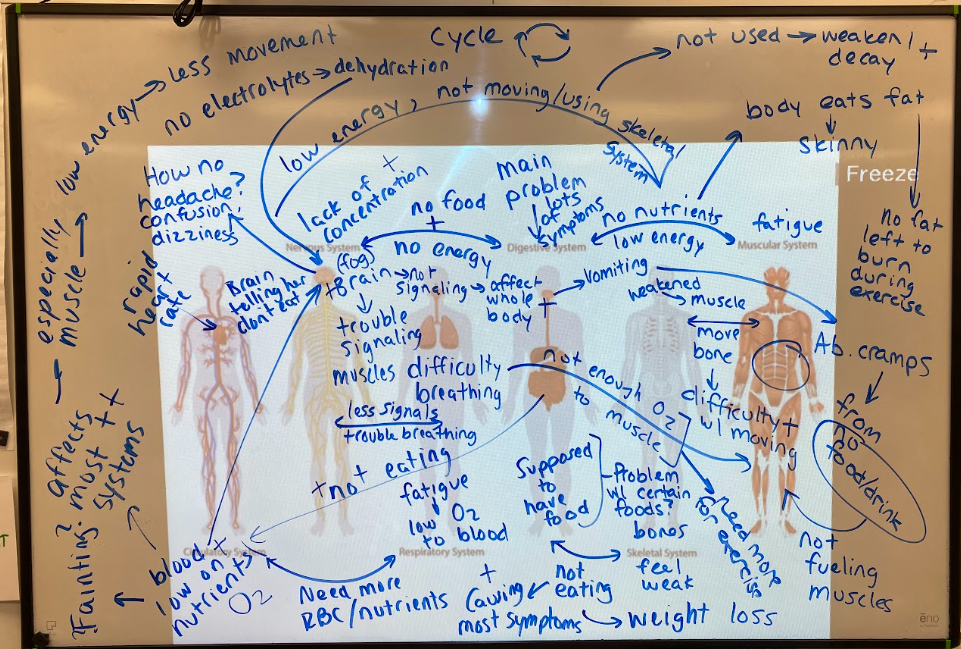
A consensus model |
|
|---|---|---|
The word wall |
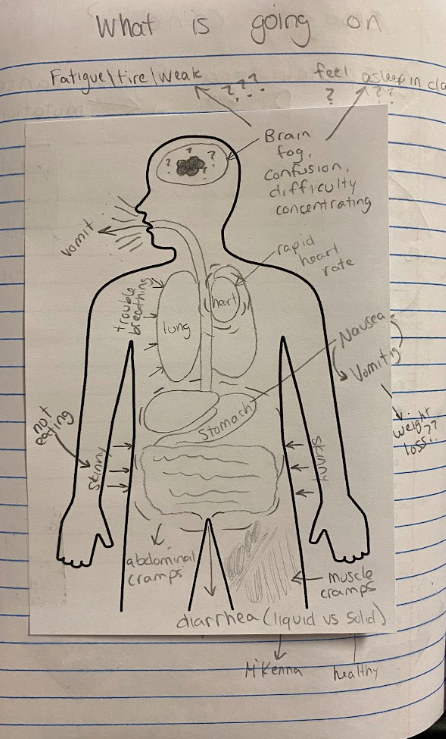
My notebook |
|
PART V • THE DIGITAL SHADOWPART VThe Digital Shadow
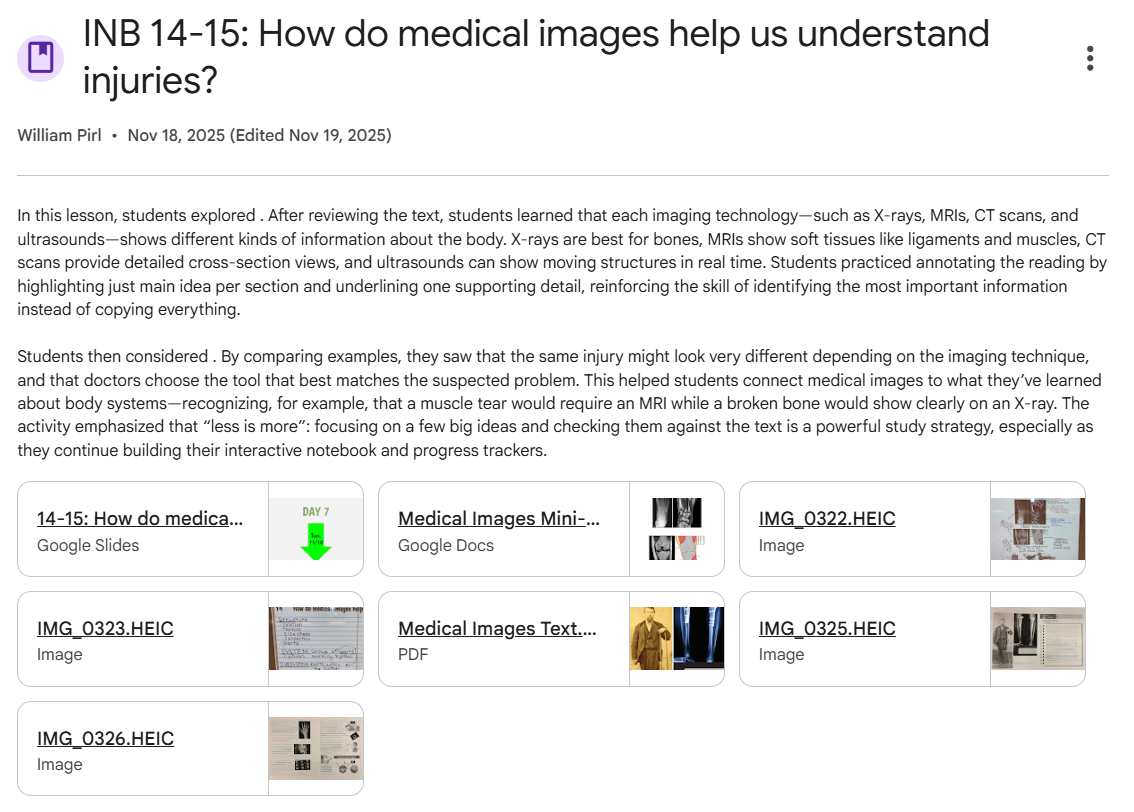
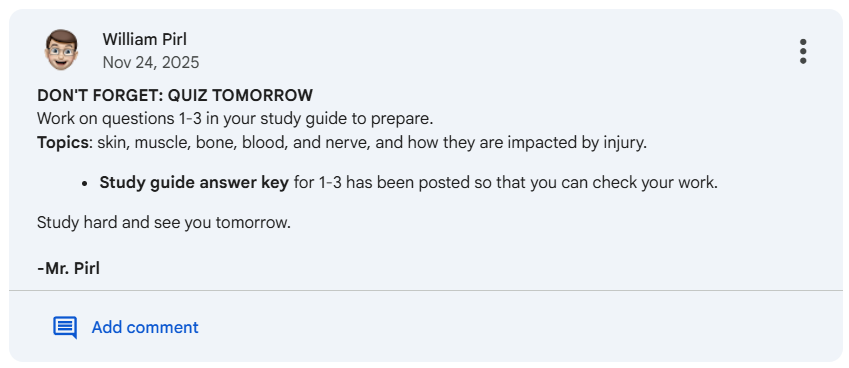
15. The Notebook Has a Digital Shadow
I do not think the physical notebook and Google Classroom compete with each other. Each is better at different things.
| PHYSICAL NOTEBOOK | GOOGLE CLASSROOM |
|---|---|
| Drawing, annotation, quick modeling | Search, duplication, links, videos |
| One tangible record of the course | Replacement copies and answer keys |
| Easy page-to-page comparison | Access from home after an absence |
| Working surface during class | Searchable table of contents by page number + question |
I used to make students maintain a traditional table of contents. Most ignored it. Eventually I realized Google Classroom already did that job better, so I stopped spending notebook space and class time on an inferior duplicate system.
A notebook tradition does not deserve to survive merely because notebook guides say you are supposed to do it.
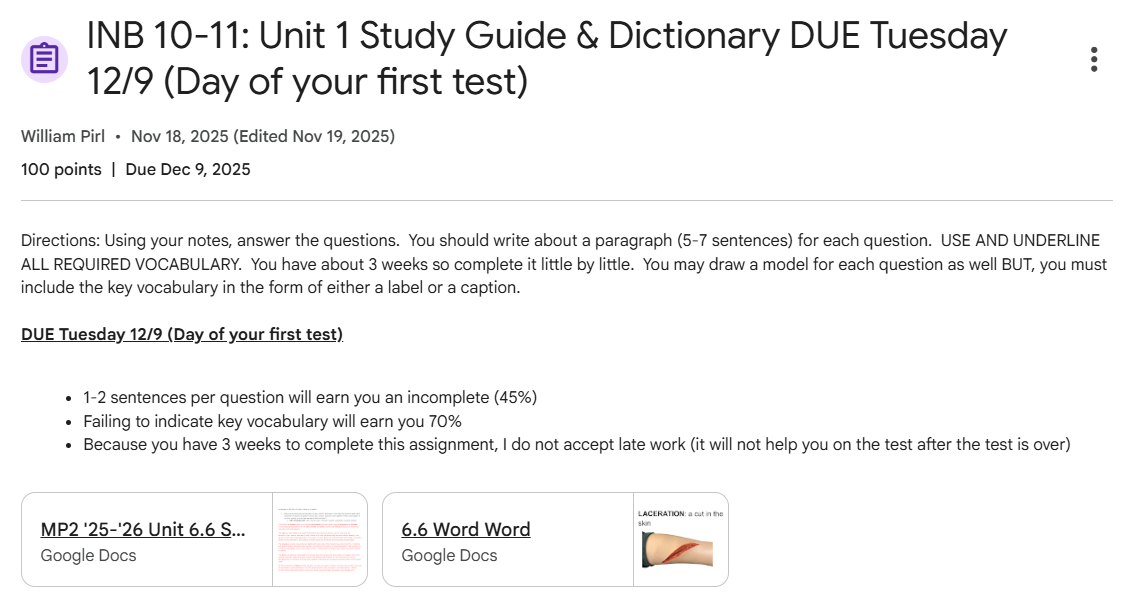
Every page. Every resource. From Day 1 to 180.
 |
 |
|---|---|
 |
 |
16. One Absence Should Not Become Two
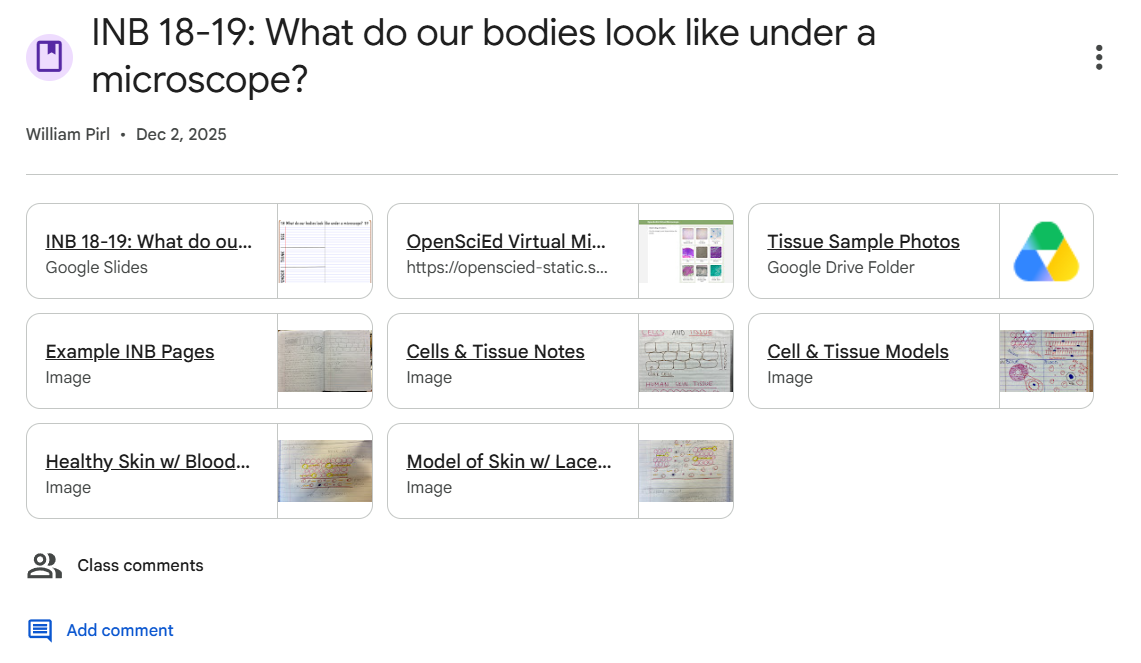
A student misses Tuesday, returns Thursday, and spends Thursday making up Tuesday. Congratulations: one absence has now reproduced. My preference is different. Participate in today’s learning. Recover the missed work outside today’s instruction using Google Classroom, notebook photographs, a reliable classmate, my notebook, study hall, lunch, or an arranged time. The goal is not merely catching up. The goal is teaching students how to catch themselves up.
ABSENCE RECOVERY 1. Participate in today’s lesson. 2. Check Google Classroom for the missed page number and question. 3. Gather replacement materials. 4. Compare with the teacher notebook/photos. 5. Complete what you can independently. 6. Write down remaining questions. 7. Bring those questions to me. |
|---|
Marrying Google Classroom, the actual classroom, and the notebook.
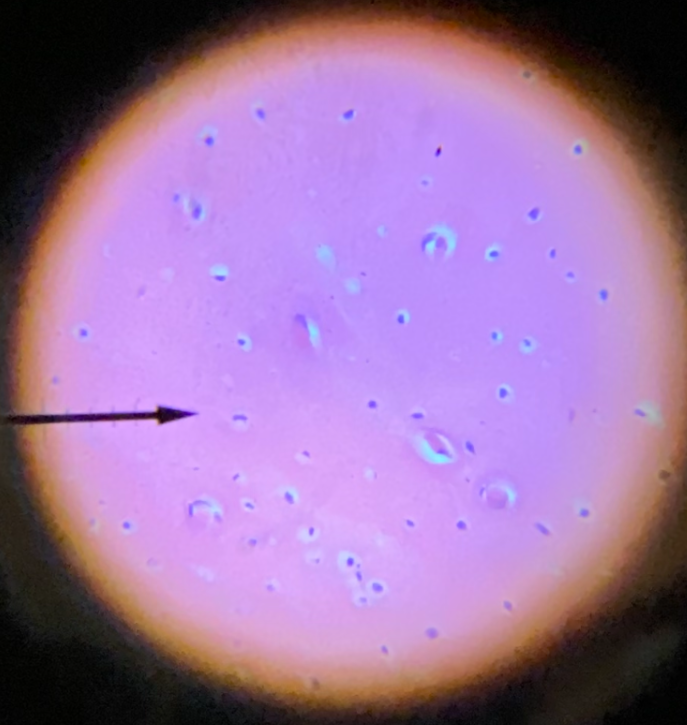
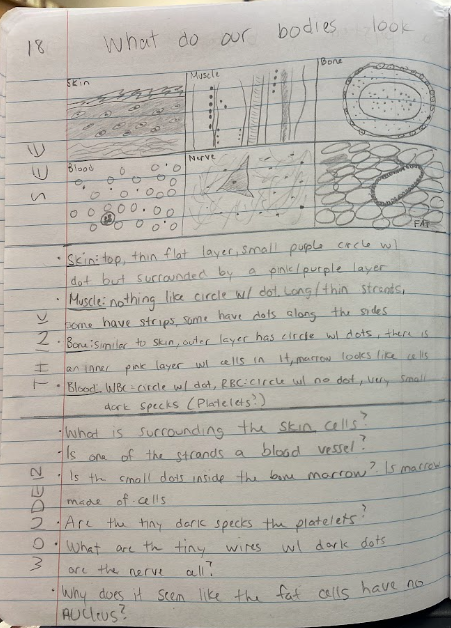
PART VI • THINK WITH THE NOTEBOOKPART VIThink with the Notebook
17. See. Think. Wonder. Then Grow Up.
I love See-Think-Wonder. It gives students a complete little intellectual sequence: I see something. I think something about it. I ask something because of it.
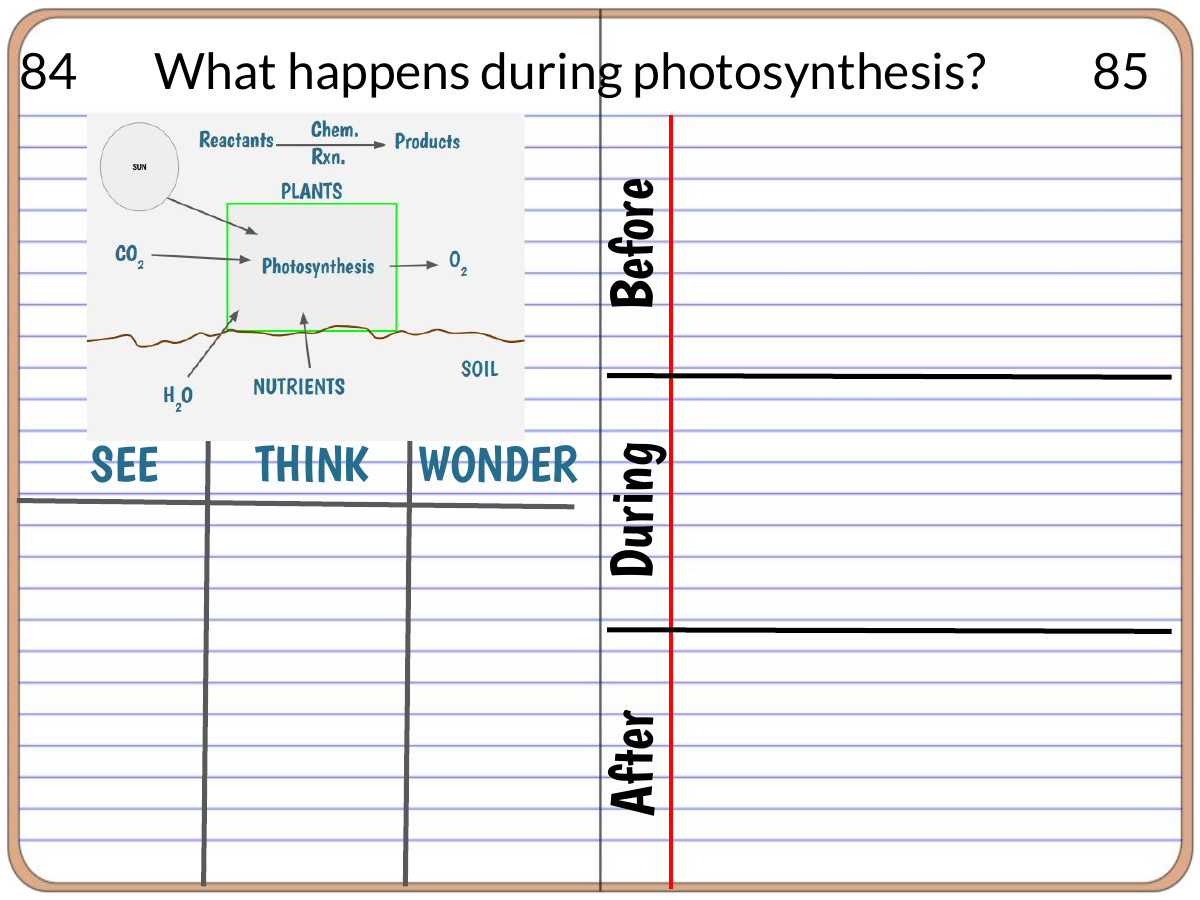
A See-Think-Wonder notebook setup used with photosynthesis. Repetition makes the routine familiar - sometimes too familiar.
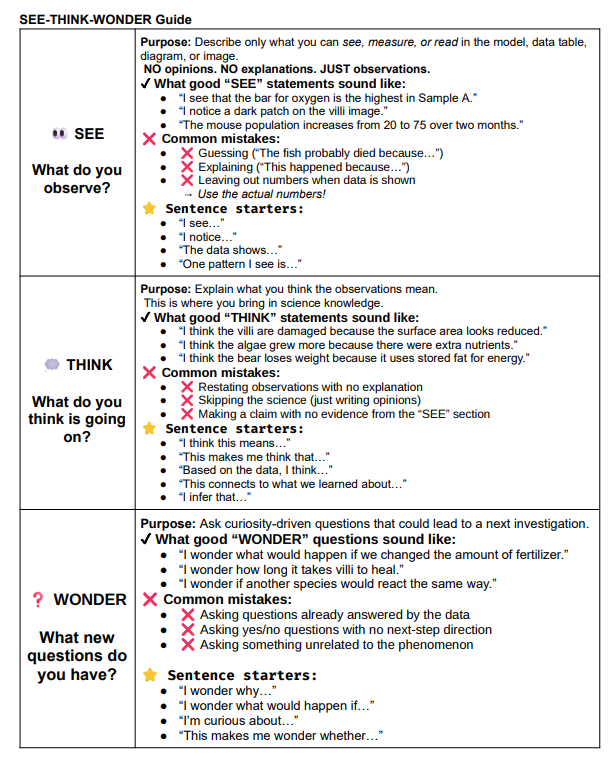
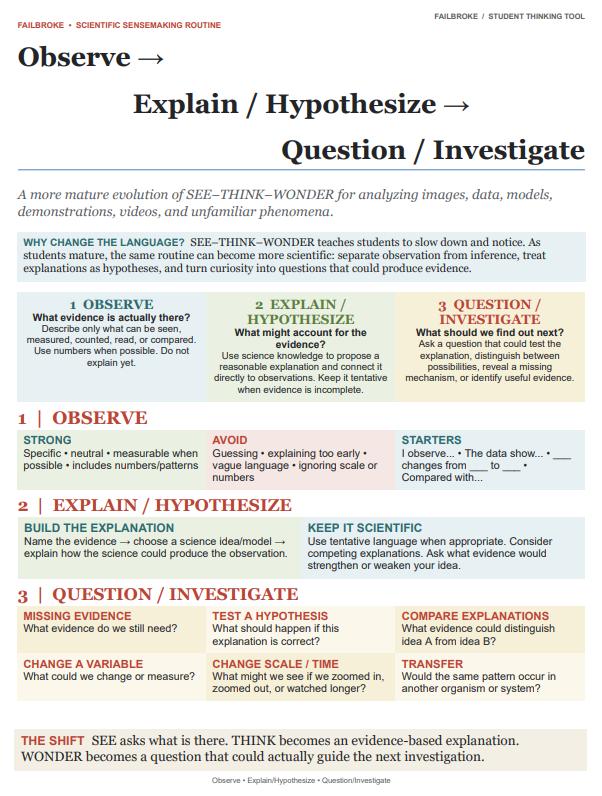
The problem with any good routine is that it can become wallpaper. Students learn how to fill boxes without actually thinking. So I have been experimenting with more scientific language as students mature: Observe → Explain/Hypothesize → Question/Investigate, and eventually Evidence → Inference → Inquiry.
THE DEVELOPMENTAL PROGRESSION Observe → Explain/Hypothesize → Question/Investigate, and eventually Evidence → Inference → Inquiry. |
|---|
 |
 |
|---|
18. The Progress Tracker Might Be the Most Important Page
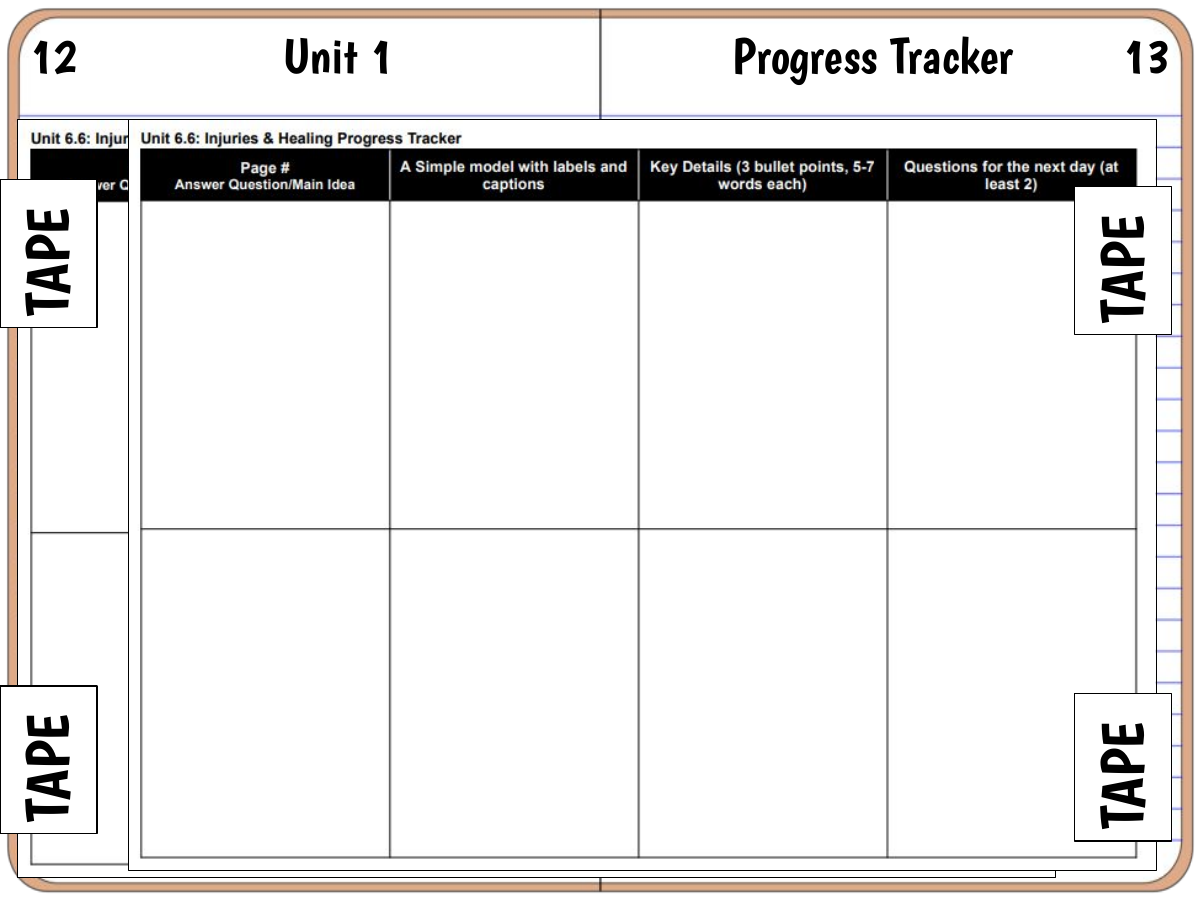
Adapted from OpenSciEd: This progress tracker is based on the progress-tracking routine used throughout OpenSciEd instructional materials. The format and classroom implementation shown here have been modified to support retrieval practice, summarization, modeling, and long-term review.
The progress tracker began as an OpenSciEd routine that I modified for my students. It became a homework and summary tool completed every one or two lessons. When time allows, students do it in class. Under a tighter schedule, it becomes a short homework routine we practice until it can be completed in about ten minutes.
If used well, one row asks students to retrieve, summarize, prioritize, simplify a model, and identify remaining uncertainty.
Seventh graders stink at summarizing AND studying
I say that with affection. Their natural definition of a summary is often “everything, but slightly smaller.” The tracker forces compression.
A study tool should not merely store information. It should teach students how to reduce information without destroying its meaning.
19. The Upside-Down Pyramid
I think of summarization as an upside-down pyramid. Start with an enormous body of knowledge: Science. Narrow it to Life Science. Narrow again to Anatomy and Physiology. Narrow again to a unit, then a lesson, then one question, then one row of a progress tracker.
COMPRESSION SCIENCE ↓ Life Science ↓ Anatomy & Physiology ↓ Injuries & Healing ↓ Today’s Question ↓ One main idea + a few details + one simplified model |
|---|
Expertise involves compression. Experts do not carry every isolated fact with equal weight. They organize information into chunks and relationships. Seventh graders can begin learning that skill.
Having Notes Is Not the Same as Knowing How to Study
One assumption I have made too often is that if I give students good notes, a study guide, or a well-organized notebook, they will know how to use it. They often don't. Effective studying is a skill that has to be taught. The National Association of Elementary School Principals recommends explicitly helping middle-school students develop study strategies rather than assuming those habits will emerge automatically. Edutopia makes a similar point: students need instruction not only in taking notes, but in using those notes later, with support gradually fading as they become more independent.
Simply rereading a notebook can create the feeling of studying without requiring students to demonstrate what they know. UNC's Learning Center instead recommends active strategies such as generating questions, explaining concepts aloud, creating models, and solving problems. It also recommends spreading study across several days. Edutopia similarly emphasizes retrieval and spaced practice: produce an answer from memory, check it against the notes or key, correct errors, and return to the material later.
That gives the interactive notebook a purpose beyond storing information. Students can cover a progress-tracker row and retrieve the answer, redraw a model from memory, explain an arrow, teach a concept aloud, or connect today's learning to an earlier page. Ultimately, I don't just want students to leave with good notes. I want them to know how to use those notes: retrieve, check, correct, explain, connect, and revisit the material over time.
References
National Association of Elementary School Principals. (n.d.). Study skills toolkit for middle-schoolers. NAESP
Terada, Y. (2021, September 3). Teaching students to use evidence-based studying strategies. Edutopia. Edutopia
University of North Carolina at Chapel Hill Learning Center. (n.d.). Studying 101: Study smarter, not harder. UNC Learning Center
Nemours KidsHealth. (2023, February). Six steps to smarter studying. Nemours KidsHealth
20. The Study Guide I Want to Stop Making
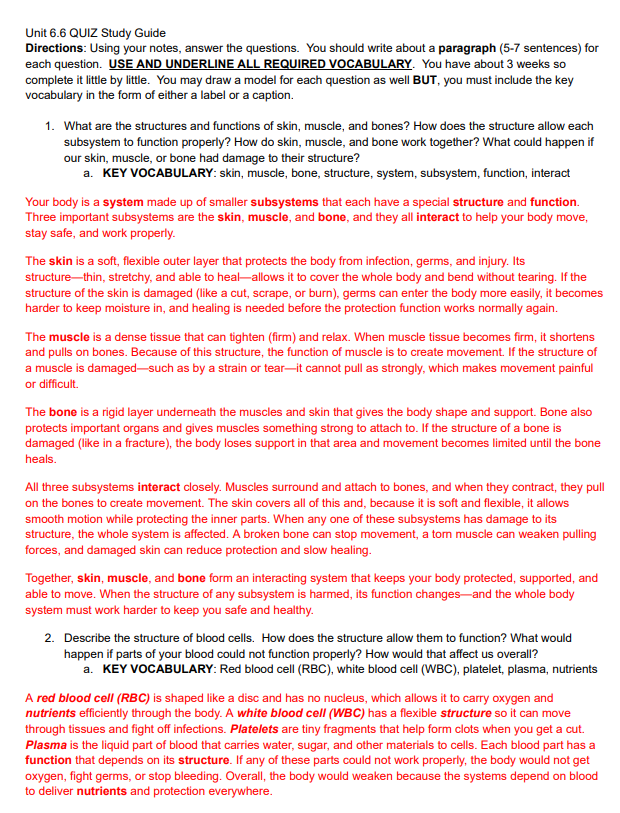
There is a contradiction in my system. I want the progress tracker to become the study guide. Then I make a traditional study guide anyway.Partly that is because students and families expect one. School systems have habits. Changing a learning routine takes time.
But if the tracker works as intended, preparation has happened throughout the unit: repeated retrieval, simplified models, key details, unresolved questions. A conventional study guide appears at the end and says, “Here are the things you should have learned. Go relearn them.” My long-term goal is to make that redundant. I am not there yet.
WHY KEEP THE CONTRADICTION IN THE BOOK? Because real teaching systems are transitional. Some tools remain because students know how to use them. Some routines are being faded. A practical guide should not pretend every component has reached its final form. |
|---|
 |
|
|---|
Which one seems more effective? Which one would you get more out of?
21. Vocabulary Is a Tool, Not the Unit
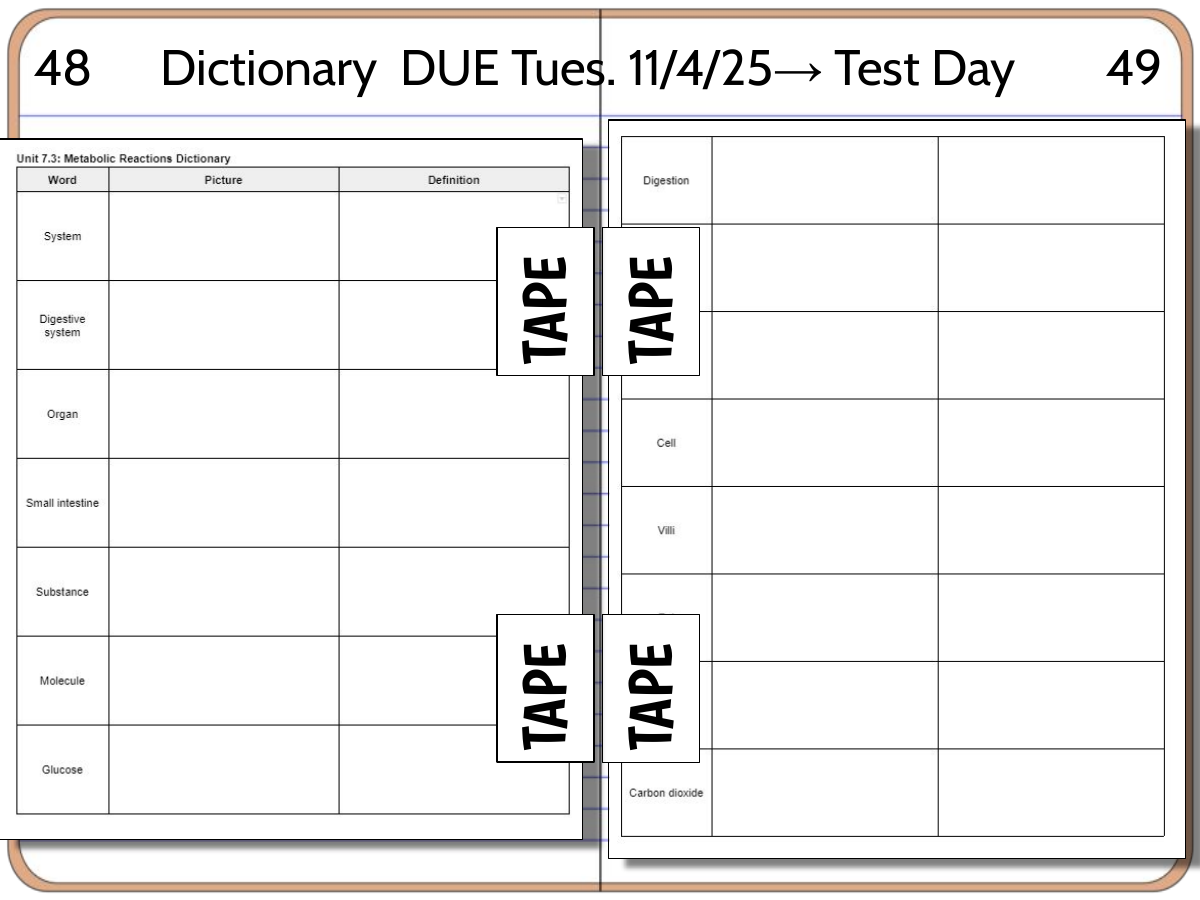
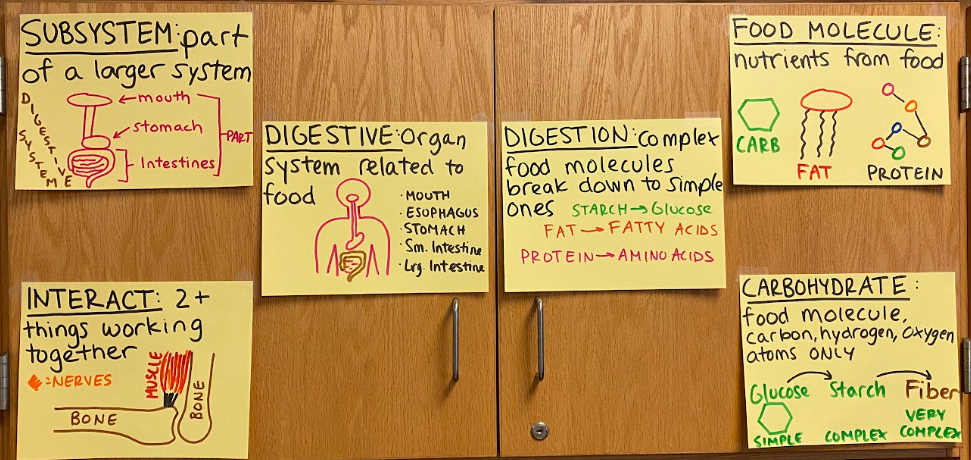
The long-term dictionary: term, definition, and simple visual. Useful for some classes; unnecessary for others.
Science has a vocabulary problem. There are a lot of words. The dictionary became one way to provide repeated exposure. Students use the word wall and digital dictionary to add definitions and simple models, often during early-finisher time or as homework.
I am not completely sold on my own dictionary. That uncertainty belongs here. Advanced classes may not need it. Some supported classes do. Multilingual learners may benefit from the stable pairing of word, image, and meaning. Used badly, it becomes glorified copying.
The word exists to make thinking more precise. The thinking does not exist to justify memorizing the word.
PART VII • DIFFERENT LEARNERS, SAME SCIENCEPART VIIDifferent Learners, Same Science
22. Same Lesson. Different Scaffold. Same Destination.
This animal-jigsaw lesson is one of the clearest examples of how I differentiate the notebook without necessarily changing the scientific destination.
OpenSciEd Lesson 14 asks students to investigate another organism, compare it with humans, and argue whether animals share similar metabolic processes while using different structures to perform those functions. I keep that core reasoning and change how much organizational work students must generate themselves.
| GROUP | WHAT THEY RECEIVE | PRIMARY COGNITIVE WORK |
|---|---|---|
| Advanced | Animal text | Select evidence, organize notes, build a model, compare with humans |
| Gen Ed | Text + blank comparison organizer | Select and classify evidence, compare, explain |
| SpEd / greater support | Text + prefilled evidence statements | Evaluate each statement as same/similar/different and reason from it |
This is not three levels of “smart.” The scaffold should respond to the students, the content, the purpose of the lesson, and available time.
23. Advanced: Organization Is Part of the Thinking
When advanced students receive only the source text, the notebook has to do more than simply hold information. Students must decide what matters, how ideas relate, and how those relationships can be represented visually. In the Golden Orb Weaver example, the spider itself becomes the organizational structure. Students place information about digestion, respiration, circulation, and matter movement where it makes sense within or around the organism, then connect those processes to one another and compare them with human systems. The finished page becomes a hybrid of notes, diagram, causal model, and comparison table—but students have to determine much of that structure for themselves.
That kind of organization is productive intellectual work when students are ready for it. Deciding where information belongs requires students to categorize evidence, recognize relationships, distinguish important details from interesting ones, and translate written information into a different representation. Those are valuable thinking demands that would disappear if I automatically handed students a beautifully designed organizer. The question is not whether I can make the task easier to organize—I almost always can. The better question is whether providing that structure removes a barrier or removes an opportunity to think. For students who are ready to manage the additional complexity, sometimes the blank notebook page is the scaffold I should deliberately not provide.
Adapted from OpenSciEd Unit 7.3, Lesson 14: A Golden Orb Weaver model/notes chart developed from the lesson materials. Rather than using a pre-structured graphic organizer, the organism itself becomes the organizational framework for representing respiration, circulation, digestion, matter movement, and comparisons with human body systems.
24. An Alternative: Give Them Somewhere to Put the Thinking
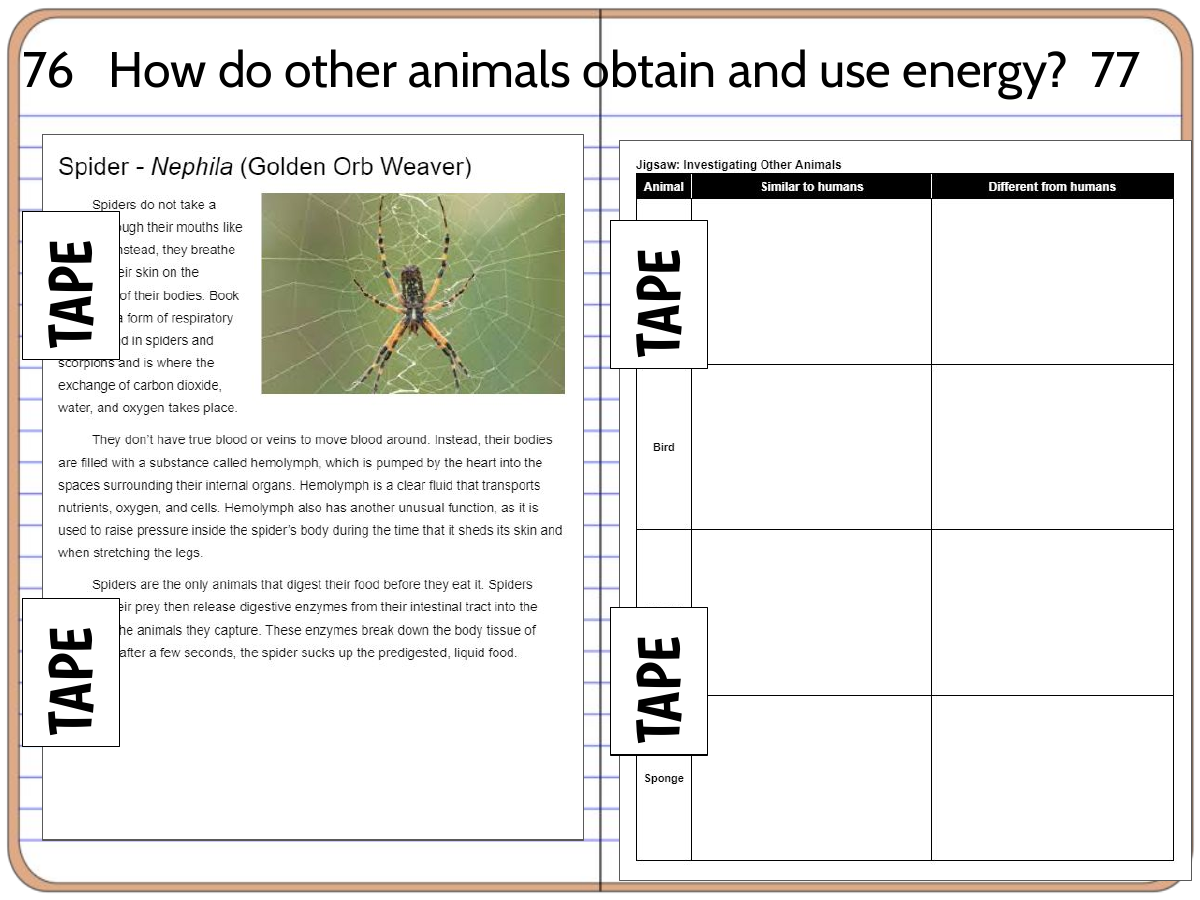
Gen Ed notebook setup: the same spider source text is paired with a blank “Similar to humans / Different from humans” organizer.
The general education version removes one demand: students do not have to invent the comparison structure while learning unfamiliar biology. They still have to read, identify evidence, classify it, and explain similarities and differences.
They are not being given the answer. They are being given somewhere to put the answer.
The general education version removes one significant demand without removing the thinking that matters most. Students no longer have to simultaneously read unfamiliar biology, identify important details, invent an organizational structure, and determine where each piece of evidence belongs. Instead, the notebook provides a simple framework—Similar to Humans / Different from Humans—that makes the purpose of the reading visible from the beginning. Students still have to do the scientific work: read closely, identify relevant evidence, classify similarities and differences, and use those comparisons to understand how different organisms accomplish similar life functions. The organizer simply reduces the executive-function and organizational load surrounding that work. Providing structure does not necessarily mean providing answers or lowering expectations; sometimes it means removing a secondary challenge so students have more cognitive bandwidth for the challenge I actually care about. In this case, I am less interested in whether every student can invent an effective note-taking system while learning unfamiliar spider anatomy than whether they can recognize and explain patterns in the evidence. They are not being given the answer. They are being given somewhere to put the answer.
25. Modified: Shift the Work to Evidence Evaluation
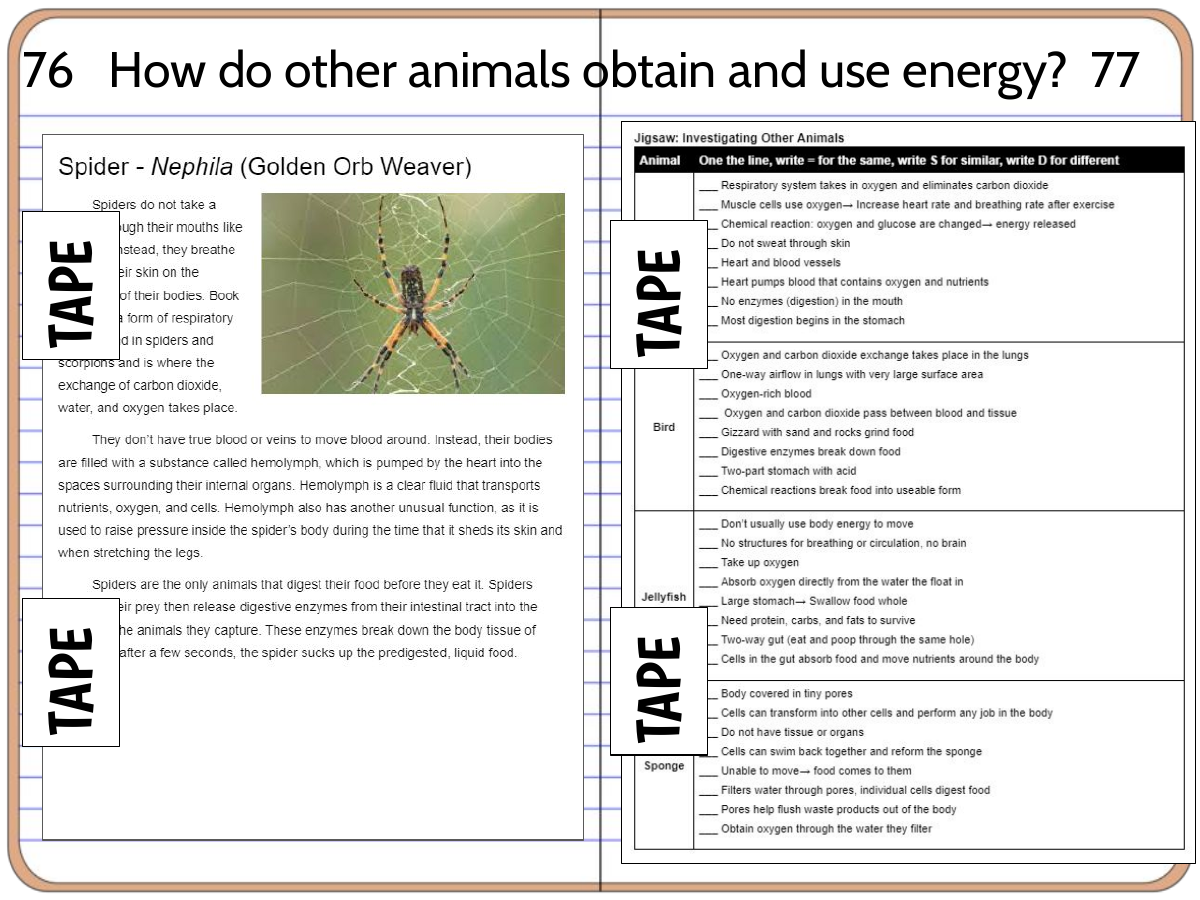
Higher-support version: relevant statements are prefilled so the primary task becomes evaluating evidence as same, similar, or different from humans.
Here the scaffold moves again. Students do less of the extracting, sorting, and organizing because those demands may compete too heavily with the science itself. I can provide selected evidence, a partially completed organizer, or a more explicit comparison framework. That reduces the reading, writing, and executive-function load while still requiring students to interpret evidence, identify patterns, and decide what the information means.
The scientific destination remains the same: students are still working toward the idea that different animal structures can perform similar functions and that animals share core metabolic relationships involving matter and energy. The scaffold changes the route, not the endpoint. The goal is to shift effort away from navigating the task and toward reasoning about the science.
THE BIGGER POINT Differentiation is not always three separate curricula. I would argue that this would put an unsustainable burden on a teacher. Sometimes it is the same question, the same page numbers, the same phenomenon, and a deliberate change in what the learner must generate independently. |
|---|
PART VIII • ASSESSMENT, REPAIR, AND REALITYPART VIIIAssessment, Repair, and Reality
26. The Disaster Notebook
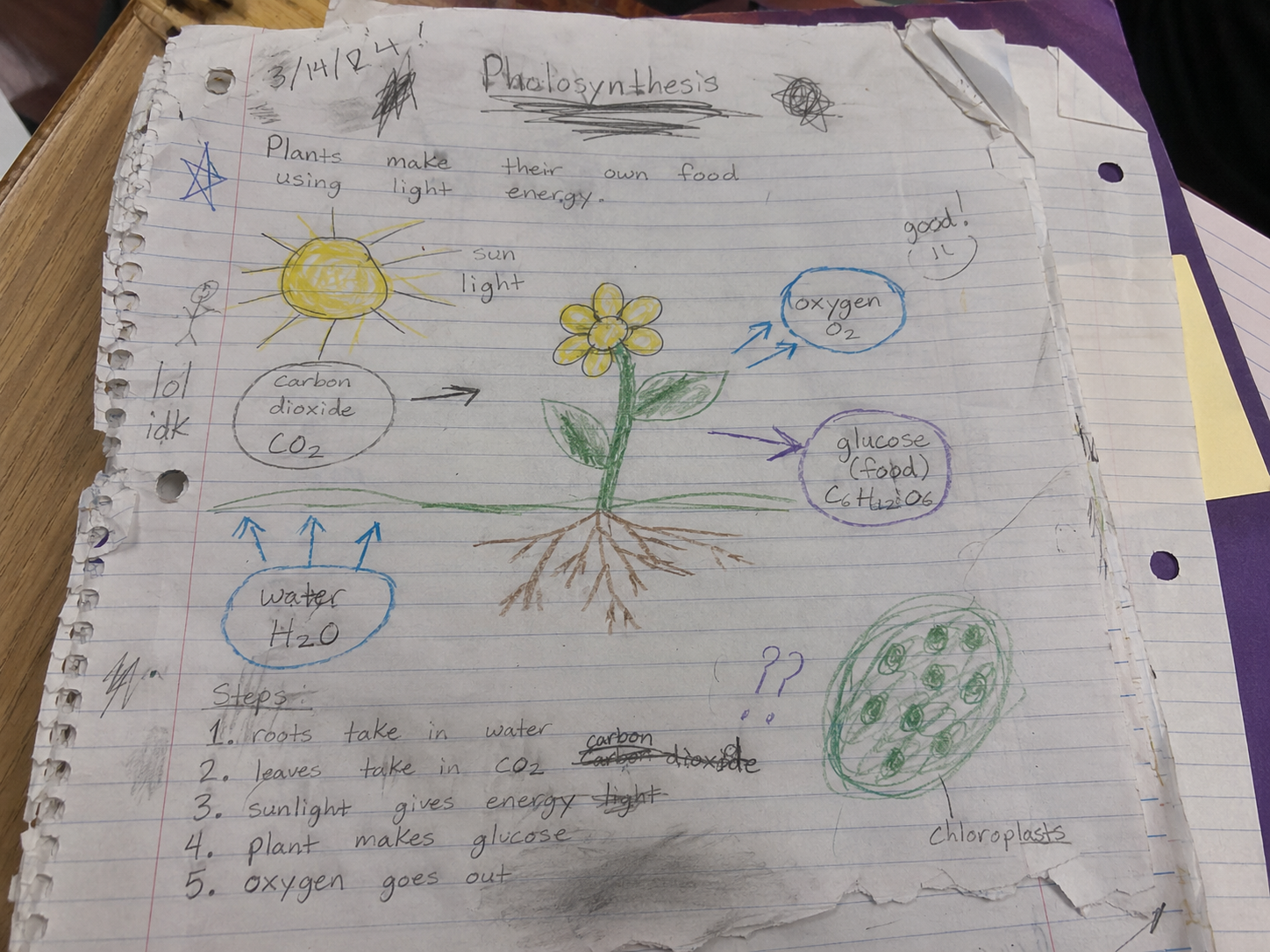
Some notebook examples online look like museums. Perfect handwriting. Color-coded foldables. Every line aligned. I do not teach exclusively those children. Some student notebooks look like they were assembled on a fishing boat during a hurricane. That is part of teaching middle school. I try not to let the problem get completely out of hand. Explicit slides help. Notebook checks help. Walking around helps. Knowing which students struggle with visual processing, motor demands, or task initiation helps. The goal is not perfection; it is usability. If a student can find the page, understand what they were trying to do, and return to the learning later, the notebook is probably doing its job.
Sometimes success is not turning a disastrous notebook into a beautiful notebook. It is turning a disastrous notebook into a slightly less disastrous notebook.
|
 |
|---|---|
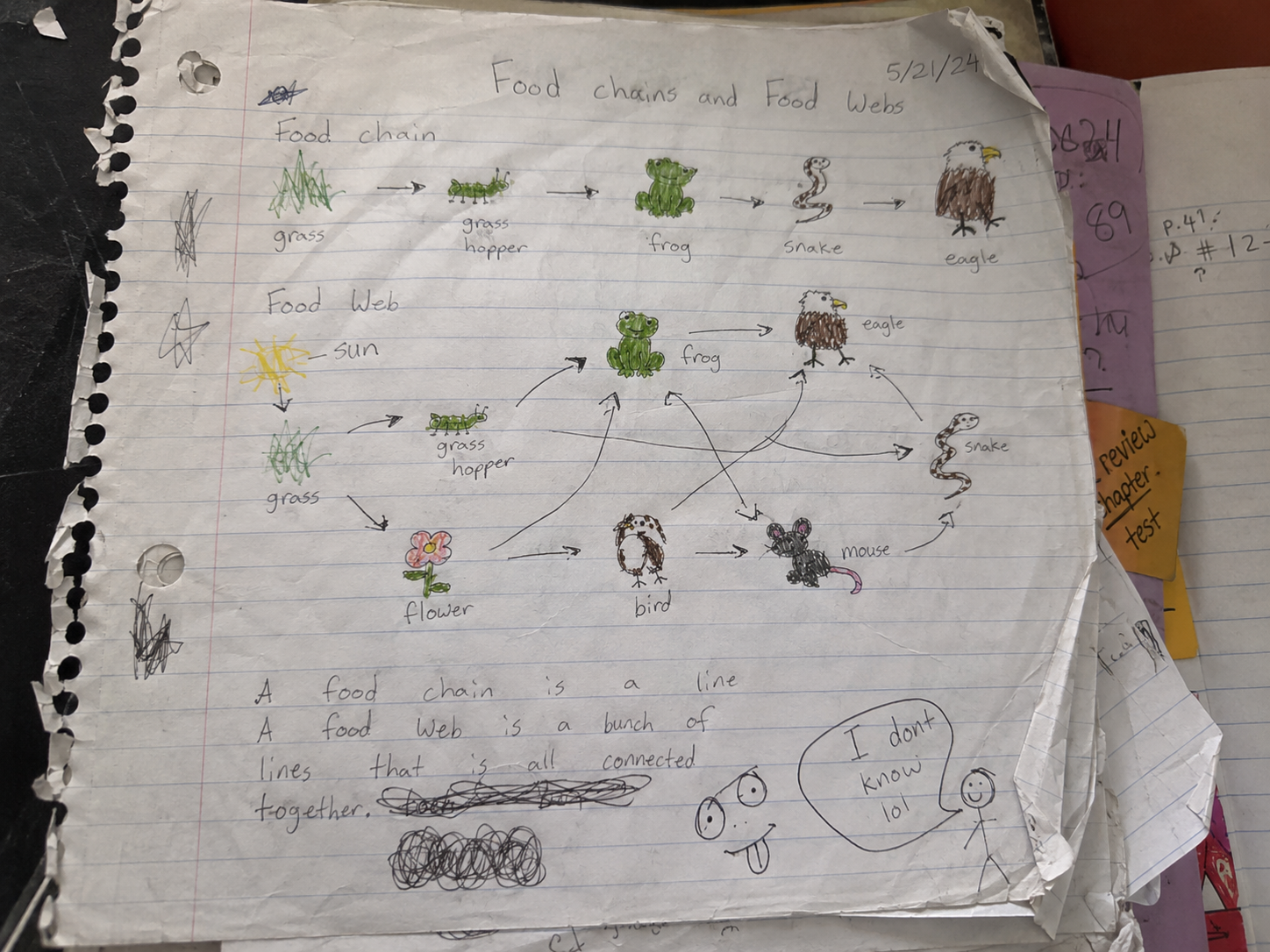 |
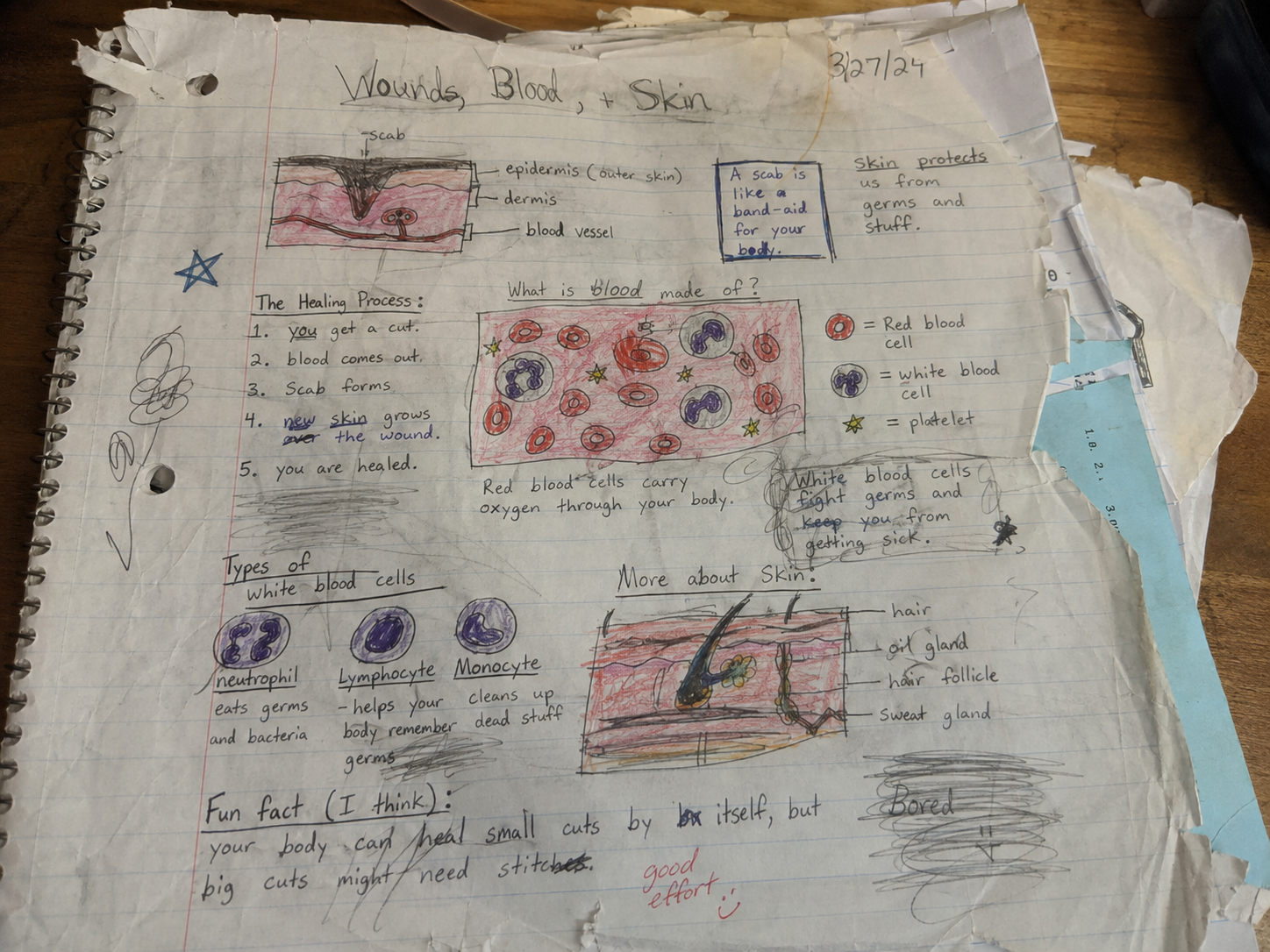 |
None of these are the worst notebooks I’ve ever seen.
27. Notebook Checks Are More Than Grades
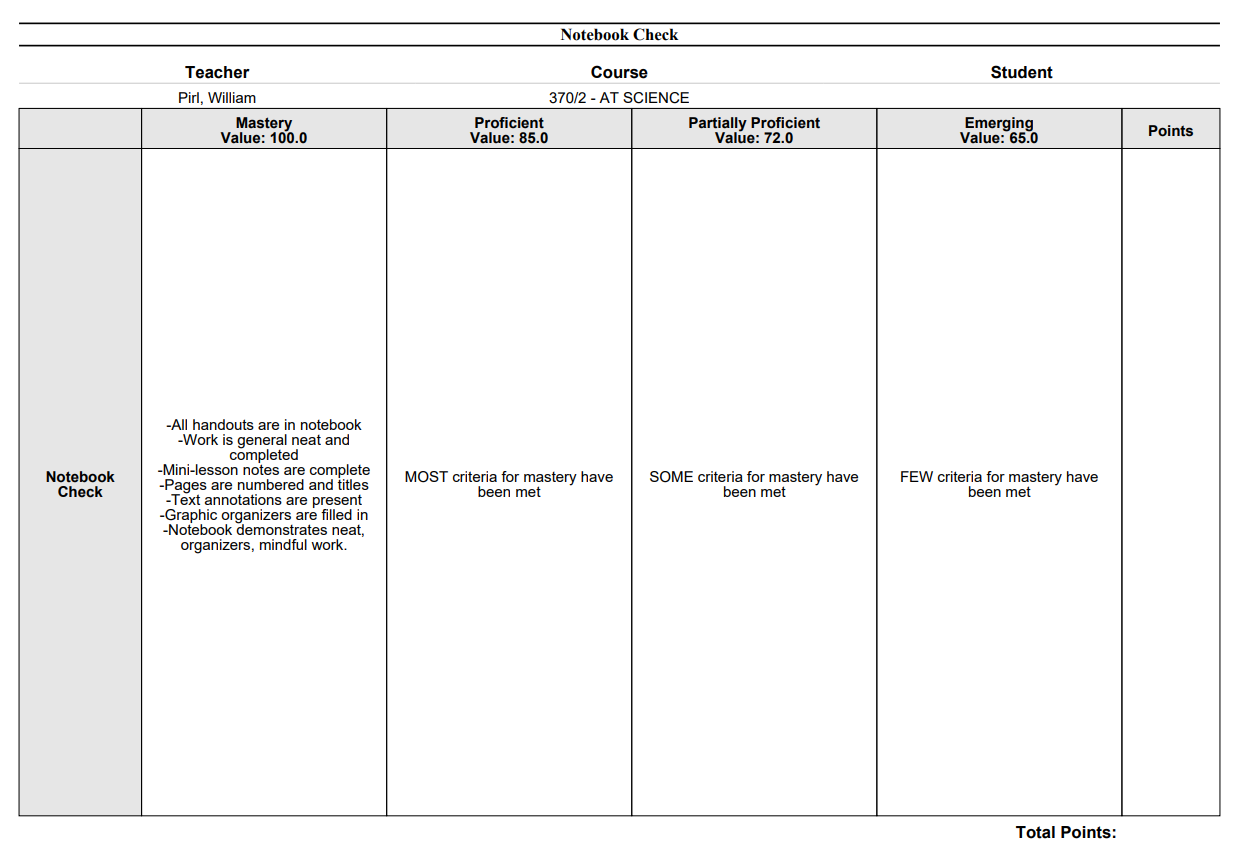
A holistic notebook-check rubric emphasizing completeness, notes, page numbers/titles, annotations, graphic organizers, and usable organization.
I have used holistic checks when I need to assess the notebook quickly: is the system complete, organized, and usable? I have also used much more granular inventory checks that identify the exact work that should appear on each spread. Both have a place. A quick check tells me whether the notebook is functioning. A detailed inventory tells me exactly where the breakdown occurred.
| Quick Check | Inventory Check |
|---|---|
| Is the notebook usable? | What specifically is missing? |
| Is work reasonably complete? | Which pages need repair? |
| Can the student find things? | Which assignments were skipped? |
| Is there evidence of ongoing effort? | Where did the pattern begin? |
The most useful notebook check, though, often becomes a short conference rather than a grading event. Missing page? Pull another copy. Bad fold covering the work underneath? Fix it. One unfinished model? Finish it. Two weeks of incomplete pages? Now we have something more important than a point deduction: evidence of a pattern worth addressing. The notebook gives me something concrete to talk about.
Instead of telling a student, “You need to be more organized,” I can point to the actual problem: “You're missing four of the last six summaries,” or “You have the handouts, but none of your models are finished.” That makes intervention more specific. It also makes conversations with families, support staff, and co-teachers more useful because we are no longer discussing a vague impression that a student is “falling behind.” We can see where the system stopped working and decide what support might get it moving again.
The grade matters less to me than what the check reveals. A notebook check is partly assessment, partly maintenance, and partly early-warning system. The goal is not to punish the messy notebook. It is to catch small problems while they are still repairable.
28. The 200-Point Inventory
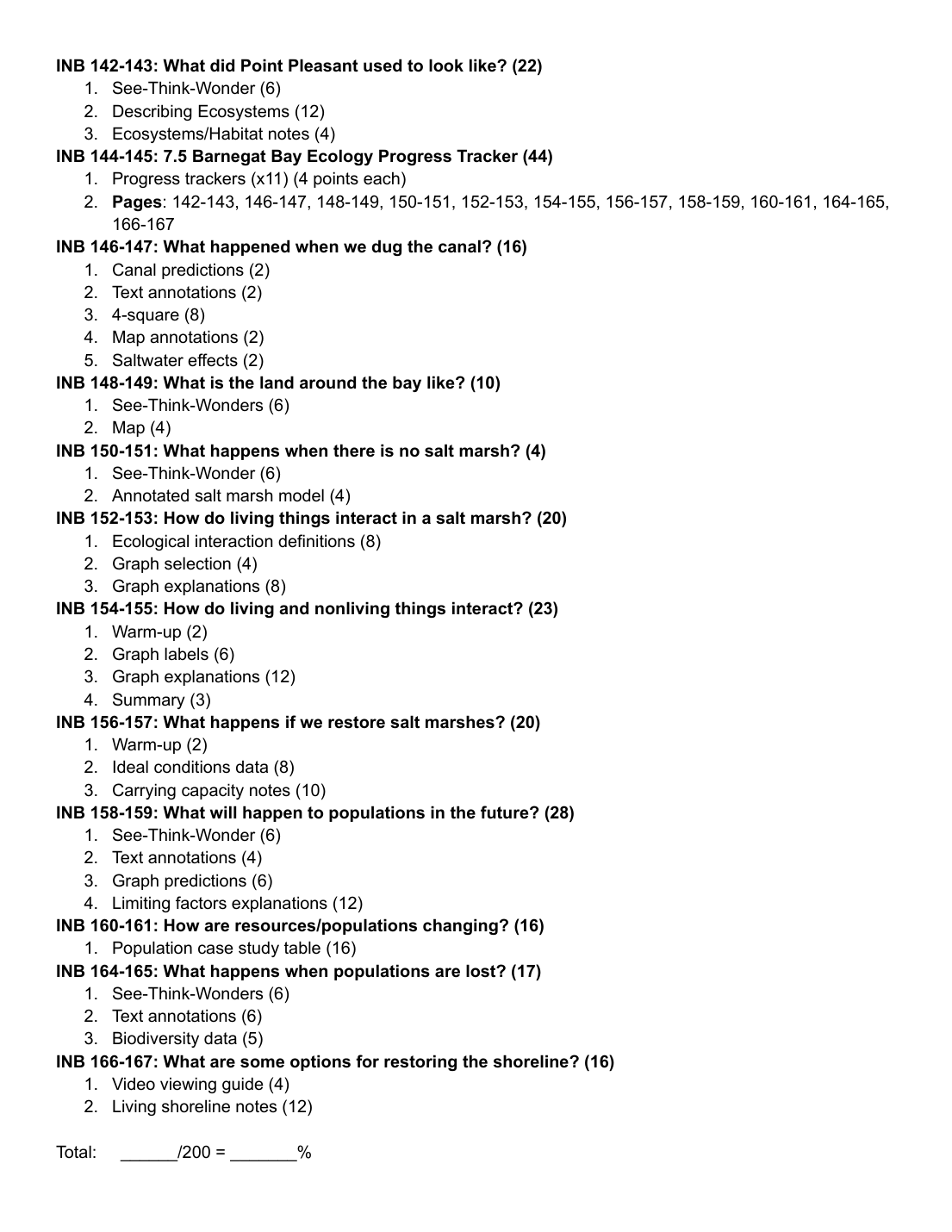
A final notebook check for the Barnegat Bay ecology unit. The large total is distributed across many small pieces of work, including eleven progress-tracker entries.
This looks intimidating because the total is 200 points. But it is not a 200-point handwriting contest. It is an inventory of the learning opportunities that should exist in the notebook: predictions, annotations, map work, graph explanations, summaries, data, and repeated progress tracking.
Different work receives different weights because the work is not interchangeable. A two-point warm-up is not the same thing as a twelve-point graph explanation.
Where is the evidence that you did the intellectual work of the unit?
29. Grade the Thing You Actually Wanted
Not every notebook page deserves the same kind of grade.
| IF THE GOAL WAS... | THEN I CARE MOST ABOUT... |
|---|---|
| Brainstorming before instruction | Participation, not scientific accuracy |
| Collecting evidence | Completeness and quality of evidence |
| Scientific explanation | Accuracy, reasoning, use of evidence |
| Modeling practice | Whether the model represents the relationship |
| Dictionary / progress tracker | Completion, summarization, useful rehearsal |
| Inquiry activity | What students figured out - sometimes assessed with a separate Google Form |
Grading an initial model for accuracy would undermine the point of an initial model. Sometimes I grade the learning with a short digital check rather than grading the notebook artifact itself.
30. Rescue the Learning, Not the Artifact
A student comes to you in November with a notebook catastrophe. Do not automatically reconstruct September page by page.
NOTEBOOK TRIAGE Cosmetic problem: crooked pages, messy folds. Fix when convenient. Organizational problem: numbering drift, several missing pages. Choose a reset point and synchronize. Learning problem: missing pages contain prerequisite knowledge needed now. Recover those pages specifically. System failure: lost notebook, long absence, almost no work. Start a new notebook if necessary and build a recovery plan. |
|---|
The goal is to recover the learning and restore a usable system. Reconstructing every decorative artifact may be an impressive punishment, but it is not necessarily good teaching.
31. You Get Out What You Put In
I tell students some version of this: put good stuff into the notebook and it can give good stuff back. Put trash into it and it will give you trash back.
The notebook is not magic. Taping worksheets into a composition book does not cause learning. Writing words down does not guarantee memory. A beautiful model does not guarantee understanding.
But the notebook can become evidence. If a student is struggling on assessments and a month of notebook work is missing, that matters. Completion grades give me a window into how the student is participating and something concrete to discuss with families.
PART IX • MAKE THEM GO BACKPART IXMake Them Go Back
32. Make Them Go Back
One of the easiest ways to ruin an interactive notebook is to treat every page as disposable.
Finish page 122. Turn the page.
Finish page 124. Turn the page.
Finish page 126. Turn the page.
Eventually, students have 175 pages of learning they interacted with exactly once.
If students never have a reason to revisit old pages, we have built an archive rather than a learning tool.
The notebook becomes much more valuable when students are expected to move backward as well as forward. A new question should sometimes send them hunting through an old model. A quiz review should require them to find evidence from three different lessons. A progress tracker should force them to reconsider what actually mattered several days later.
Give Old Pages Another Job
| Routine | Reason to go back |
|---|---|
| Progress tracker | Retrieve and summarize previous learning |
| New model | Compare with or revise an earlier model |
| Study routine | Find evidence, explanations, and vocabulary |
| Class discussion | Support a claim with prior work |
| Unit assessment | Reconstruct the storyline of the unit |
| Portfolio/showcase | Decide which learning mattered most |
I especially like assignments that require students to connect pages that were originally created days or weeks apart. A diagram from one lesson, a lab result from another, and a progress-tracker summary from a third may suddenly belong together. That is when the notebook stops looking like a sequence of isolated assignments and starts revealing the larger scientific story.
And sometimes the prompt can be ridiculously simple:
“Go back to page 87.”
“Find something from the last unit that helps.”
“Compare today's model to your first one.”
“What did you believe then that you would change
now?”
The physical act of flipping backward matters. It reinforces the idea that earlier learning has not expired just because we turned the page.
A useful notebook is not merely a place where students put completed work. It is a place they return to when they need to think again.
33. The Barnegat Bay Notebook Showcase
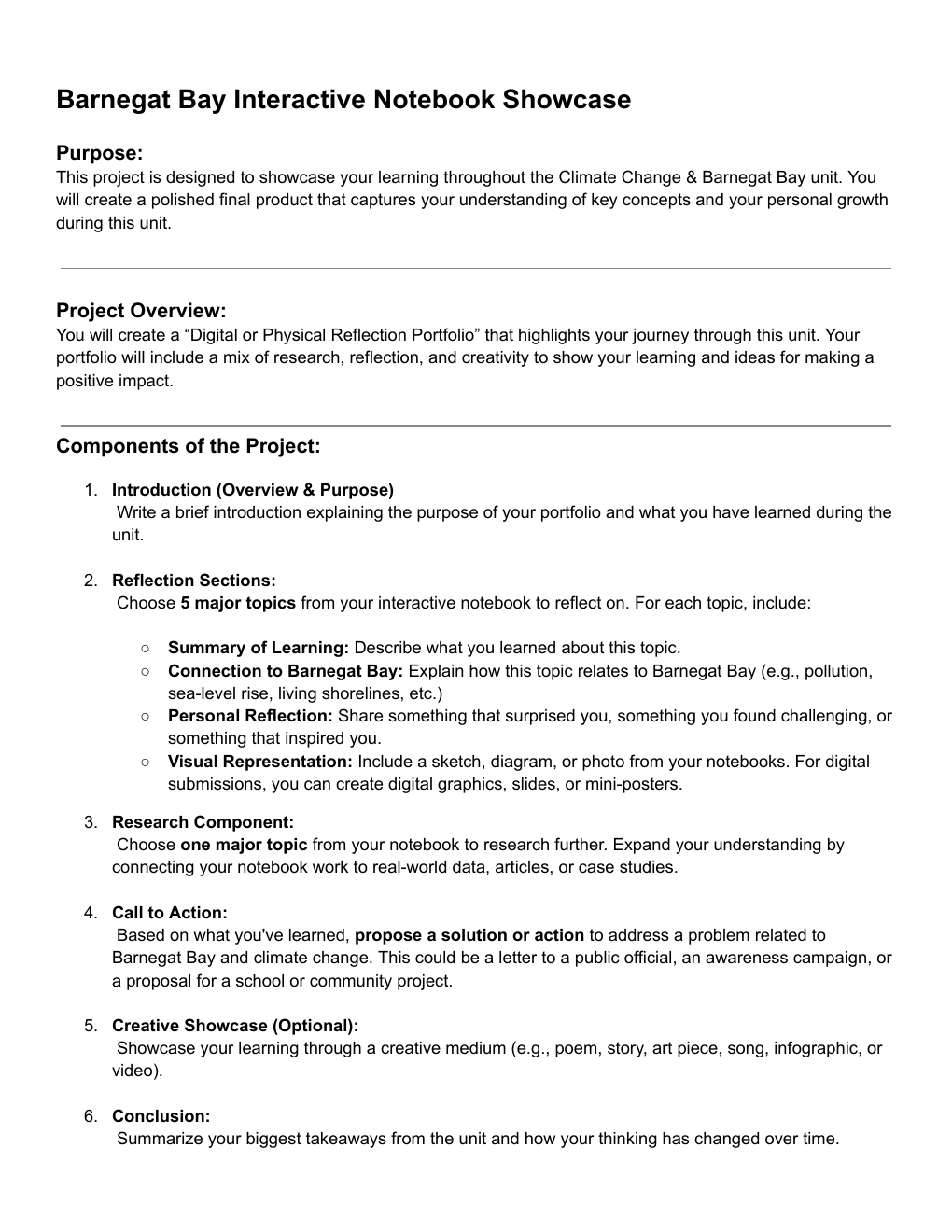
The Barnegat Bay Interactive Notebook Showcase asks students to mine their notebook rather than abandon it at the end of the unit.
Students choose several major topics from the unit, summarize what they learned, and connect each idea back to Barnegat Bay. They have to decide which ideas are important enough to include rather than simply reproducing everything we covered. They reflect on what surprised them, what challenged them, where their thinking changed, and which activities or pieces of evidence helped them understand the science more clearly. They pull visuals, diagrams, graphs, data, or models from earlier notebook pages and reuse them as evidence of learning rather than starting from scratch. Then they select one topic to investigate further, adding information that extends beyond what we did in class. The final step pushes the task beyond review: students propose a realistic action, solution, or response connected to the local environment and explain how their scientific understanding supports that choice.
The notebook becomes source material for a new performance rather than a stack of completed assignments. Students have to select, compress, connect, extend, and apply what they learned across the entire unit. That combination matters because each step asks them to do something different with the information. Selecting requires judgment. Compressing requires understanding. Connecting forces them to see relationships across lessons. Extending asks them to go beyond the material already provided, and applying requires them to use science in a new context. They are not simply repeating old information or decorating a final project. They are reorganizing weeks of learning into a more coherent explanation of what matters and why. In that moment, going back through the notebook becomes part of the thinking itself, and the notebook finally functions as something students can use rather than something they merely filled.
34. The Notebook Reveals the Storyline
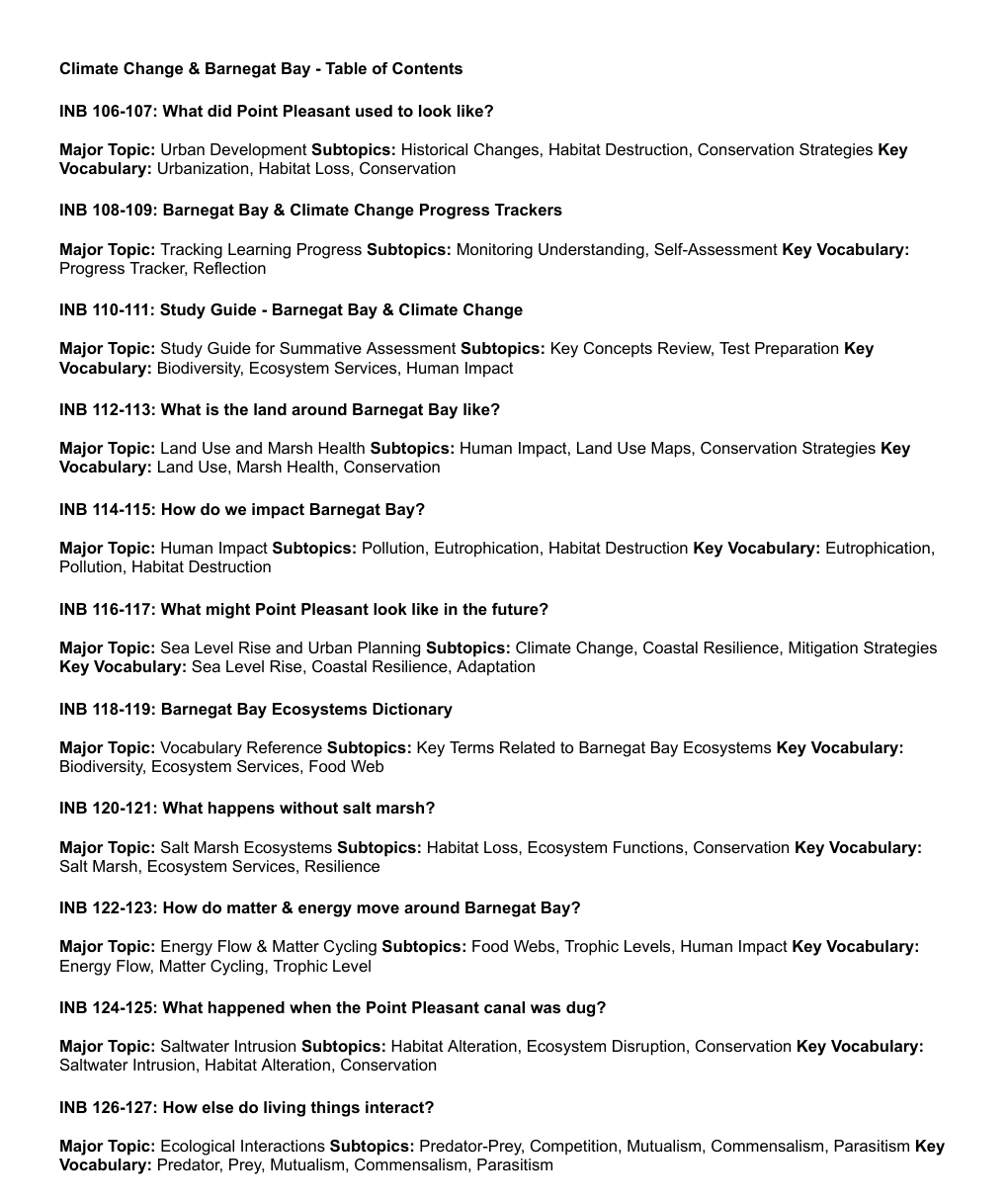
The Showcase table of contents makes the intellectual storyline visible: land use, human impacts, sea-level rise, salt marshes, matter and energy, populations, climate justice, eutrophication, living shorelines, and conservation.
A sequence of questions turns a notebook into something more than chronological storage because each new idea has the potential to reactivate something students learned earlier. An early page about land use may suddenly become relevant when students begin studying eutrophication. A lesson on limiting factors can help explain later changes in populations. Work on sea-level rise, development, or pollution can take on new meaning once students begin thinking about climate justice and asking who experiences environmental consequences most directly. The value is not just that the notebook preserves each piece of learning, but that it gives students a place to see relationships emerge across time. Concepts that first appeared separate begin to overlap, reinforce one another, and occasionally complicate earlier thinking. Students can trace how one question led to another, how evidence from one lesson helps explain a different phenomenon, and how their understanding of Barnegat Bay becomes more sophisticated as the unit progresses. The notebook becomes less like a stack of completed pages and more like a network of ideas, evidence, questions, and explanations that students can continue to revisit and reorganize as their understanding grows.
35. Differentiation Can Preserve the Architecture
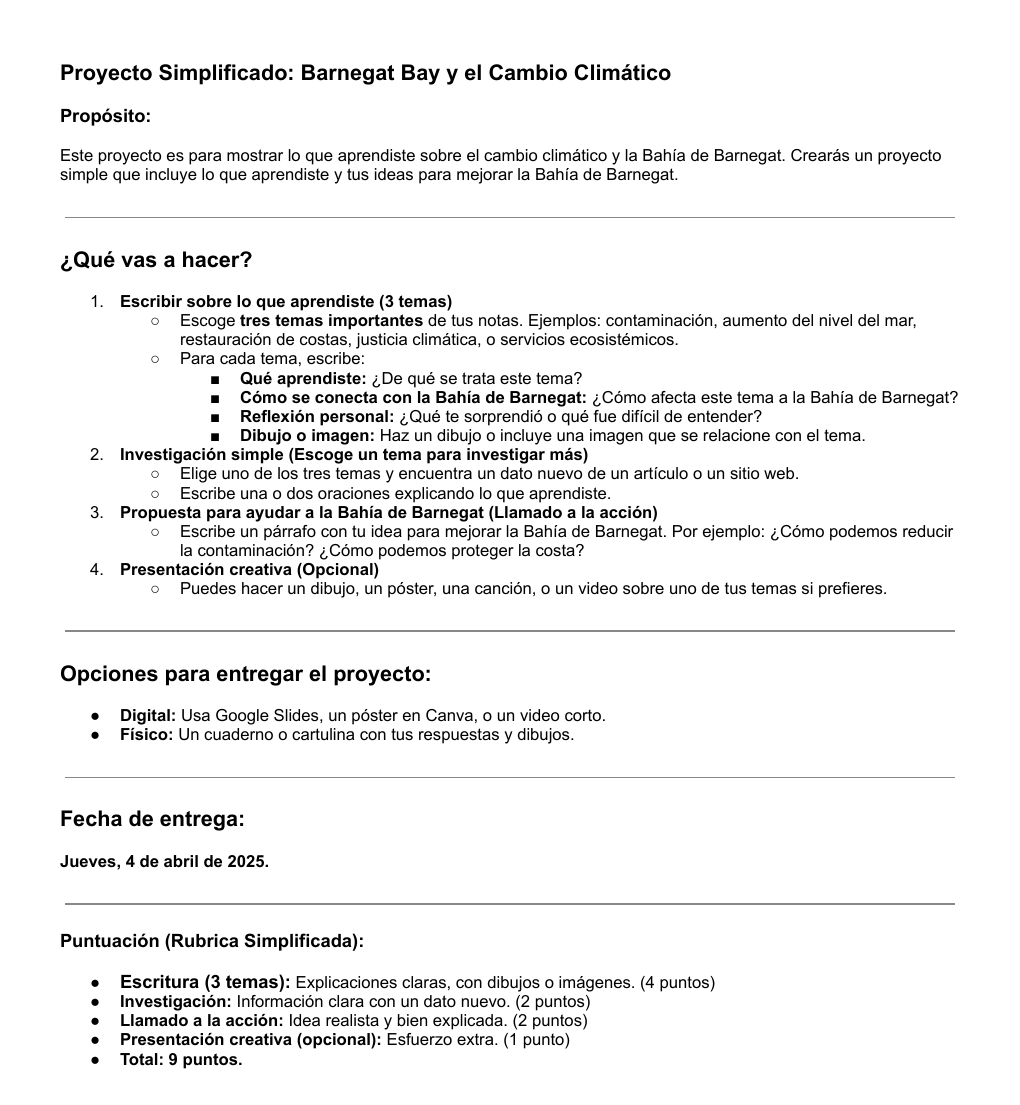
A simplified Spanish version of the Showcase reduces the number of required topics, research load, and language demand while preserving reflection, connection, research, and action.
A translated Spanish version is a good example of reducing task complexity and language demand without throwing away the intellectual architecture of the assignment. The student may receive clearer directions, simplified wording, additional sentence support, or access to the task in a more familiar language, but the scientific work has not disappeared. They still have to explain what they learned, connect ideas to Barnegat Bay, research beyond the information already provided, and propose a reasonable action based on evidence. What changes is the amount of unnecessary friction between the student and that thinking. Translation is not the intellectual accommodation; it is an access tool that helps the student reach the intellectual work. That distinction matters because a scaffold should not automatically mean a smaller destination. Sometimes the most appropriate modification is simply removing a barrier that was never part of the learning target in the first place. That is the same philosophy running throughout the notebook system: change the support, change the pathway, change the amount of structure—but preserve the thinking whenever possible.
“A scaffold should change the path to the thinking—not remove the thinking itself.”
36. Stop Doing Things You Cannot Sustain
I have tried planners, weekly reflections, journaling, coloring, executive-function systems, traditional tables of contents, elaborate notebook checks, and probably a dozen other routines that seemed like good ideas at the time. Some were genuinely useful. Some worked beautifully for a few weeks. Some students ignored them so thoroughly that I eventually started resenting the five minutes of class time I was protecting for the routine.
That frustration is information.
A brilliant routine you cannot sustain is not a brilliant routine.
There is a temptation, especially when designing a new notebook system, to keep adding. Every problem seems to suggest another structure. Students forget assignments? Add a planner. They cannot find old work? Add a table of contents. Do they not reflect enough? Add a weekly reflection. Their notebooks look chaotic? Add a color-coding system. Pretty soon the system designed to support learning has become another course students—and the teacher—have to manage.
The Hidden Cost of a “Good Idea”
Every notebook routine costs something.
| A routine costs… | Ask yourself… |
|---|---|
| Class time | Is this worth the minutes it takes every week? |
| Teacher attention | Will I actually check or reinforce it? |
| Student attention | Is it helping them think or just giving them another instruction? |
| Materials | Is the cutting, taping, copying, or coloring worth it? |
| Consistency | Can I still imagine doing this in February? |
That last question has become increasingly important to me.
Can I still imagine doing this in February?
September-me has tremendous ambition. September-me has freshly organized materials, sharpened pencils, new systems, and visions of students carefully maintaining routines for the next ten months. February-me is trying to teach eight classes, answer emails, grade assessments, adjust lessons, attend meetings, help individual students, plan a massive field trip, and locate the paper cutter that has apparently disappeared again.
A system has to survive both versions of me.
The notebook exists to serve the learning. The learning does not exist to serve the notebook.
37. Your Notebook Does Not Need to Be Pinterest-Worthy
Some of my favorite notebook pages are ugly. Not unusable. Ugly.
A dense notebook page filled with real thinking. |
A model that grew through discussion and annotation. |
|---|
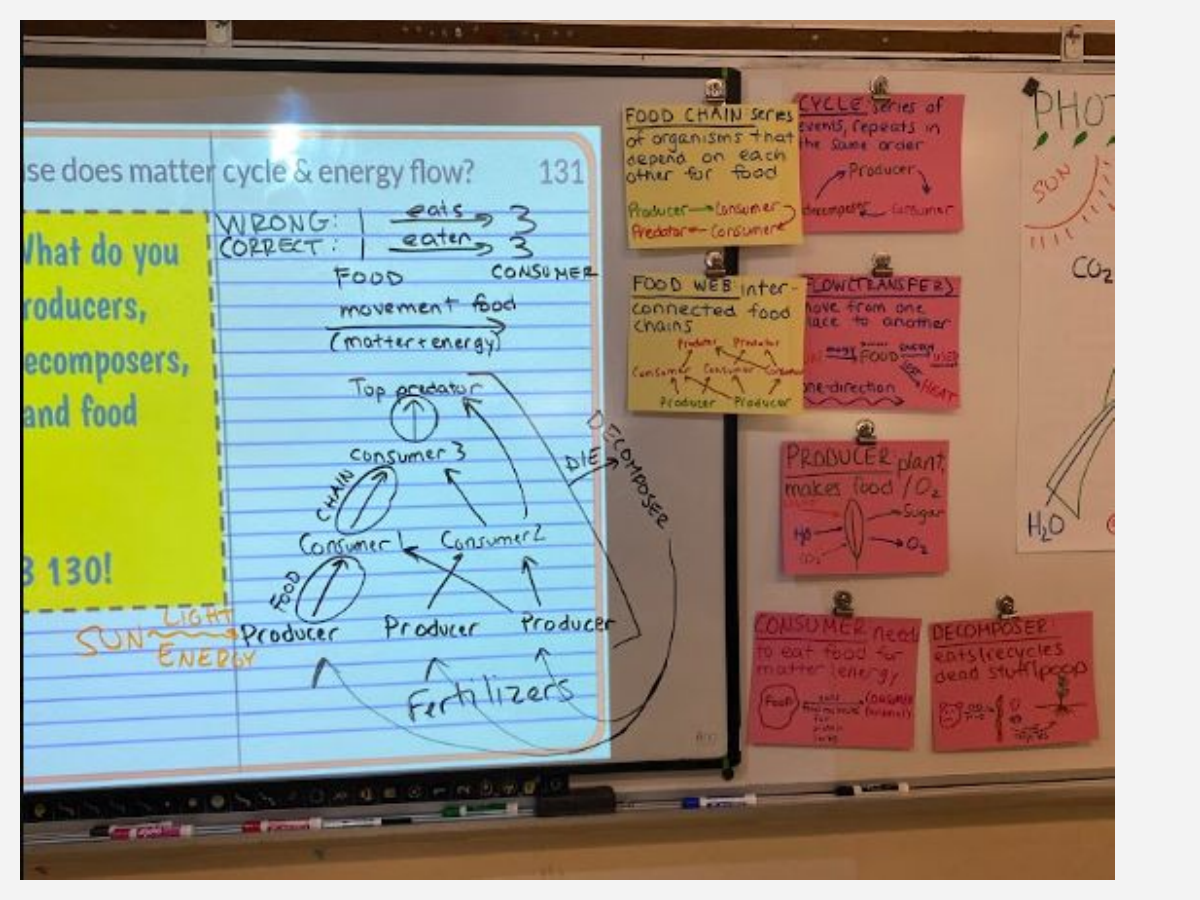
Arrows everywhere. Questions in margins. Crossed-out ideas. Color layered over color. A model that grew beyond the space originally allocated to it. Those pages are sometimes better evidence of learning than immaculate ones.
The tests I care about
• Can you find what we learned?
• Can you explain the model?
• Can you retrieve evidence from an earlier lesson?
• Can you see where your thinking changed?
• Can you recover after an absence?
• Can you use this to study?
• Can you connect something on page 32 to something happening on page 88?
A working notebook should sometimes look like work happened in it.
Conclusion: Build a Notebook That Gives Something Back
A composition notebook is an inexpensive object. Cardboard. Paper. Marbled cover. Nothing magical.
The value is in the system built around it. None of the things I value about interactive notebooks happen simply because I hand a seventh grader a composition book in September. We build routines around it. We learn how to set up a page, preserve evidence, add our own thinking, construct and revise models, recover from an absence, and return to earlier learning when a new question requires it. Over time, what begins as a collection of paper and tape can become a record not only of what students learned, but how their thinking developed.
| The notebook provides... | So students can... |
|---|---|
| A stable structure | Find and organize their learning |
| Original evidence and sources | Return to what they actually observed or read |
| Models and explanations | Make complex thinking visible |
| Questions and revisions | See that understanding can change |
| Progress trackers and summaries | Decide what matters and compress information |
| Earlier pages | Connect new learning to old learning |
| Teacher exemplars and digital backups | Recover after absences or confusion |
| A yearlong record | Retrieve, study, reflect, and recognize growth |
That flexibility may be the most important lesson I have learned from using interactive notebooks. The notebook is not the lesson, and the notebook is not the product. It is infrastructure. Sometimes that infrastructure supports an open investigation; sometimes a teacher-led mini-lesson. Sometimes students receive a blank page and determine how to organize their thinking. Sometimes I provide the organizer because creating one would add difficulty without adding useful learning. Sometimes students draw the model themselves; sometimes they attempt it alongside me and receive a clean copy afterward. The page can change because the purpose does not: create a reliable place where evidence, information, questions, models, explanations, and revisions can accumulate.
Students will forget most of what I taught them. If they can remember some of the executive functioning, metacognitive skills, or study habits I have done a good job. That will serve them in any classroom in the future.
What I Hope Students Take With Them
I am not under the illusion that every student will treasure their battered composition notebook when June arrives. Some will probably throw it away before they reach the parking lot. The notebook itself is disposable. The habits built through using it are not.
Ideally, students leave a little better able to:
organize information instead of simply collecting it;
distinguish an important idea from an interesting detail;
turn evidence into an explanation;
represent complicated ideas with simpler models;
recognize what they understand and what they still need to figure out;
retrieve information rather than merely reread it;
connect new learning with something they learned weeks or months earlier;
revise an idea when better evidence becomes available;
recover something they missed without waiting for an adult to reconstruct it for them; and
figure out what to do next when they do not immediately know the answer.
That last one may matter most.
At the beginning of the year, I may show students exactly where four pieces of tape go. I project a picture of pages 12 and 13, point to the corners, demonstrate the fold, keep my own notebook beside them, photograph the finished page, and provide explicit directions for recovering anything they miss. By the end, ideally, much of that scaffolding has become unnecessary. They know where to look. They know how to set up the page, check their work, find an earlier model, reconstruct something they missed, or recognize when they need help.
The success of the system is not that students become increasingly dependent on a perfectly organized notebook. It is that the notebook helps them become increasingly capable of managing their own learning.
Build the structure. Teach the routine. Fill it with thinking. Then slowly make yourself less necessary.
And for the love of God: two fingers of tape.
That is enough.
APPENDIX A • TOOLS WORTH STEALING
A First-Week Setup Guide
The first week is less about creating a perfect notebook and more about establishing a few routines that will save enormous amounts of time later. I do not try to teach every possible procedure on Day 1. Students do not need a forty-minute lecture on flap taping before they have anything worth flap taping. I introduce the system as they need it, then let the notebook fade into the background so the science can take over.
THE EARLY STANDARD Neat enough to use. Organized enough to find. Clear enough to understand. |
|---|
Student checklist
1 Make it identifiable. Put your name prominently on the cover and personalize it enough to recognize it instantly. |
2 Number only when instructed. Do not number the entire notebook in advance. |
|---|---|
3 Start with the question. New major work begins with what we are trying to figure out. |
4 Learn the attachment routine. Tape where the visual shows and fold materials neatly inside the notebook. |
5 Use color with a purpose. Color should communicate structures, relationships, inputs, outputs, or other information. |
6 Keep the notebook all year. This is a long-term record and reference, not a disposable packet. |
7 Know the recovery system. If absent, check Google Classroom, posted examples, and replacement materials first. |
Leave room for change. The course, the class, and the notebook will all evolve. |
Teach the system as students need it
IDENTIFY Name the notebook and make it recognizable.
BUILD Number the current pages, write the question, and attach the first materials.
MODEL Project a photograph or use your own notebook when the procedure is new.
RECOVER Show students where to find missed work before they need the system.
Why I don't pre-number the whole notebook
It is tempting to map every page in August, but the course needs room to change. A lesson may take longer than expected, one class may need an extra page, or I may insert something that did not exist when I planned the unit. I tell students which pages to number when we arrive there. That keeps the class synchronized without forcing the curriculum to obey a notebook map created months earlier.
DO NOT CONFUSE SETUP WITH LEARNING If students spend fifteen minutes decorating headings, drawing borders, or trying to make every page visually perfect, the notebook has started competing with science. Early scaffolds—projected examples, tape locations, page photographs, and quick reminders—are worth using when they make the procedure obvious. Then remove them as the routine becomes automatic. |
|---|
BY THE END OF WEEK ONE I am not looking for expert notebook keepers. I want students to understand the basic operating system. Everything else can grow from there.
APPENDIX B • TOOLS WORTH STEALING
Notebook Page Decision Tool
Not every page should ask students to do the same amount of construction. Sometimes recreating a model is part of the thinking; sometimes it is just copying. A blank page can create productive freedom or an unnecessary barrier. This tool helps decide which is which.
THE CORE RULE Print what would lose value if students had to recreate it. Leave blank what would lose value if you created it for them. |
|---|
A five-question decision path
| 1 | Does recreating the source help learning? If yes, let students create or simplify it. If no, preserve the source by printing, projecting, or providing it. |
|---|
| 2 | Does designing the organizer help thinking? If the organization itself is part of the intellectual work, leave more open space. If not, provide the structure. |
|---|
| 3 | Is time more valuable elsewhere today? A template or finished notes can buy back minutes for discussion, modeling, practice, or transfer. |
|---|
| 4 | Is motor, writing, reading, or processing demand obscuring the science? Scaffold the page. Reduce the barrier without automatically reducing the conceptual target. |
|---|
| 5 | Can students still explain, apply, or transfer after the scaffold? If yes, rigor may still be intact. If no, reconsider what the scaffold removed. |
|---|
The decision is not “easy or hard.”
The better question is: where do I want students spending their effort? If the target is modeling, construction may deserve time. If the target is evaluating evidence, copying a complicated diagram may be wasted effort. If the page is mainly a reference, clarity may matter more than recreating every line.
CREATE When making the representation is part of the learning. |
SCAFFOLD When students need the thinking but not every logistical demand. |
PROVIDE When preserving accuracy, access, or time matters more than reconstruction. |
|---|
APPENDIX C • TOOLS WORTH STEALING
A Simple Notebook Check
A notebook check does not need to become a forty-minute grading event. The fastest version asks one practical question: is this notebook complete enough, organized enough, and usable enough to support the next round of learning? A short check can catch missing pages, incomplete thinking, or organizational breakdowns before they become a month-long problem.
NOTEBOOK CHECK = MAINTENANCE + FEEDBACK The grade matters less than what the check reveals. |
|---|
Quick scan: five things to look for
□ Page sequence and titles: Can the student locate the right spread without a scavenger hunt?
□ Required materials: Are handouts, models, readings, and data pages present?
□ Student thinking: Is there evidence of annotations, explanations, revisions, or responses—not just pasted paper?
□ Progress tracker or summaries: Has the student been pulling learning forward over time?
□ Usability and organization: Could the student actually use this notebook to study, explain, or retrieve prior work?
Turn the check into a two-minute conference
NOTICE “You have the materials, but the last three summaries are blank.” |
REPAIR Replace a missing page, fix a fold, finish one model, or identify what must be completed. |
NAME THE PATTERN If the same problem keeps repeating, make it visible to the student and support team. |
|---|
Feedback worth writing
| One thing you are doing well: _________________________________________________ |
|---|
| One thing to fix next: __________________________________________________ |
A missing page is usually a repair problem. A repeated pattern of missing work is different. Once the notebook makes that pattern visible, the conversation with the student, family, co-teacher, or case manager becomes much more specific than “you need to be more organized.”
APPENDIX D • TOOLS WORTH STEALING
Progress Tracker Guide
A progress tracker gives students a reason to move backward through the notebook instead of treating every page as disposable. It compresses a lesson into a few pieces that can be retrieved later: the main idea, the most useful evidence, a simplified model, and a question that still matters. The point is not to rewrite the lesson. The point is to preserve its intellectual backbone.
THE HABIT TO BUILD Study it, don’t just complete it. |
|---|
Four moves, four different kinds of thinking
MAIN IDEA Answer the day’s question in one clear sentence. If the sentence could describe almost any lesson, it is probably too vague. |
KEY DETAILS Choose only the evidence or information that helps support the main idea. Selection is part of the work. |
|---|---|
MODEL Simplify the day’s representation. Redraw the relationship, system, or process rather than copying every visual detail. |
QUESTIONS Record what remains unclear, what changed, or what the class should investigate next. Good learning creates new questions. |
Turn the tracker into a study routine
| 1 | Cover it. Hide the row and answer the lesson question from memory before looking. |
|---|
| 2 | Check it. Compare your memory with the tracker or teacher version. Correct weak or incomplete summaries. |
|---|
| 3 | Redraw it. Rebuild the model without looking. Then compare what you remembered with what you originally drew. |
|---|
| 4 | Use the questions. Let the questions column tell you what needs another explanation, another example, or more practice. |
|---|
The tracker works best when students know they will actually return to it. A completed row is not the finish line. It is a compact piece of learning designed to be reopened, tested, corrected, and connected to later ideas.
APPENDIX E • TOOLS WORTH STEALING
Model-Making Checklist
Students often assume a better scientific model is a more detailed scientific model. I want them to learn almost the opposite: a useful model is selective. It includes the parts needed to explain the phenomenon and removes details that make the explanation harder to see. This checklist is meant to push models away from decoration and toward communication.
A MODELING RULE You’re not coloring things to make it beautiful; you’re coloring things to make it easier to understand. |
|---|
Before you call the model finished
□ Does every part of the model serve a purpose?
□ Can unnecessary detail be removed without weakening the explanation?
□ Are arrows labeled—or otherwise understandable—so another person knows what is moving or changing?
□ Is color carrying information instead of simply decorating the page?
□ Could another person explain the model from what you drew?
□ Does the model actually answer the question at the top of the page?
□ What new evidence would make you revise this model?
Three ways to improve a weak model
REMOVE Delete details that are accurate but irrelevant to the explanation. |
LABEL Make relationships visible. Name arrows, inputs, outputs, structures, or changes. |
REVISE Treat the model as temporary. New evidence should be allowed to change it. |
|---|
The test: can the model do work?
A scientific model should help a student explain, predict, compare, or revise—not merely prove that they can draw. If the model is attractive but cannot answer the page question, it is not finished. If it is simple, a little ugly, and makes the relationship obvious, it may be doing exactly what it needs to do.
FOR STUDENTS Simple is not the same as simplistic. A strong model removes clutter while preserving the relationship that matters. |
|---|
APPENDIX F • TOOLS WORTH STEALING
How Families Can Use the Notebook
A parent or caregiver does not need to reteach the science, understand every diagram, or turn the kitchen table into a second classroom. The notebook can support a much simpler kind of conversation: show me what you have been learning, explain one idea, and tell me where you are stuck. Five minutes is enough to learn a lot.
KEEP IT SIMPLE The most useful parent question may simply be: “Tell me what you learned on these two pages.” |
|---|
A five-minute notebook check at home
| 1 | Open the most recent two spreads. Do they look reasonably complete? You are not grading handwriting or artistic quality. |
|---|
| 2 | Ask the question. Have the student read or explain the question at the top of one page. What was the class trying to figure out? |
|---|
| 3 | Point to one visual. Ask what an arrow, model, data point, or piece of evidence means. The student should do the explaining. |
|---|
| 4 | Check a missing page. If something is absent, compare the page number or assignment with Google Classroom rather than guessing what belongs there. |
|---|
| 5 | Use the progress tracker. Can the student explain the main idea without rereading the entire lesson? If not, that is useful information for studying. |
|---|
Questions that help without turning into a quiz
“What changed in your thinking?” Invites reflection instead of recall alone. |
“Show me a page you are proud of.” Lets the student choose evidence of success. |
|---|---|
“Which page would help you study?” Builds awareness of the notebook as a tool. |
“Where did you get confused?” Makes uncertainty normal and actionable. |
APPENDIX G • TOOLS WORTH STEALING
Sources, Credits, and Adaptation Notes
This guide is built primarily from classroom materials, routines, photographs, and examples developed through day-to-day teaching. Some parts also adapt or respond to ideas from published curriculum. Keeping those categories visible matters: readers should be able to tell what is original classroom work, what has been adapted, and what should be credited to an outside source.
Teacher-created materials
Most notebook layouts, slides, charts, rubrics, photographs, and supporting resources reproduced in this guide are teacher-created materials from William Pirl’s classroom and archive. Where student work is used in a public-facing edition, identifying information should be removed and school or district privacy requirements should be followed.
OpenSciEd adaptations
The animal-jigsaw case study adapts OpenSciEd Middle School Unit 7.3, Lesson 14. The lesson is discussed here for instructional analysis and adaptation: how to preserve its scientific destination while changing task structure, reading load, or notebook demands. OpenSciEd materials should be credited according to the license and attribution requirements attached to the specific materials being used.
SUGGESTED CAPTION Progress Tracker: Adapted from the progress-tracking routine used in OpenSciEd. The format and classroom implementation shown here have been modified to support summarization, modeling, retrieval practice, and ongoing reflection. |
|---|
A simple crediting habit
• Label teacher-created materials as your own classroom examples when that context matters.
• When a routine began somewhere else, say so—even when your version now looks substantially different.
• Keep source links, unit/lesson information, and license notes with the working files instead of trying to reconstruct them later.
• Distinguish between adapting an instructional idea and reproducing copyrighted text, images, or layouts.
• Anonymize student work before public distribution and remove names, faces, IDs, or other identifying details unless appropriate permission is in place.
Working-edition note
This working manuscript uses teacher-created examples and photographed pages supplied for development. Before publication, complete a final source audit so captions, licenses, image credits, and student-work permissions match the exact materials in the finished edition.
A PRACTICAL RULE Credit the source. Explain what you changed. Make the difference visible. |
|---|
Pirl Experimental • Learn. Experiment. Refine. Impact