The Lesson That Actually Fit the Period
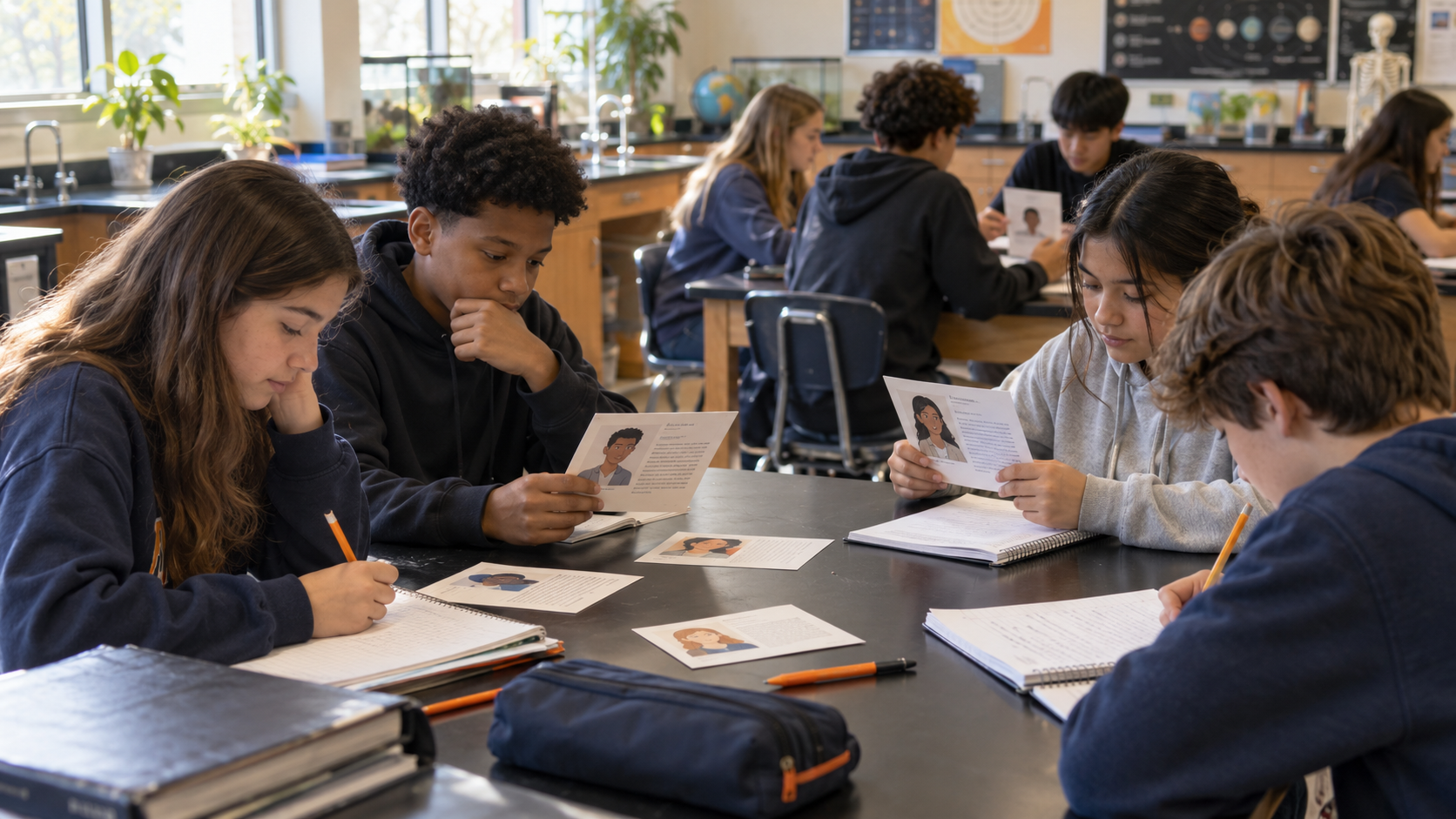
Seventh-grade science students read illustrated student case studies and write reflections in composition notebooks.
There is a particular kind of relief that comes when a lesson works the way it was supposed to work—not just on paper, but in an actual classroom with actual seventh graders.
Today, that happened.
The lesson was built around six fictional student case studies. Each student had recognizable strengths, challenges, and classroom habits. None of the cases represented one specific child, but together they captured many of the students I have taught over the years: the student who understands more than their work shows, the student who participates but struggles to stay organized, the student who completes everything without taking many risks, and the student whose habits keep getting in the way of their ability.
The portraits mattered more than I expected. They made each case feel like a person instead of a paragraph. Students were not simply reading a list of behaviors and labeling them as good or bad. They were looking at a student, considering that student's choices, and identifying what was helping or hurting that person in school.
More importantly, they could see themselves.
A Safer Way to Talk About Student Habits
It can be difficult to ask middle school students to evaluate their own habits directly. A question like, “What do you need to improve?” often produces a predictable answer: study more, pay attention, or stop talking. Those answers are not necessarily wrong, but they are usually too broad to lead anywhere.
The case studies created some useful distance. Students could first analyze someone else.
They could say that one student needed to ask for help sooner. They could notice that another student's strong class participation was being undermined by missing assignments. They could recognize that a quiet student might be thinking deeply even if they were not speaking often. They could identify organization, persistence, preparation, focus, and self-advocacy as habits—not fixed personality traits.
That distinction matters. If a problem is part of who a student is, it can feel permanent. If it is a habit, it can be changed.
I found myself wondering how many students who identified a specific area for one of the fictional students were also identifying something they could improve in themselves. They did not have to announce that connection to the room. The lesson gave them a private opportunity to make it.
The Timing Actually Worked
The other surprise was the timing.
When we design lessons, we often estimate time as though classrooms operate without transitions, questions, interruptions, pencils that need sharpening, or students who require a second explanation. A lesson may technically contain 45 minutes of activities while somehow requiring 70 minutes to teach.
This lesson was different. As written, it genuinely could have filled one of our 66-minute periods.
The full version included a warm-up, six student cases, individual writing, several stop-and-discuss opportunities, class sharing, and a final reflection. The discussion points were not filler. They offered natural places to compare interpretations, challenge assumptions, and let students hear how their classmates understood the same person differently.
I did not use the full version today. I needed the lesson to fit into a much smaller window, so I pared it down. I read each scenario aloud, gave students roughly two minutes to respond, moved quickly through all six students, and ended with the reflection. In one class, I included a few individual or whole-class share-outs. In another, there was no sharing at all—just focused writing.
We completed the warm-up, all six cases, and the final reflection in about 20 minutes.
That did not feel like the ideal version of the lesson, but it worked. The structure held together even after I removed most of the discussion. That is a sign of a thoughtfully designed activity: it can expand when time allows and contract when the day demands it without losing its purpose.
Next time, I would seriously consider giving it the entire 66-minute period. The conversations I skipped would have added something worthwhile, and the original pacing left enough room for them. But knowing that the lesson can also function in 20 minutes makes it far more useful in a real curriculum.
A Lesson That Is Not Finished When the Period Ends
The students taped the case-study sheets into their science notebooks. That may turn out to be the most valuable part of the whole activity.
In two or three weeks—probably around the middle of the first marking period—I want them to return to what they wrote. By then, they will have enough classroom experience to compare their early intentions with their actual habits.
I can ask them to reread their responses and write a half-page journal entry:
Which strengths have you demonstrated so far?
Which habit did you say was important but have not consistently practiced?
What is one specific change you could make during the next few weeks?
What evidence would show that you improved?
That turns a beginning-of-the-year activity into something more than a one-day conversation about being a “good student.” It becomes a checkpoint. Students will have a record of what they noticed before grades, missed work, and routines had fully settled in. They can use their own earlier thinking as evidence.
Reflection is more powerful when students have something concrete to reflect on.
Why One Lesson Worked Better Than the Other
The case studies were part of a larger lesson sequence that also included stations. The stations did not go as well.
I think that one was on me.
I had not made the expected product clear enough before putting the activity in front of students. The ideas were there, but I had not worked through all the practical questions: What exactly should students produce at each stop? What does a strong response look like? How much should they write? What should they carry from one station to the next?
I put the stations in front of students before I had ironed out those details. Their uneven results were useful feedback.
The case-study lesson had received more of that practical thinking in advance. I knew what I wanted students to notice. I knew what they needed to write. I understood where I could slow down, where I could cut, and which parts had to remain intact. The difference was visible immediately.
That comparison reinforced something I already believe but occasionally need to relearn: a strong activity idea is not yet a strong classroom lesson. Students need a clear product, workable pacing, and a reason for each step.
AI Helped Build It. The Classroom Made It Better.
This lesson began through brainstorming with AI. What impressed me was not simply that it generated six student profiles or a sequence of prompts. It helped build a lesson whose pacing accounted for the length of a real class period and whose pieces could be adjusted once I was standing in front of students.
That is the kind of support teachers need from AI. The goal is not a pile of instantly generated worksheets. It is a starting point that reflects how classrooms actually work—followed by a teacher's judgment about these students, on this day, with this amount of time.
Today, the case studies worked exceptionally well. The students recognized authentic strengths and challenges. They wrote thoughtfully. The lesson could have supported a full period, but it survived being compressed into a much shorter one. It also created a resource we can return to later.
And the stations reminded me that even a promising idea still needs refinement.
That feels like a fair summary of good teaching: build something carefully, put it in front of students, notice what happens, and make the next version better.
