Why My Tech Savvy Classroom Still Works by Hand
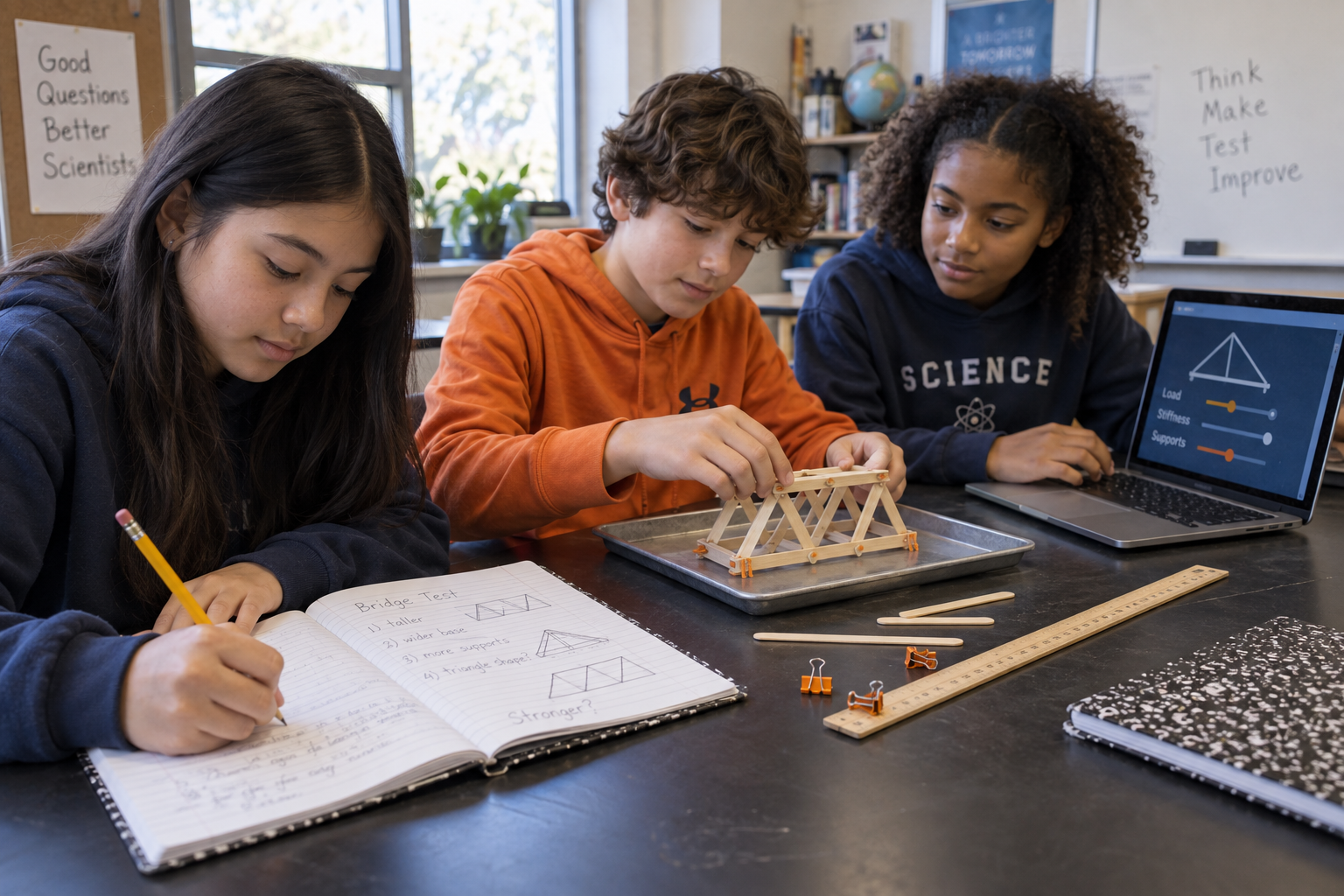
If you know me through Pirl Experimental, you know how excited I get about technology. I build simulations, experiment with AI, and keep finding new problems I want these tools to help solve. Then you walk into my classroom and find students writing in composition notebooks, drawing diagrams by hand, and working with materials spread across their desks. The laptops might be closed. They might stay closed for the entire lesson. Both versions of me are telling the truth. I believe deeply in what technology can help us accomplish, and I care just as deeply about giving students opportunities to work with their hands. The more capable these tools become, the more deliberately I want to choose when we use them.
My optimism about AI goes well beyond making a worksheet faster. I see possibilities for tackling problems that overwhelm individual teachers: planning for different needs, making complicated ideas accessible, and finding useful patterns in more information than we can reasonably process alone. I want to explore those possibilities. I also want to use the time they save to be more available to the students sitting in front of me. That enthusiasm does not automatically translate into more screen time for children. A tool that helps me design a lesson may never appear in the lesson itself. I can use AI to rethink an activity, clarify directions, or create a better prompt, then hand students paper and ask them to talk to each other. Some of my most valuable uses of technology may result in a classroom that looks wonderfully low tech.
I ask students to write by hand because I want them to practice putting their thinking into words. I ask them to draw because choosing what to include, where to put it, and how to connect it requires decisions. A rough diagram can give us something specific to discuss. Why does that arrow point there? What is missing? What would you change now that we have more evidence? The point is not beautiful handwriting or artistic talent. I want students to make their thinking visible and work through it. There is room for typing, dictation, and other supports when those help a student participate. What matters to me is that students are making decisions about the ideas they put on the page.
Being a science teacher certainly gives me opportunities to make things, test things, and occasionally clean up the consequences. But this belief extends beyond science. Students need practice handling materials, organizing a page, explaining an unfinished idea, and working beside another person. I value the patience involved in adjusting something that does not fit and the conversation that happens when two people disagree about how to build it.
That is why I am judicious about putting students in front of a screen. Before opening a simulation or showing a video, I want to know what it contributes. Does it make something observable that we could not otherwise see? Does it let students test a useful question? Will watching this help them do something afterward? I also ask what we are giving up during those minutes. A video can be exactly what a lesson needs. It can show an inaccessible place, slow down an event, or give everyone a shared observation to discuss. I want to leave space to pause, notice, and question. When students could reasonably investigate something themselves, though, I have to consider whether showing them the result too early would take away the experience I wanted them to have.
My current brainstorming for the OpenSciEd Unit 6.6 launch has made this balance especially concrete. The unit begins with a student who dropped a weight on a foot. Kids want to know how much weight it was. That question helped shape the Mystery Injury Simulator: examine the injury, collect evidence, then change variables in a virtual experiment to investigate possible explanations. There is a real reason to use a simulation here. Students can explore scenarios involving an injured foot without recreating an injury on anyone. They can revisit observations, compare trials, and record questions alongside their evidence. The simulation gives us a manageable model to investigate. It also gives us a reason to discuss what a model can represent and where its limits are.
I want to pair that virtual investigation with physical models students can build and test. I am still working out the materials and procedures. Perhaps they will compare structures made from different materials, observe where those structures fail, and revise their designs. The digital and physical models will each leave things out. Comparing those limitations could become part of the learning, too. Also, how often do I get to tell students that we are building something so we can break it? There is some built-in interest there. I would like to put that interest to work.
Even the AI vision board I generated for this launch has scientific inaccuracies. That makes it a useful starting point for questions, provided I identify it honestly. I want students asking what looks wrong and what evidence they would need before trusting a convincing image or explanation.
As I develop lessons, I am going to keep looking for these connections. A simulation might help students choose a question for a physical investigation. An unexpected result at the table might send them back to the simulation. Their notebooks can hold predictions, sketches, and explanations that develop across both experiences. I do not need an equal number of minutes with and without a screen. I need a reason for the transition. I want students to see me excited about AI and willing to question its output. I want them to see me choose a pencil, a conversation, or a pile of materials with the same confidence. Being comfortable with technology should give us more choices about how we learn. As I keep experimenting, I want those choices to bring students closer to the work: noticing carefully, making something, testing an idea, and deciding what to try next.
