The Student Is More Than the IEP
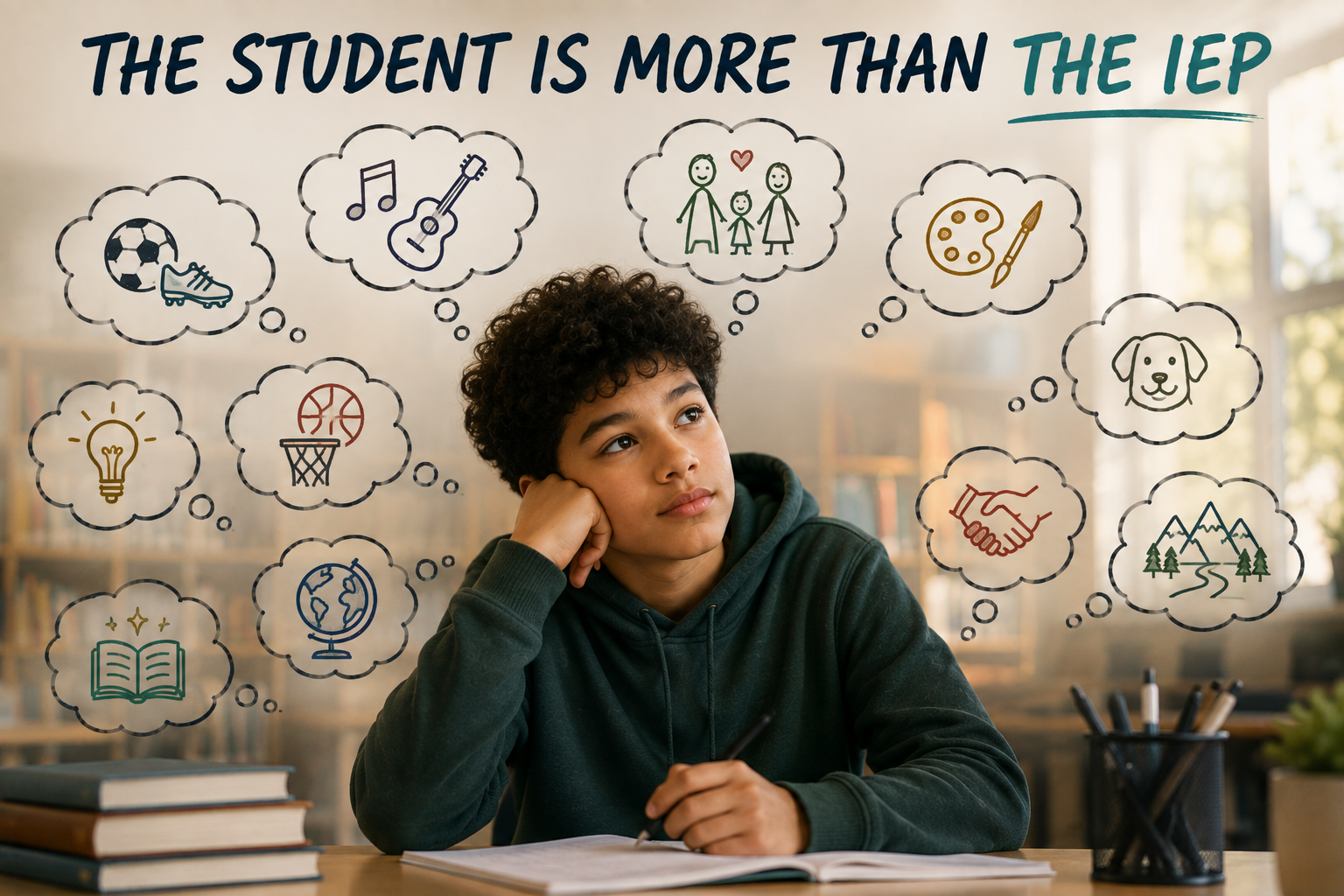
A student’s interests, relationships, experiences, and strengths reveal far more than any document can capture.
by Dan Drzyco
Special Educator
Point Pleasant, NJ
_____________________________________________
DAN DRZYCO
When I get my rosters at the beginning of a new school year, there are obviously things I want to know about my students. When reviewing an IEP, I usually start with the student’s classification. Is there a specific learning disability? Other health impairment? ADHD? ASD? Are there other factors I should be aware of? From there, I look at modifications and accommodations. If something stands out or seems particularly important, I may go further and read comments from previous teachers.
All of that information is important. It gives us a baseline and a place to start.
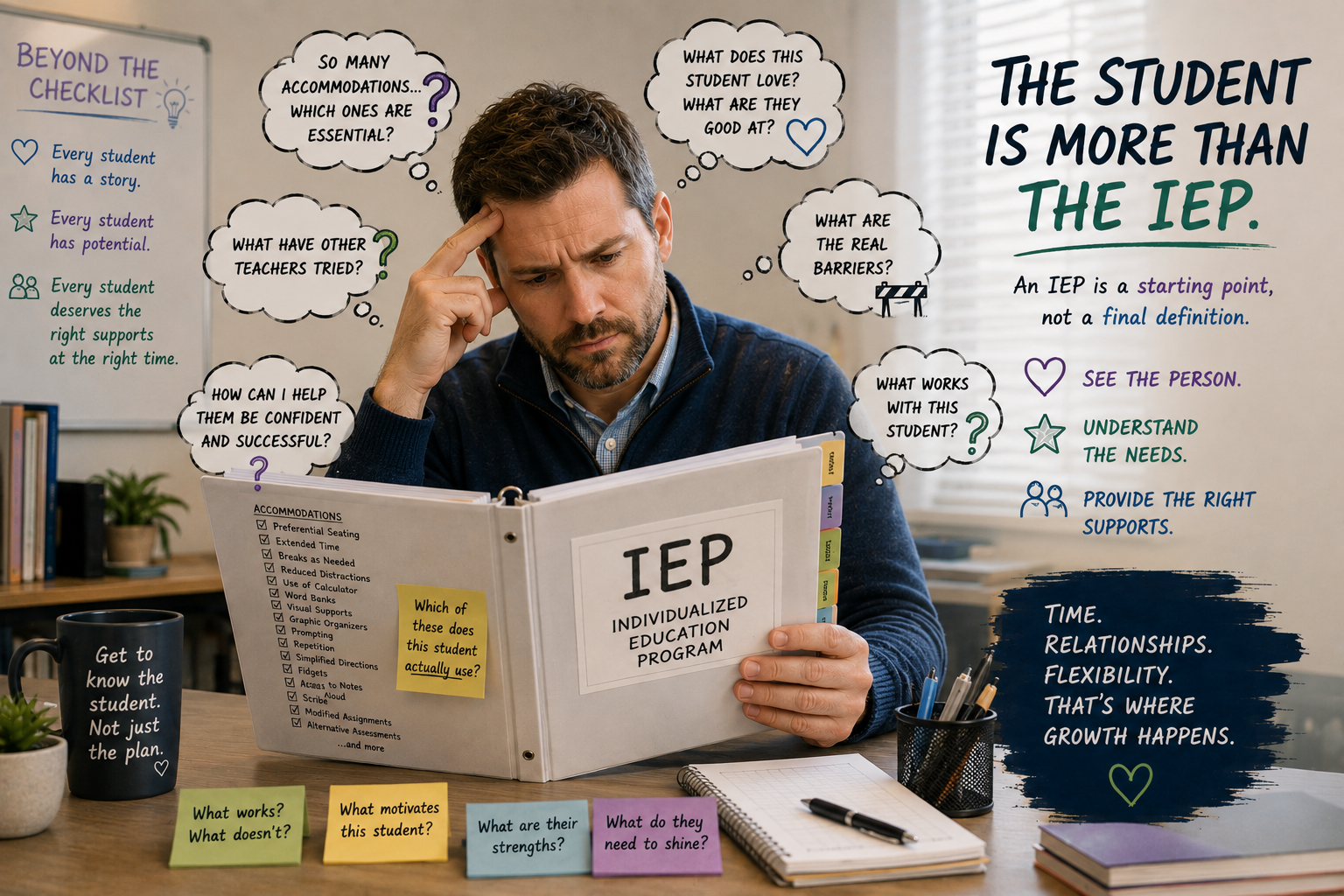
An IEP provides important information. The educator’s challenge is turning that information into support that works for the individual student.
But it doesn’t tell me who the student is.
That takes time.
It usually takes more than a few weeks for me to really begin to understand where a student is, both academically and socially. In some ways, I think of it like conditioning athletes. You can’t get an athlete into shape in two weeks, and I can’t truly understand a student’s needs after a few days in my classroom.
I need work samples. I need to see how they work independently and with other students. I need to see them in large groups and small groups. Most importantly, they need enough time to become comfortable with us as teachers so that they can show us who they really are.
That process can’t be rushed, and I don’t think it should be.
We don’t want to rush students into understanding an unfamiliar topic, so why would we rush ourselves into believing we understand them?
PIRL EXPERIMENTAL · MY TAKE
The IEP Is the Beginning
This distinction is important to me. I absolutely want the IEP before I meet a student. I want to know what previous educators and specialists have learned, and I want to start the year prepared to provide the supports that student is entitled to receive.
But I don't want that information to become my conclusion about the student before I've taught them.
The IEP gives me a head start. It shouldn't give me a finished picture.
DAN DRZYCO
There is also so much more to our students than their reputations, whether that reputation exists on paper or through word of mouth.
I’ve had students whom other teachers viewed as defiant or difficult, and my experience with that student has sometimes been completely different. I’ve been fortunate that almost all of my co-teachers have taken a similar approach. We take our time and get to know the individual before passing judgment.
And even then, are we supposed to pass judgment?
Is that our place?
I don’t think so.
Our job is to facilitate understanding and provide a safe and comfortable learning environment.
After all, who wants to learn when they’re uncomfortable, scared, or intimidated?
Not me.
I also don’t think that being in special education classes defines you as a student. It can’t mean the same thing for everyone. That’s not fair, and it’s not accurate.
Every student comes into the classroom with different strengths, challenges, experiences and ways of learning. Special education services are there to provide students with the tools and support they need, not to define who they are or what they’re capable of.
Most of the students on my rosters are very willing to learn. Our responsibility is figuring out how they learn best.
Sometimes past experiences have hurt a student’s confidence or self-esteem. Part of those first few weeks is beginning to rebuild that. My co-teacher and I are also constantly trying to determine why a student may be struggling.
Is it the content? Is it confidence? Is it the environment? Does the student understand something in a small-group discussion but become uncomfortable demonstrating that understanding in front of the entire class?
We have to learn as they learn, adapt as they adapt, and avoid putting them into a box based on who they were when an IEP was written.
PIRL EXPERIMENTAL · MY TAKE
Tell Me What You've Learned
This is one place where I think IEPs could become even more useful to classroom teachers. I'd like more room for meaningful anecdotal information—not simply what a student is supposed to need, but what the people who have actually worked with that student have learned.
When does this student thrive? When do they shut down? What has a previous teacher tried that worked remarkably well? What didn't work? What does the student say helps?
That information shouldn't define the student either. But it could give the next teacher better questions to start asking.
DAN DRZYCO
That doesn’t mean eliminating challenges.
Quite the opposite.
We want to challenge students to the best of their abilities. Doing that sometimes requires collaboration between teachers, the child study team, parents and, importantly, the student. We work together to figure out what allows that individual student to succeed.
My co-teacher is great at developing multiple versions of tests and quizzes. We can then work together to determine which version is appropriate for which student and whether something needs to be revised further to meet an individual’s IEP.
PIRL EXPERIMENTAL · MY TAKE
Support Doesn't Automatically Mean Easier
Dan’s being a little modest here.
We collaboratively develop many of those assessment versions, but he is often the one making the best recommendation about which version a particular student should receive. And what I appreciate most is that his recommendation isn't automatically the easier assessment.
Quite often, it's the opposite.
He'll advocate for giving a student the more challenging version because he's seen enough to believe that student is ready for it.
That's an important distinction in differentiation. The goal isn't to make everything easier. It's to remove unnecessary barriers while preserving appropriate challenge.
Sometimes support means providing more scaffolding.
Sometimes support means saying, I think you can do more.
DAN DRZYCO
Assessment doesn’t always have to look the same either.
A student doesn’t necessarily need to complete a long writing assignment in Social Studies to prove that they understand a historical concept. Sometimes I’ll have students create sketch notes or doodle notes to answer a question that other students may answer through writing. They might create a poster project or a one-page graphic organizer instead.
In Science, we might provide an interactive diagram with drop-down menus that allow a student to correctly label a scientific model or scenario, while another student might draw, label and explain the entire model.
Those supports don’t diminish the student’s understanding.
They’re tools.
Where would we be without a hammer?
We don’t judge a carpenter today for building a house using nails, screws and modern tools instead of leaning poles together to create a shelter. We’ve developed better tools, and we’ve learned to use them.
Education shouldn’t be any different.
We adapt.
Those adaptations will be different for different people, and that isn’t limited to education. We all use tools to accomplish things in our lives.
PIRL EXPERIMENTAL · MY TAKE
Which Tools Actually Work?
The tool analogy also makes me think about the way accommodations are sometimes documented.
I'd rather have a shorter, more precise list of supports that we know a student actually uses and benefits from than a long laundry list of accommodations that may or may not have been consistently implemented, used, or successful.
That doesn't mean removing supports arbitrarily. It means gathering better information about them.
Which accommodations does this student actually use? Which make a measurable difference? Which are needed only in certain situations? Which has the student outgrown? Is there something we're missing entirely?
An accommodation becomes much more useful to the next teacher when we can explain not only what it is, but when, why, and how it helps this particular student.
DAN DRZYCO
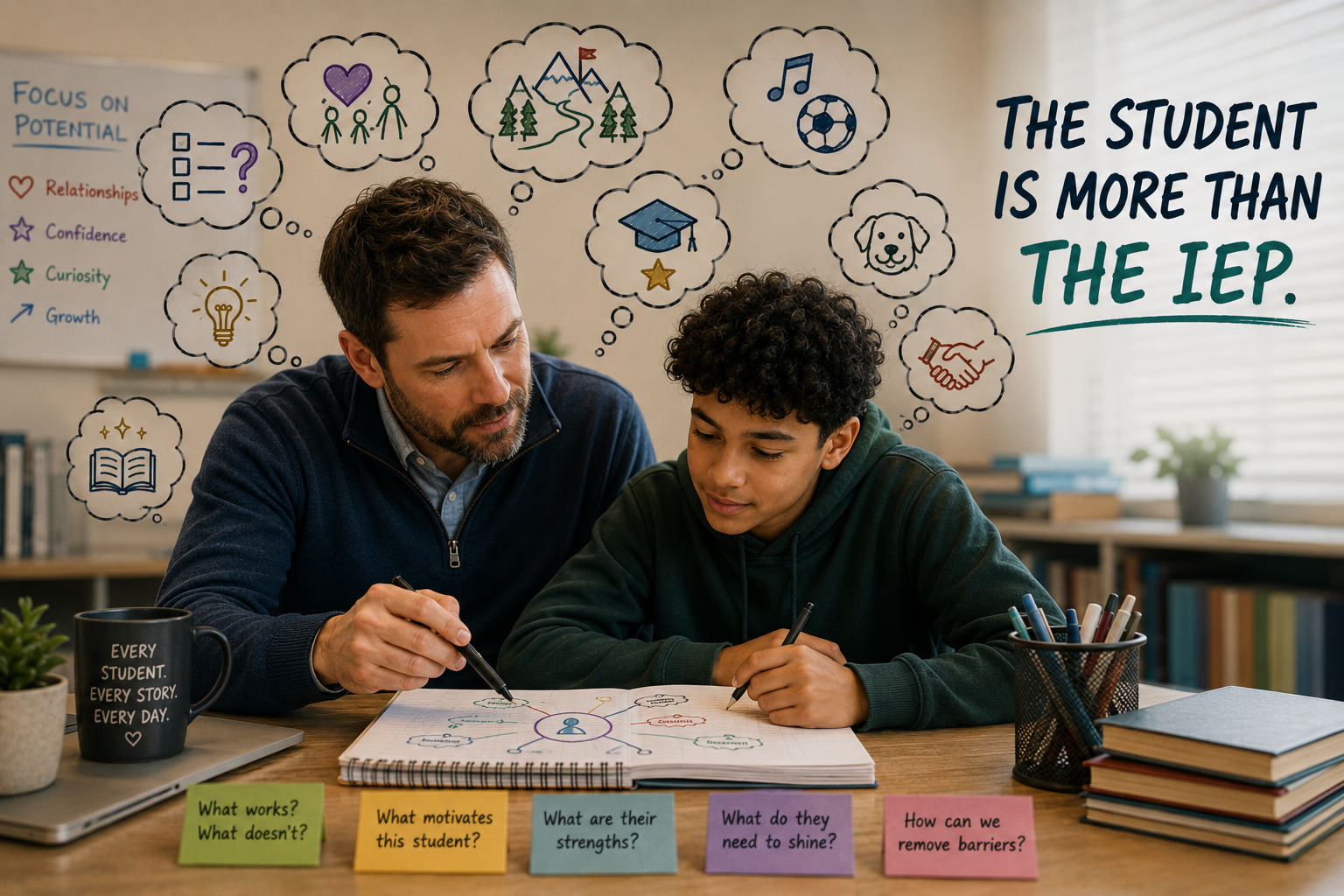
The clearest understanding develops when educators work with students—not simply from the information written about them.
If I could take one idea from special education and apply it to every classroom, it would be simple: get to know your students before you judge their abilities.
One day doesn’t define a student.
One week doesn’t define a student.
Again, I think about sports. One football game doesn’t define an athlete. A player might spend weeks preparing for an opponent and still miss a tackle. A baseball player might give up a home run. A team might lose the game.
That doesn’t erase the work that came before it.
The dedication to themselves and their teammates, the preparation, and the lessons they learned along the way still matter. They’ll take those lessons with them, apply them the next time, make new mistakes and learn from those too.
The classroom isn’t much different.
One of the biggest mistakes we can make is deciding who a student is based on their reputation. Another is assuming that one test, one assignment or one way of teaching must fit everyone simply because “that’s how it has always been done.”
An IEP is incredibly valuable. It gives educators information, supports, accommodations, goals and a starting point for understanding what a student may need.
But it is still a starting point.
PIRL EXPERIMENTAL · MY TAKE
A Living Document for a Growing Student
This is where all of these ideas come together for me.
I'd like an IEP to tell me more specifically what we're learning about the student over time: more refined goals, useful anecdotal observations, and better information about which accommodations and modifications have actually helped.
But there's a danger there too. Yesterday's useful observation can become tomorrow's label.
A student who needed significant scaffolding two years ago may not need the same scaffolding today. A student who struggled with writing last year may have made enormous progress. Something that didn't work with one teacher, class, or group of peers might work beautifully in a different environment.
So I don't want a more detailed IEP because I want a more detailed box to put a student in.
I want a more useful starting point—and one that leaves room for the student to change.
An IEP should evolve with the student.
DAN DRZYCO
Because if all you know about a student is what you read in their IEP, then you don’t really know everything you need to know to help them learn how to succeed for themselves.
