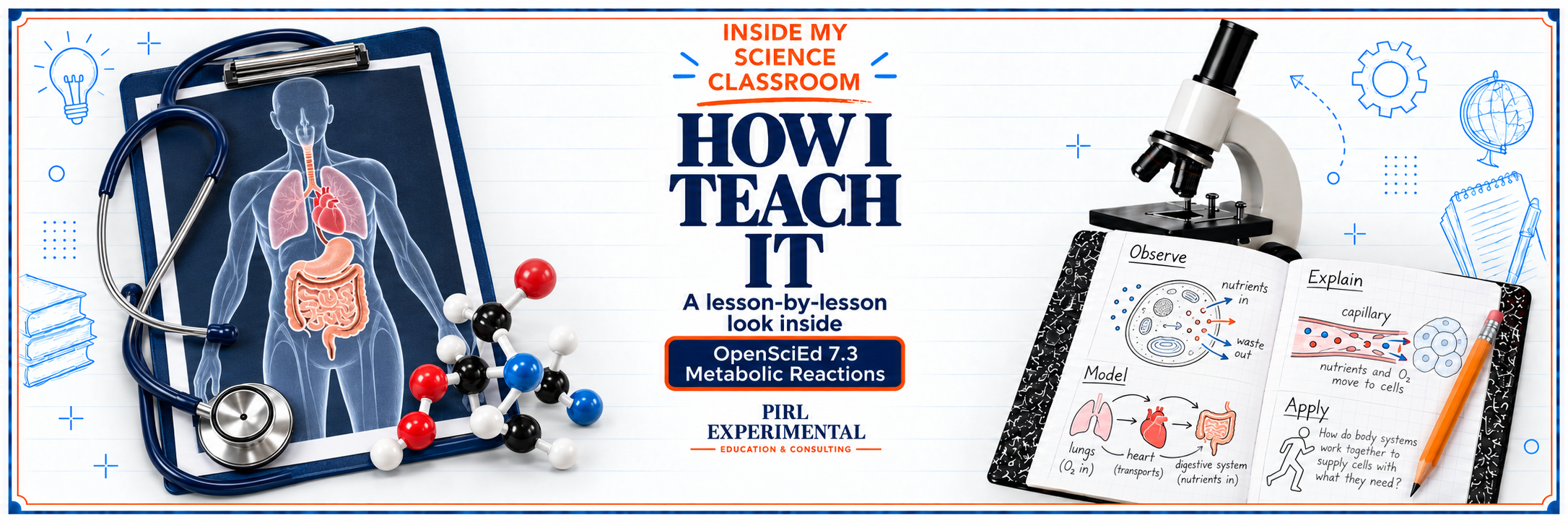

BSCS A Medical Mystery Review
BSCS’s A Medical Mystery helped my students keep learning while I was on paternity leave. Here’s why I recommend exploring the original unit behind OpenSciEd 7.3—and how its investigations, visuals, and teacher supports can fit different learners and classroom needs.
Pirl Experimental • OpenSciEd in my classroom
From a medical mystery to interacting body systems
How I reorganize the M’Kenna storyline to connect digestion, absorption, circulation, respiration, cellular energy, and stored body matter.
Read the full Unit 7.3 report (PDF) ↗Metabolic Reactions: Inside Our Bodies in my classroom
The diagnosis is an important checkpoint. The larger goal is explaining how one problem can affect the whole body.
This report describes a substantial reorganization of Unit 7.3. M’Kenna’s case remains the anchor, while the digestive-system sequence becomes more focused and the work on circulation, respiration, cellular respiration, and stored fat expands. Students build a connected explanation that they can later apply to brown-bear hibernation.
How can a problem in the small intestine cause symptoms in body systems far from the digestive tract?
How the explanation develops
- Build the systems mystery. Use the doctor’s note, symptom timeline, and an initial whole-body model. The sequence of symptoms helps students identify a starting point while keeping the explanation open.
- Explain digestion and absorption. Compare selected images and food-molecule data, then use a model of selective movement across a boundary. Connect chemical digestion to the smaller molecules that can be absorbed.
- Use structure and evidence to diagnose. Connect damaged villi and reduced surface area to reduced absorption. At the diagnosis checkpoint, students select a condition, rank evidence, and explain how that evidence supports their claim.
- Follow materials to the cells. Trace nutrients through the blood, add lung gas exchange, and model cellular respiration. Students connect food molecules and oxygen to carbon dioxide, water, and energy available for cell processes.
- Explain body changes and transfer. Use stored fat and matter tracking to explain weight changes. Integrate the systems in one model, then use seasonal bear data to explain survival without eating during hibernation.
What I would protect
- The symptom timeline and an initial systems model.
- Absorption, villus structure, and the diagnosis checkpoint.
- Circulation and respiration as connections between organs and cells.
- Cellular respiration, stored-fat reasoning, and the bear transfer task.
What I would condense
- An exhaustive comparison of every digestive organ and image.
- Every food-molecule graph when a smaller set establishes the pattern.
- Open-ended procedure design when another science practice is the target.
- Repeated model-sharing routines that delay the whole-body explanation.
Adjust the support around the science
Resource students can use fewer graphs at once, color-coded arrows, labeled villi and cell diagrams, and an evidence bank for diagnosis. General education students can rank evidence and construct a complete systems explanation. Honors students can compare diagnoses, examine model limitations, and account explicitly for conservation of matter as stored fat is used.
What I want students to explain
The sequence includes two substantial opportunities to show understanding: the diagnosis checkpoint and the brown-bear transfer. Between them, brief checks can ask students to distinguish digestion from absorption or trace glucose and oxygen to a cell and the products away from it. In the final transfer, “metabolism slows” needs an explanation using stored matter, cellular respiration, and the seasonal data.
Use this as a planning reference
The ten-page report includes eleven planning phases, suggested block ranges, the rationale for compressing digestion and expanding other systems, assessment ideas, and differentiation supports. It also identifies planning decisions to revisit, including the chemistry bridge and the calendar for a future implementation.
Read the sequence as one connected explanation. At each stage, ask what students can now account for in M’Kenna’s symptoms and what their current model still cannot explain.