Unit 7.1 Supplements
A look at how I supplement and shorten OpenSciEd Unit 7.1 using ACS Middle School Chemistry, PhET simulations, and hands-on reaction investigations. I share the ideas I prioritize, how students capture their learning, and how these resources fit into a focused chemistry mini-unit.
Pirl Experimental • OpenSciEd in my classroom
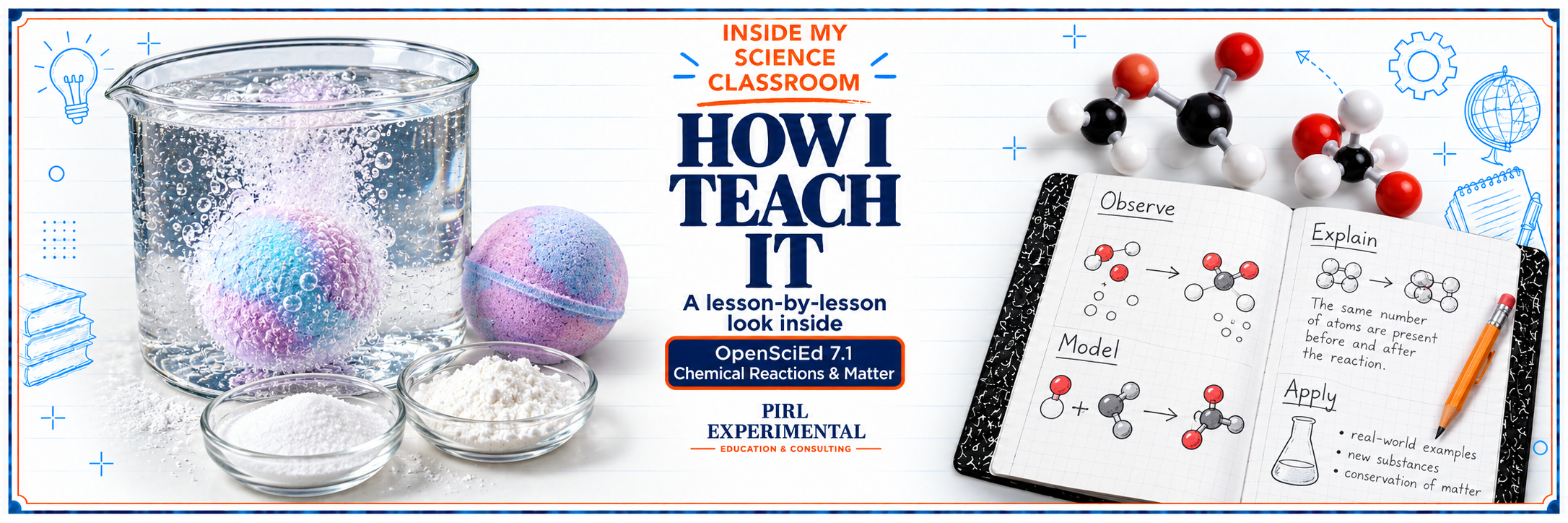
From fizzing bath bombs to a model of matter
A look at how I have adapted Unit 7.1 around the investigations and models that help students explain chemical change, conservation of matter, and atom rearrangement.
Read the full Unit 7.1 report (PDF) ↗Chemical Reactions & Matter in my classroom
The bath bomb gives students something to explain. The investigations give them the evidence to explain it.
My materials for this unit include a version that follows the OpenSciEd bath-bomb storyline more closely and a later, more condensed chemistry mini-unit. This report brings those versions together so another teacher can see the reasoning behind the sequence, the investigations I would preserve, and the routines I would shorten.
How can a bath bomb produce a gas and form new substances if matter is conserved?
How the explanation develops
- Start with the mystery. Observe the bath bomb, record questions, and draw an initial model. The first model makes students’ thinking visible before the class has the vocabulary or evidence to explain everything.
- Make conservation visible. Compare mass evidence from closed and open systems. When gas leaves an open system, the measured mass can decrease because matter crossed the system boundary.
- Investigate substances and combinations. Compare ingredient properties, solubility, and combinations that produce gas. Use gas-property evidence to narrow possible identities rather than treating all bubbles as the same thing.
- Separate kinds of change. Compare dissolving, phase changes, and chemical reactions. Bubbles alone do not prove that a new substance formed; boiling water is an important counterexample.
- Explain the change with atoms. Use particle models to show how atoms can rearrange into new molecules while their types and numbers remain the same. Return to the bath bomb and revise the original explanation.
What I would protect
- The initial bath-bomb model and closed-system mass evidence.
- Ingredient comparisons that support a claim about the reacting substances.
- A clear contrast among dissolving, phase change, and chemical reaction.
- Atom rearrangement followed by model revision and transfer.
What I would condense
- Repeated whole-class share-outs that revisit the same conclusion.
- Driving Question Board routines once they stop guiding the investigation.
- Symbolic equation practice beyond what students need to explain conservation.
- Extensions that interrupt the main explanation of the bath bomb.
Adjust the support around the science
The investigation and central question can stay the same across classes. Resource students can use prepared tables, fewer gas-property choices, sentence frames, and partially completed particle models. General education students can compare evidence and revise models independently. Honors students can evaluate competing product models and justify conservation with both particle diagrams and equations.
What I want students to explain
I would check understanding as the explanation develops: an initial particle model, a closed-versus-open-system explanation, an unfamiliar reaction scenario, and a final model or transfer task. Knowing the words “reactant” and “product” matters, but students also need to use those ideas to explain where the matter went.
Use this as a planning reference
The eight-page report includes nine planning phases with suggested block ranges, student tasks, intended understandings, documented classroom adaptations, assessment checkpoints, and differentiation options. It also identifies decisions to revisit, including the role of the Basic Chemistry Mini-Unit.
Use the report to choose a coherent sequence for your students. Keep the evidence that makes conservation and rearrangement understandable, then decide how much practice and support each class needs.