Scientific “Play Time”: Making Room for Curiosity in the Lab
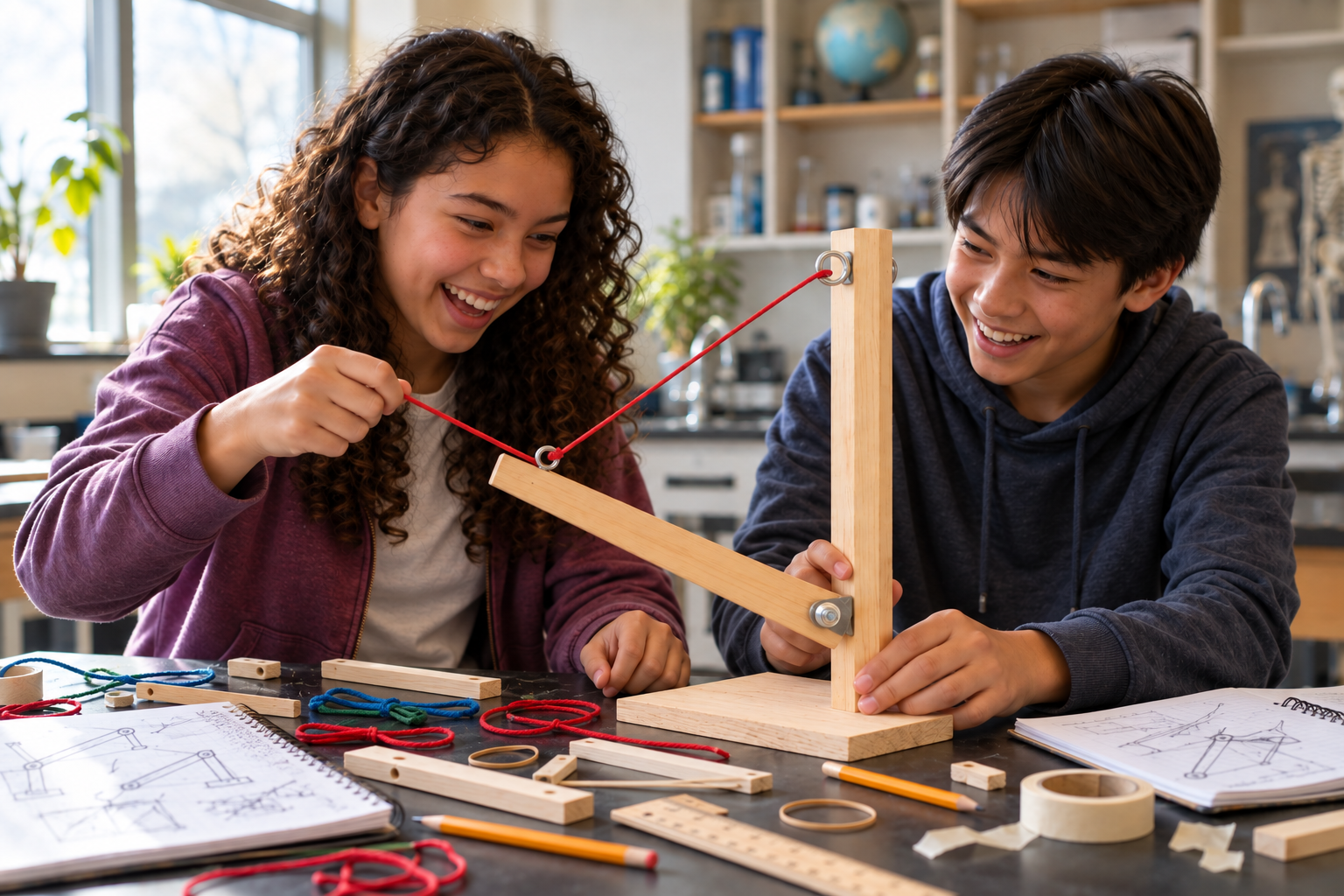
Today, I sent my students over to their lab stations, and many of them immediately started playing with the materials.
They were supposed to be writing. Instead, they were exploring what was in front of them. Before long, some had fallen behind.
That is a familiar middle school science moment: the materials have everyone’s attention, the written work is waiting, and the clock keeps moving. As the teacher, I still have to help students finish the investigation and make sense of it.
But the experience also reminded me of something I usually build into a lesson on purpose: time to play.
Typically, I give students a few minutes to explore their materials before asking them to work through the investigation. They can look closely, try things within the boundaries I have established, and start forming ideas about what the materials might do.
Often, they figure out some of the purpose of the investigation on their own. They notice how parts interact. They discover something that changes when they make an adjustment. They begin predicting what might happen next.
Whatever they cannot figure out often becomes a question they can write down or explain to someone else.
That is a useful place to begin teaching.
I see this especially clearly with online simulations. OpenSciEd includes opportunities for students to orient to a simulation by examining its controls, representations, and displays. I think of my initial “play time” as serving a similar purpose: students are getting familiar enough with the model to begin thinking with it.
The Villi Absorption simulation and the Chloroplasts and Food simulation are good examples. One lets students investigate relationships involving the structures of the small intestine and food absorption. The other lets them explore inputs and outputs involved in a plant cell making food.
There is a lot happening on those screens. Students have to figure out what the objects represent, what the controls change, and where to look for results. If I immediately add a page of questions, they are trying to understand both the tool and the assignment at the same time.
Sometimes, I get more useful thinking by giving them a little time to explore and then asking:
“What have you figured out so far?”
That question gives students permission to share an incomplete idea. They do not need a polished explanation of absorption or photosynthesis. They need something they noticed and a way to show us what led them to notice it.
A student might point out that changing a setting changes an outcome. Another might identify something that seems necessary for the model to keep working. Someone else might be confused about an object on the screen.
Now we have material for a conversation.
This is also a formative assessment opportunity. As students explain their discoveries, I can hear what they already understand, which relationships they are noticing, and where they are making assumptions.
I can ask, “What did you change?” or “What did you see that makes you think that?” I can invite them to show me. A student may have noticed a real pattern but attached an explanation that needs work. That gives me a specific place to respond.
I also have to remember that being busy with materials does not automatically mean a student understands them. Clicking every button or moving every part can produce plenty of activity. The conversation helps me find out what thinking is underneath it.
The discussion gives students access to one another’s discoveries, too. One group may notice something that another group overlooked. A question from one student can give someone else a reason to try again.
And the questions that surface can help establish the purpose of the investigation. “Does that happen every time?” or “Which change caused that?” creates a reason to collect evidence. Students have something they want to settle.
The writing can then capture thinking that has already begun. Students have an observation to describe, a prediction to explain, or a question they want to investigate.
Of course, today was also a reminder that exploration takes time, whether I plan for it or it happens while students are supposed to be doing something else.
I cannot simply add unlimited exploration and expect the rest of the lesson to fit. I need to make the time and the transition clear.
For an upcoming activity, that might sound like: “You have three minutes to explore these materials. Be ready to share something you figured out and something you are still wondering.”
I would establish what students can safely manipulate, give everyone a chance to participate, and then pause for a brief discussion. After that, I would clearly shift the task: now we are using those first observations to plan, test, record, or explain.
Those first impressions still need checking. If students changed several settings at once, we may need a more careful comparison. If they think they have discovered a rule, we need evidence that supports it.
That transition is part of the science I want them to learn.
Today, some students fell behind, and that matters. They need practice managing their time and documenting their work. I also need to account for the curiosity that shows up when interesting materials are placed in front of them.
Next time, I want to give that curiosity a clear place in the lesson: a few minutes to explore, a chance to share, and a question worth investigating. Then, when I ask students to write, they have something they are ready to say.
