A Good Bad Day in the Science Classroom
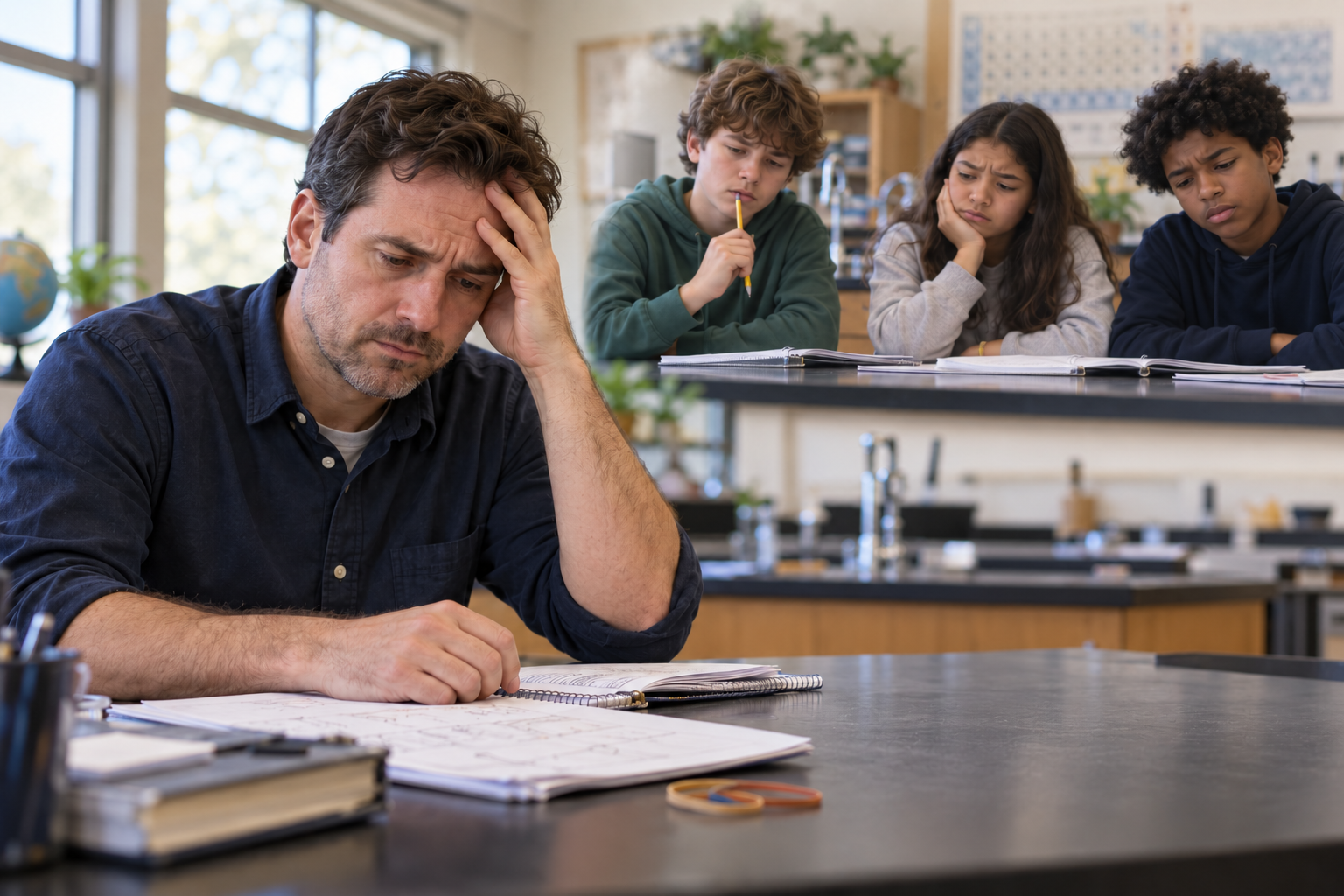
Yesterday morning, I tried the arm model lab with students for the first time. It went poorly, and I was extremely dissatisfied.
I had an idea for a hands-on investigation that would help students understand how the parts of an arm work together. There were wooden bones, rubber-band muscles, strings, and spring scales. There were plenty of possibilities.
But the experience I had pictured and the experience unfolding in my classroom were not lining up.
I took that hard.
I’m putting a lot of pressure on myself to find good, interesting ways to teach my content. I want students doing meaningful work. I want the materials, questions, and observations to lead somewhere. When a lesson doesn’t come together, I can be much harder on myself than I would ever be on someone else.
Yesterday, I didn’t give myself much room to be a teacher trying something for the first time.
I made adjustments throughout the day. I changed how I introduced the materials and thought about what students needed to notice before they could explain anything. I kept working on it, but I never reached that comfortable feeling of having the lesson figured out.
And when I get into that kind of self-criticism, it doesn’t always stay neatly contained in my classroom. A lesson I’m unhappy with can become a reason to question other decisions, including ones that have nothing to do with school.
That was a lot to put on a wooden arm and some rubber bands.
The lesson started taking shape
Today felt different.
After teaching, observing, talking through possibilities, and revising, I could see a more coherent two-day sequence.
Students would begin by comparing the model materials with the real structures. What does wood show well about bone? What does it leave out? How does bubble wrap represent a protective covering?
One student had already made a connection I wanted to build on: we wrap things in bubble wrap to protect them during shipping. That helped the student connect a material’s properties to the function of skin.
That was useful thinking. Even while I was dissatisfied with the lesson as a whole, there were things happening that deserved my attention.
From there, students could explore the opposing rubber bands during scientific playtime, then describe what they changed and how the arm responded. On the second day, they could draw the setup, explain the functions of its parts, and investigate forces with the spring scale.
The lab write-up became more coherent, too. Instead of maintaining several substantially different versions, I had one four-page packet that could work across most of my classes, with flexibility in how far we went. My Resource class would still have a more supported version.
I was also reconsidering the force investigation itself. Could the scale act as an opponent in a simplified arm-wrestling challenge? What would its reading actually tell us? How could students distinguish an arm that was balanced from muscles that weren’t pulling?
I was still asking questions. But today, those questions felt more productive and less like evidence that I didn’t know what I was doing.
The lab wasn’t suddenly finished forever. I had a better approach, and I felt more confident about where I was taking it.
I had forgotten how uncertainty feels
That shift made me think about my students.
I regularly ask them to engage with challenging science. I encourage them to take risks, try an idea, put effort into something unfamiliar, and revise their thinking when the evidence calls for it. I believe that working through those experiences can lead to meaningful learning.
But before committing to starting over with what I was teaching, I had become comfortable. I knew the content, the lessons, and many of the places where students would need help. Experience gave me a sense of what was likely to happen next.
I had forgotten some of the anxiety that comes with not having that confidence.
The not knowing. The uncertainty. The feeling that I should already understand how to do something that I am still learning to do.
Yesterday brought those feelings back.
I could recognize that I was teaching this lab for the first time and still feel deeply uncomfortable when it didn’t go well. Knowing that revision is part of the process did not automatically make me comfortable living through it.
That seems worth remembering the next time I tell a student to keep trying.
Remembering the longer timeline
There was another reminder I needed, too: the learning process is much longer than one two-day lesson.
I often remind parents of the timeline behind our middle school science standards: “By the end of grade 8…” Students have time to build their understanding. They need opportunities to revisit ideas, use them in different situations, and make connections that may not have been clear the first time.
Apparently, I needed someone to give me my own reminder.
I was putting pressure on this one lab to come together and on myself to have it figured out. In doing that, I was losing sight of where it fit in a much longer learning process—for my students and for me.
The arm model can give students an observation we return to when we study tissues, cells, injuries, and healing. A connection that starts with bubble wrap protecting a package can become part of a more developed explanation of skin. They do not have to leave this lesson with every idea fully formed for the experience to have value.
I still need to notice what is working, respond when students need support, and make thoughtful adjustments. But I can judge a lesson by what it contributes to their developing understanding. I can ask, “What did they notice today that we can build on next?”
And I can give my own learning a longer timeline, too. My first attempt gave me information I could use to teach the lab better. I was already using it. I needed to let that count as progress.
What I want to carry back into class
I will continue to ask students to do challenging work. This experience reinforced how much I value that work. It also reminded me to acknowledge what it can feel like.
I can tell students that it is uncomfortable to have an idea that isn’t working yet. I can make room for uncertainty without treating it as a reason to stop. And I can help them find a next step: look again, compare observations, ask a more specific question, or change one part of the approach.
I also want to be more deliberate about recognizing revised thinking. When a student changes an explanation because of something they observed, that is progress worth pointing out.
Science gives us opportunities to practice this. Questions lead to investigations. Models help us explain some things and leave other things unresolved. Evidence can require us to reconsider an answer we felt good about.
I want students to experience that process, and I need to remember that participating in it can feel vulnerable.
Yesterday was a good “bad experience.” I would have preferred a smoother first attempt, but the discomfort helped me remember something I had become too comfortable to feel.
Today, I walked away more assured of the philosophy behind PIRL Experimental—and more aware that I have to allow myself to live it, too.
Experiment. Learn. Refine.
Yesterday, that process was uncomfortable. Today, I could see what I was learning from it.
