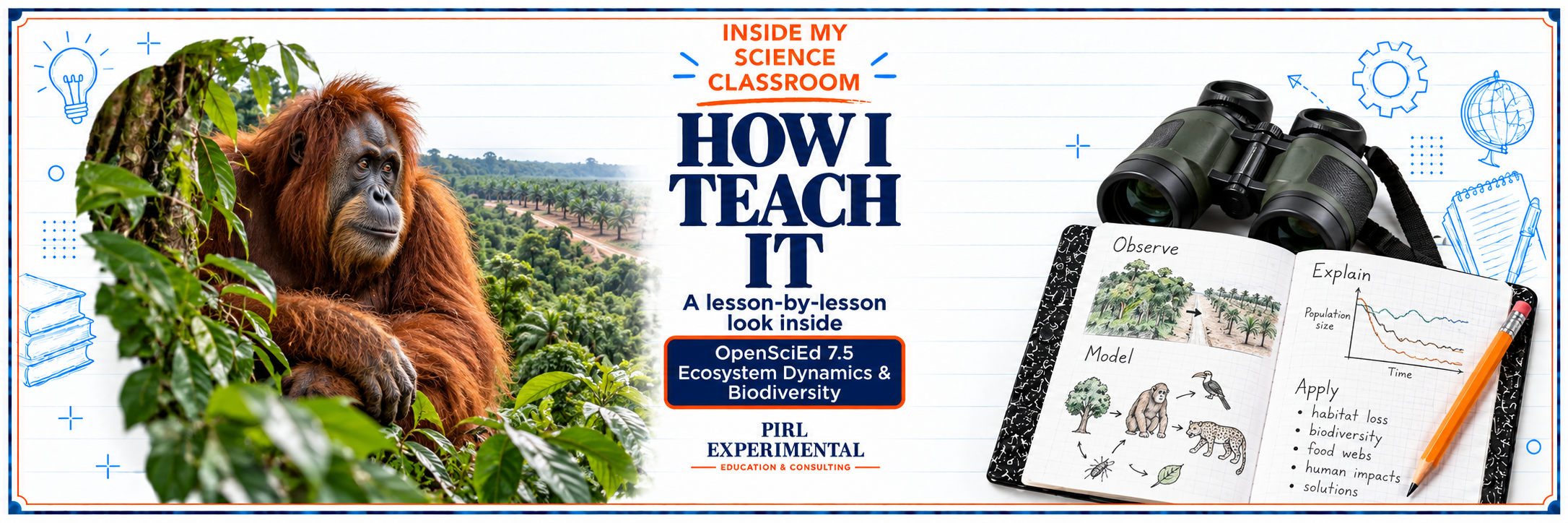
Pirl Experimental • OpenSciEd in my classroom
Using ecology to weigh real land-use choices
How palm oil and orangutans create a reason to investigate populations, resource limits, species interactions, biodiversity, and the needs of people.
Read the full Unit 7.5 report (PDF) ↗Ecosystem Dynamics & Biodiversity in my classroom
A useful land-use proposal has to account for wildlife, ecological relationships, and the people who depend on the land.
My Unit 7.5 materials stay closer to the original OpenSciEd storyline than my versions of Units 7.3 and 7.4. The main changes involve pacing, focused evidence selection, and assessment supports. This report follows the path from a familiar product to an ecological explanation and an evidence-based design.
How can land-use decisions support orangutans and other populations while also meeting the needs of people?
How the explanation develops
- Connect a product to a population. Use candy ingredients, palm-oil production, habitat evidence, and orangutan population trends to establish the problem. Initial patterns raise questions; later investigations build the causal explanation.
- Examine the tradeoffs. Compare land requirements for different oils and consider climate, location, and farmer perspectives. Students need evidence about consequences before proposing a simple replacement.
- Explain population limits. Use maps, graphs, models, or simulations to connect habitat and resources to population size, competition, and carrying capacity. Apply the reasoning to a new population.
- Expand to an interacting ecosystem. Compare rainforest and oil-palm systems, then investigate species interactions, indirect effects, biodiversity, and responses to disturbance. A change in one population can affect others.
- Design and defend a solution. Compare farming approaches, define criteria and constraints, and test a land-use proposal. Revise the design and explain its ecological benefits, human consequences, and remaining tradeoffs.
What I would protect
- The palm-oil problem and the replacement-oil tradeoff.
- Farmer perspectives and local land-use connections.
- Resource limitation, population evidence, and interacting-system models.
- A culminating design with an evidence-based defense.
What I would condense
- Question-board and progress routines treated as separate events every time.
- Long map procedures after the important location pattern is clear.
- Repeated reading protocols that do not add a new perspective.
- Optional projects that displace the population and biodiversity reasoning.
Adjust the support around the science
Resource students can use simpler graphs, fewer variables, labeled ecosystem models, shorter stakeholder texts, and structured design templates. General education students can compare several sources and defend a proposal independently. Honors students can quantify tradeoffs, challenge assumptions, compare competing designs, and investigate unintended consequences. The central design problem stays meaningful at every level.
What I want students to explain
The archive includes a monarch-butterfly transfer for resource availability and competition, an argument about orangutan extinction, and a Southwestern Willow Flycatcher transfer for biodiversity and disturbance. These checkpoints prepare students to use ecological evidence in the final land-use design instead of treating the project as an opinion exercise.
Use this as a planning reference
The nine-page report includes ten planning phases, suggested time ranges, assessment checkpoints, differentiation ideas, and decisions to revisit before another implementation. It draws on several pacing guides and classroom versions rather than presenting one fixed calendar.
When reviewing a student proposal, ask which population or interaction each design choice supports, what evidence supports that claim, and whose needs still require attention.