Pirl Experimental • OpenSciEd in my classroom
Tracing plant growth into a cycling ecosystem
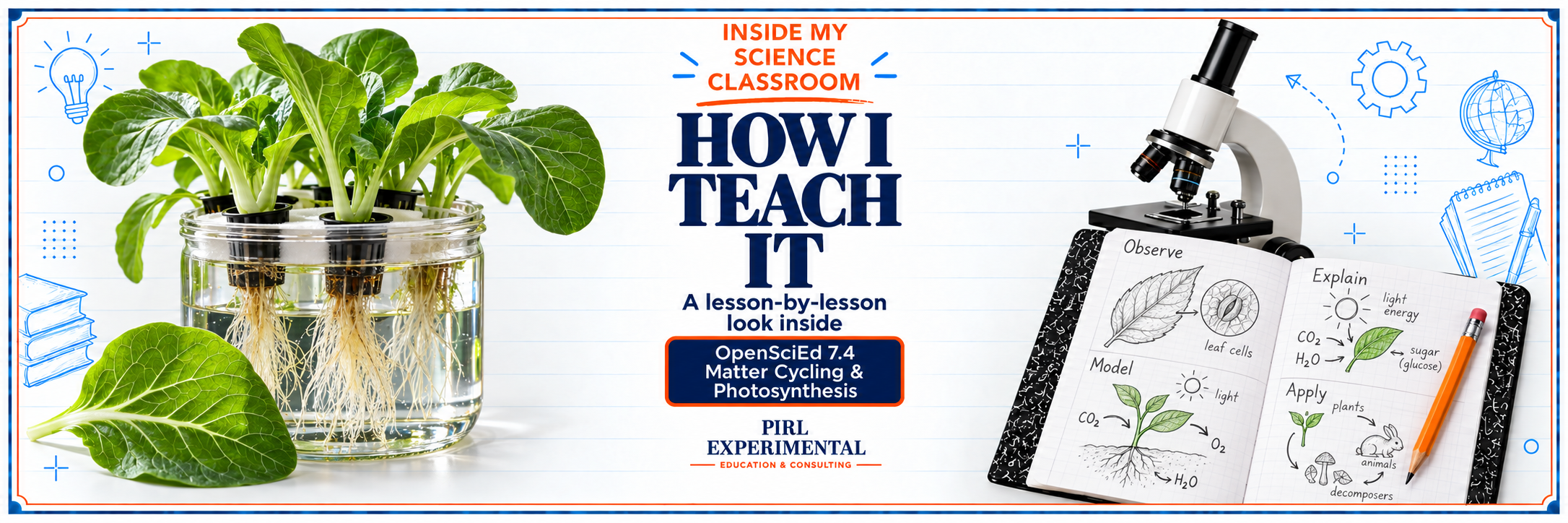
A teaching sequence that connects hydroponics, leaf structures, photosynthesis, plant respiration, decomposers, and the movement of matter and energy through a system.
Read the full Unit 7.4 report (PDF) ↗Matter Cycling & Photosynthesis in my classroom
Students need to explain where a plant’s matter comes from, what light contributes, and how those ideas connect to an ecosystem.
My archive includes several versions of Unit 7.4. The common thread is a sequence of explanations: challenge the idea that plants eat soil, identify their inputs, model photosynthesis, explain plants in darkness, and bring decomposers into a complete system. This report organizes those versions around the science students need to connect.
If plants do not take in ready-made food molecules, where do the matter and energy for growth come from?
How the explanation develops
- Challenge the soil-as-food idea. Use hydroponics to establish that plants can grow without soil. Inventory air, water, mineral nutrients, and light, then distinguish matter inputs from an energy input.
- Connect leaves to the inputs. Use gas-exchange evidence and observations of leaf structures to connect carbon dioxide movement, stomata, plant cells, and chloroplasts. Microscopy has a clear explanatory purpose.
- Model photosynthesis. Show how atoms from carbon dioxide and water are rearranged into glucose and oxygen. Trace light energy into chemical energy stored in food molecules without treating light as a source of atoms.
- Explain life in the dark. Use predictions, gas data, a short reading, and a revised model to show that plant cells also carry out cellular respiration. Photosynthesis requires light; respiration continues in darkness and also occurs in the light.
- Build the whole system. Follow plant matter into growth, storage, consumers, and decomposers. Use Biosphere 2 or a sealed-bottle ecosystem to explain how matter cycles while energy enters, transfers, and eventually leaves as heat.
What I would protect
- Hydroponics and an explicit distinction between matter and energy.
- Leaf observations and gas evidence tied to photosynthesis.
- Plants-at-night evidence that makes respiration necessary to explain.
- Decomposers and a whole-system synthesis.
What I would condense
- Repeated plant-food-source activities after the evidence is sufficient.
- Organelle detail unrelated to the processes students are explaining.
- Food-chain work that never traces matter or energy.
- Long sharing routines that repeat an already established model.
Adjust the support around the science
Resource students can use labeled molecule icons, prepared system diagrams, smaller data sets, and matter-versus-energy sorting supports. General education students can build independent models with explicit arrow labels. Honors students can investigate variables, track conserved atoms, and defend an explanation of system stability. Short readings work well with annotation and text–visual–explain organizers.
What I want students to explain
Useful checkpoints include an initial explanation of plant mass, a photosynthesis model, and an explanation of plants in darkness. The capstone asks students to integrate living and nonliving components in a system model. A strong explanation distinguishes matter cycling from energy flow and accounts for producers, consumers, and decomposers.
Use this as a planning reference
The nine-page report includes ten planning phases with suggested block ranges, the role of microscopy and simulations, assessment checkpoints, and differentiation ideas. It also outlines decisions for a future version, including the launch phenomenon and whether Biosphere 2 or a sealed-system task should serve as the primary capstone.
As you plan, inspect the arrows in every model. Students should be able to name what each arrow represents and say whether they are tracking matter or energy.