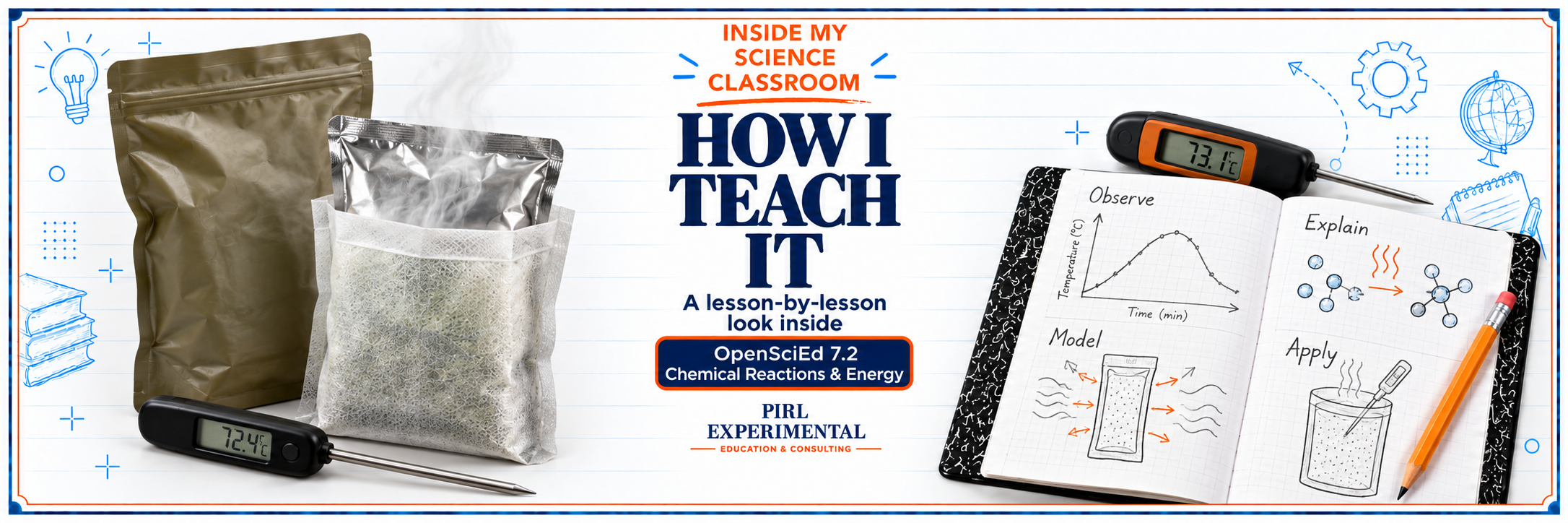
Pirl Experimental • OpenSciEd in my classroom
Using chemistry to solve a heating problem
How the MRE flameless heater connects particle models, reaction energy, evidence-based choices, and an engineering cycle students can actually use.
Read the full Unit 7.2 report (PDF) ↗Chemical Reactions & Energy in my classroom
A useful heater needs more than a reaction that gets hot. Students have to explain where energy goes and use that explanation to improve a design.
In this version of Unit 7.2, the MRE heater gives the science a practical purpose. Particle motion, atom conservation, energy transfer, and reactant proportions all help students make better engineering decisions. The report brings together the teaching sequence, supporting instruction, and design work reflected in my classroom materials.
How can a chemical reaction warm food without a flame or electricity, and what makes the heater useful?
How the explanation develops
- Check the prerequisite ideas. Use a short bridge on particle motion, heat, and temperature. Students who already understand these ideas can move quickly; others need a clear model before analyzing the heater.
- Introduce the problem and the reaction. Observe the flameless heater and build an initial explanation. Revisit reactants, products, and atom conservation so students can connect the visible change to a particle model.
- Compare energy transfers. Analyze temperature evidence from exothermic and endothermic reactions. Identify the reacting system and its surroundings, then show the direction of energy transfer.
- Make an engineering decision. Compare candidate reactions using temperature change, duration, reliability, material use, and design constraints. A large temperature spike does not settle every design question.
- Test, revise, and transfer. Investigate proportions, container structure, insulation, and contact with the food system. Use evidence to revise the design, then apply the same science to an unfamiliar heating or cooling situation.
What I would protect
- The MRE problem and a clear model of energy transfer.
- A comparison of exothermic and endothermic evidence.
- Engineering criteria and constraints that guide actual decisions.
- Time to test, analyze, and revise a design.
What I would condense
- Long introductions after students understand the heating problem.
- Repeated notebook or question-board routines with no new reasoning.
- Equation practice disconnected from atom conservation.
- Extra planning paperwork that takes time away from testing and revision.
Adjust the support around the science
Resource students can work with fewer reaction options, labeled system diagrams, prepared graphs, and frames for explaining energy direction. General education students can interpret class data and defend a design using several criteria. Honors students can compare performance quantitatively, evaluate competing constraints, and explain how the chosen system boundary affects their model.
What I want students to explain
The assessment sequence can move from a particle-motion check to energy-transfer explanations, a design-choice justification, and a final transfer task. My archive includes a hot-air-balloon task that asks students to connect reaction models, conservation, combustion, and heat transfer. That combination reveals more than recalling the definitions of “endothermic” and “exothermic.”
Use this as a planning reference
The eight-page report includes nine planning phases, suggested block ranges, the chemistry-to-engineering progression, assessment checkpoints, and differentiation ideas. Archived reaction trials and temperature targets are presented as records of earlier implementations; the report also identifies procedures and materials to review before teaching the unit again.
Begin with the design problem and identify the science students will need to make each decision. Preserve a complete test-and-revise cycle so the engineering work has an observable purpose.