Pirl Experimental Education & Consulting
How I Teach It · Seventh-grade science
How I teach Basic Chemistry
Three days with a particle reading, a school full of moving dots, and a box of Molymods. By the third day, I want students to be able to tell me where every atom went.
Put a drawing of O₂ on the board and ask, “How many do you see?” One and two are both perfectly good answers. I have to ask a better question. How many molecules? One. How many oxygen atoms? Two. That distinction is easy to skip when I already know how to read a formula. It’s also exactly what a seventh grader needs when three molecules turn into two on the next page.
This week I used a short introductory text on matter and chemical reactions to introduce the chemistry. For the next two 66-minute periods, my plan is to put the models in students’ hands. The first time they open the kit, their job is to build a molecule and read it. The second time, they’ll take molecules apart and use the same pieces to make something new.
01 / DAY 1 · THE TEXTWhat did that circle stand for in sixth grade?
We started with the particle diagrams students already knew. A page of widely spaced circles can show why a gas fills its container. Zoom in on one of those circles, though, and its identity matters. In a sample of air, one particle might be a single argon atom. Another might be an oxygen molecule with two atoms bonded together. If I draw both as plain circles, students have no way to tell which is which.
The reading gives us a way to think about the count before anybody has to balance an equation. In the school animation, each dot is a student and each classroom holds a group. Page two compares fourth and fifth periods. Sixty students sit in nine groups before the bell and seven groups afterward. I like the question “Where did the other two groups go?” because you can answer it while accounting for every kid in the building.
The school analogy slides are available to use alongside the animation.
The school analogy also leaves us with a question for tomorrow. Sharing a classroom makes students a group. What makes atoms a molecule? The text introduces chemical bonds, then connects rearrangement to things we might actually observe, like bubbles when a gas forms. Its final water diagram lets students point to each atom on both sides of the arrow.
Reading and school analogy · 10.62 MB
Introductory text, teacher notes, classroom slides, and the school animation.
02 / DAY 2 · ATOMS AND MOLECULES WITH MOLYMODWhat does the gray stick in a water model mean?
I’ll give partners a pair of magnet tiles for a few minutes before I pass out the kits. Bring two edges close, feel the pull, then separate them. I want one observation from that little bit of play. You can feel an attraction even when you can’t see anything stretching across the gap.
These builds use the Molymod Organic Student Set (MMS-008). The kit insert lists the atoms and links in the box.
The main activity is building, with the Atoms, Molecules, and Models handout alongside the models. With H₂O in hand, a partner can touch each ball, name the element, and sketch the whole molecule. Then I’ll show the same water molecule as a space-filling model. If I want to know which atom is bonded to both hydrogens, the sticks make it easy to see. If I want a sense of the space the atoms occupy, the close-packed spheres give a better picture.
Next, one partner builds methane, CH₄, while the other sketches it. Turn the model until one hydrogen nearly disappears behind the carbon. It’s still there. Now look for that same hydrogen in the drawings on the slide. For students who need a starting point, I’ll ask them to touch the carbon and follow each of its four links. For a pair ready to go further, I’ll ask them to sketch a second view and explain how both sketches can represent the same molecule.
For more examples, Common Molecules in Grade 7 gives students additional molecules to compare.
Atoms and molecules · 10.49 MB
Modeling handout, common molecules reference, lesson slides, student sheet, lesson plan, and kit insert.
03 / DAY 3 · CHEMICAL REACTIONS WITH MOLYMODCan three molecules become two?
I’ll start with two hydrogen molecules and one oxygen molecule on each table. Partners sketch the three reactant molecules, count four H atoms and two O atoms, then close the kit. Their challenge is to build two identical water molecules using only the pieces on the table. The satisfying part is being able to point to all six atoms afterward, even though there are only two molecules to pick up.
Now the two 2s in 2H₂O have jobs students can demonstrate. The large 2 tells a partner to pick up two whole water molecules. The small ₂ tells the partner how many hydrogen atoms to touch in each one. Across the pair, that’s four hydrogens.
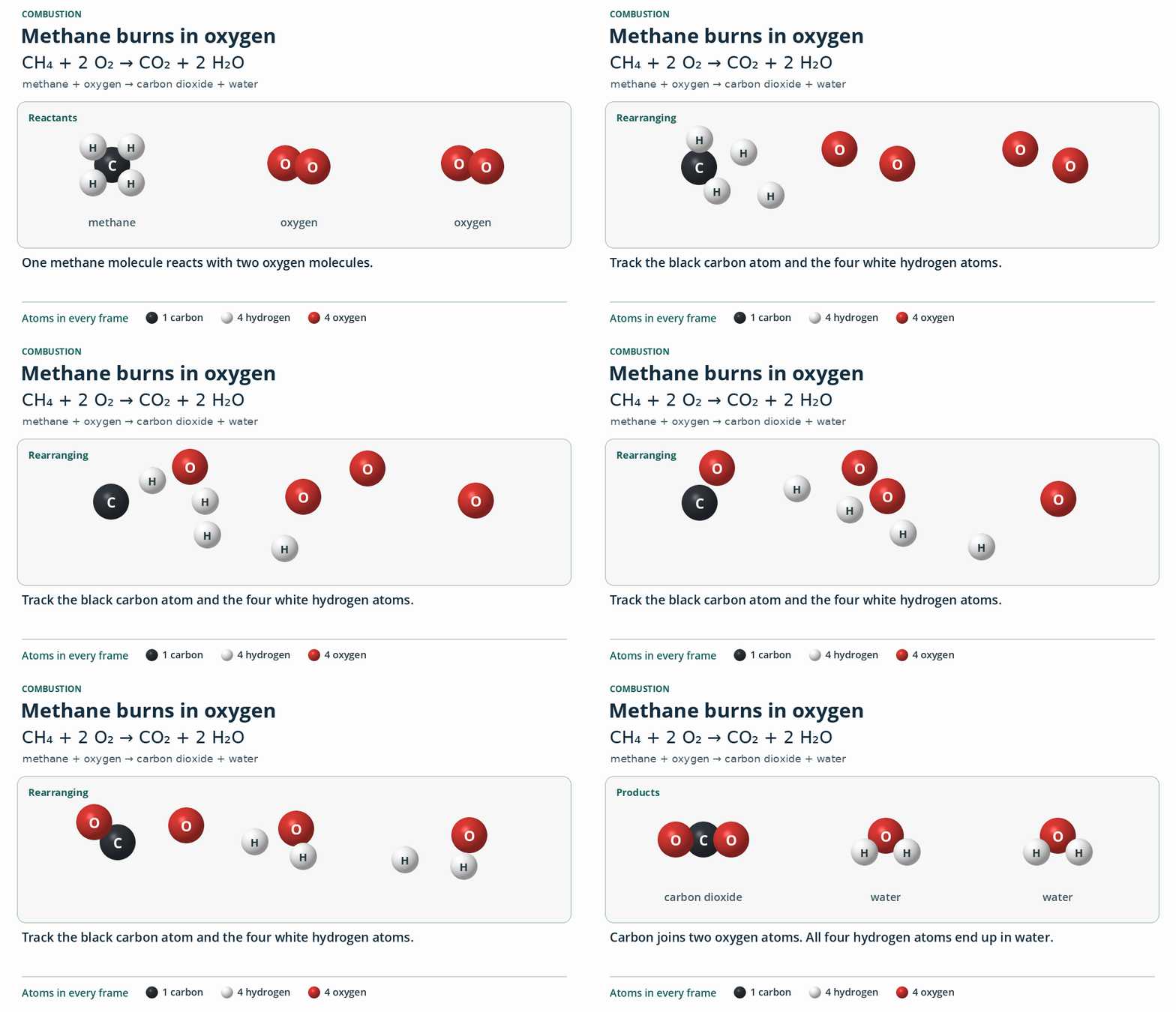
The Types of Chemical Reactions handout accompanies the next set of builds. Partners switch who assembles and who checks. I’ll save the methane slide for a prediction. Once the carbon is in CO₂, four hydrogen atoms and two oxygen atoms are still sitting on the table. What can we build with what’s left? I want both water molecules in the sketch before we play the animation.
Three reactions to build and check
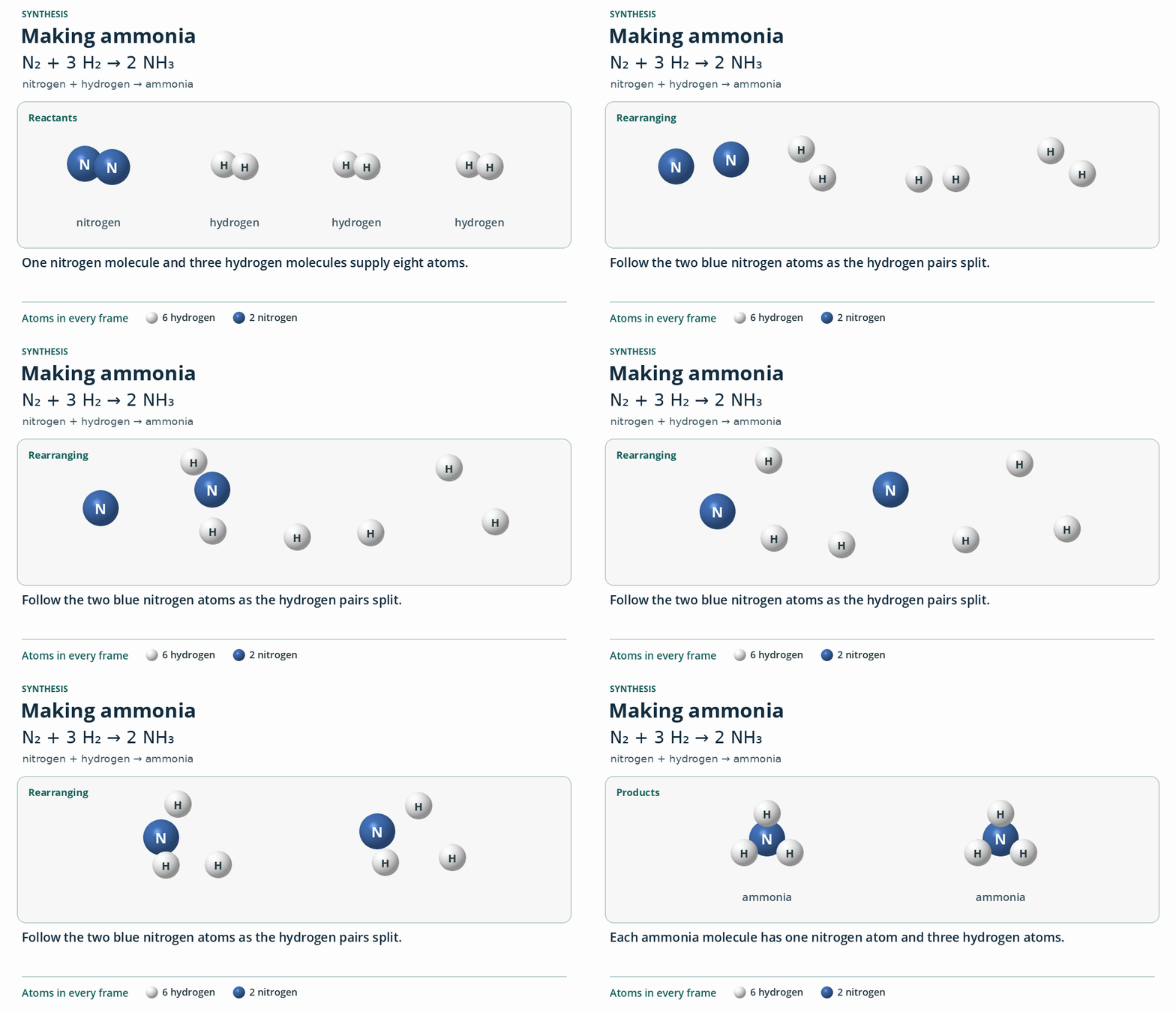
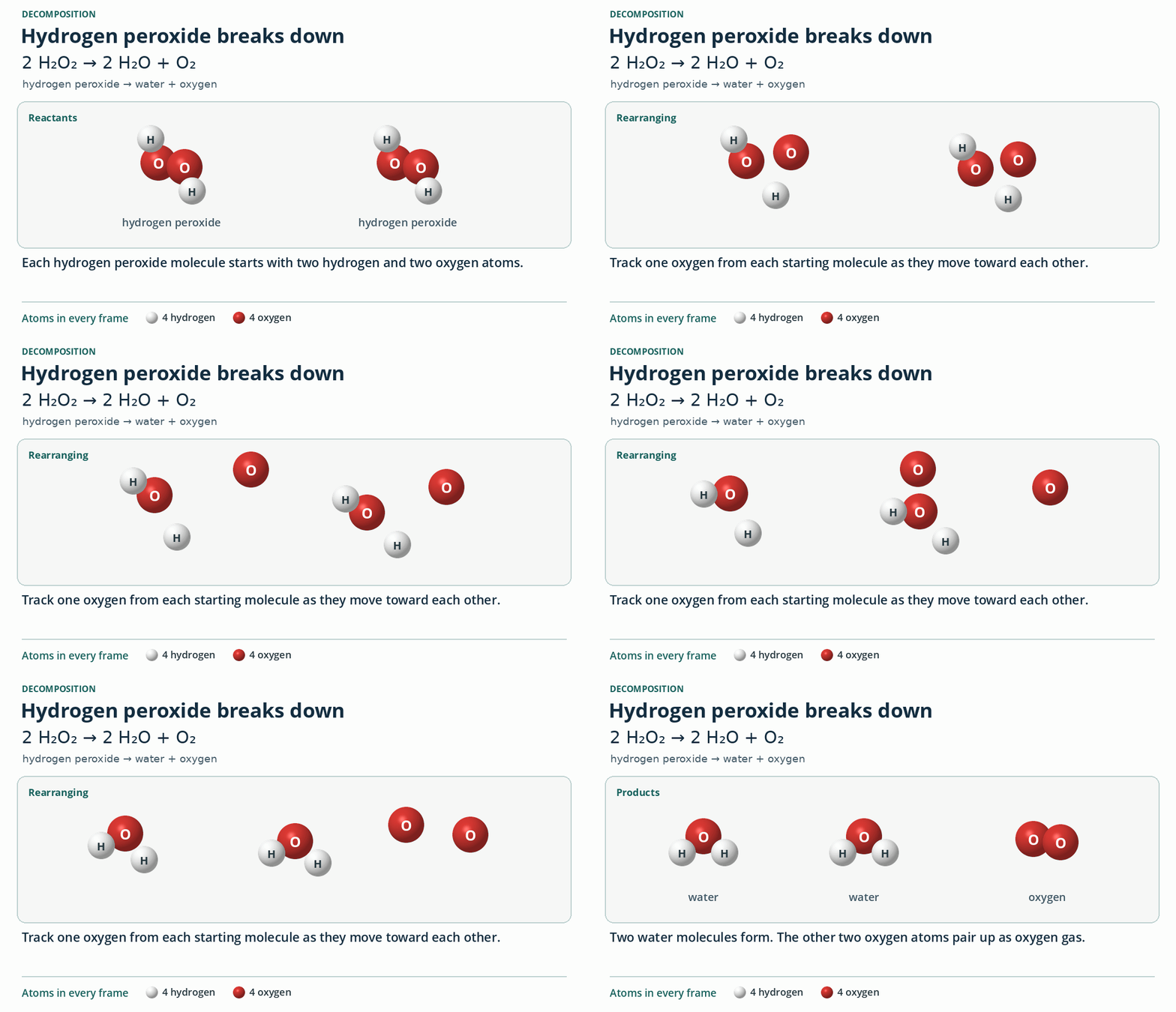
Each GIF shows a before-and-after atom count. The pieces separate on screen so students can follow them. The middle frames are a bookkeeping aid and don’t describe the steps of the actual reaction. Open a reaction to play it and close it to hide the motion. The reaction animation slide deck collects the animations for classroom use.
Build ammonia N₂ + 3H₂ → 2NH₃
Take apart hydrogen peroxide 2H₂O₂ → 2H₂O + O₂
Trace the hydrogen in methane CH₄ + 2O₂ → CO₂ + 2H₂O
Chemical reactions · 16.94 MB
Reaction handout, class slides, animation slide deck, student sheet, lesson plan, and all three GIFs.
04 / WHAT I’LL LISTEN FOR“They’re the same” needs one more question.
If a student tells me “both sides are the same,” I want to know what they counted. Six atoms on each side is a start. Four hydrogens and two oxygens on each side tells me they kept track of each element. Showing me which atoms have new partners tells me they can also explain why we call it a reaction.
That gives me a way to decide what to do next. If a student counts the three starting molecules and goes looking for a third product molecule, I can bring back those nine classrooms that became seven. If they count each kind of atom correctly, I can hand them a new equation and let them try it without the kit.
