Pirl Experimental · Education & Consulting
Think Like a Scientist
Helping students record their ideas and recognize what to do with them
- 01Observe
- 02Hypothesize · Explain · Predict
- 03Question · Investigate
- 04Revise · Refine
I am really liking our Think Like a Scientist procedure. As we work through the opening of our injuries and healing unit, the four-square is giving students a useful place to put their thinking. An observation has a place. A possible explanation has a place. So does a question, or an idea that changes after we look at something new. For the kinds of quick notes I want students to make during an open-ended science lesson, those categories cover a lot.
I am still working on helping students recognize what is worth writing and when. Knowing that there is an observation box does not automatically tell a seventh grader which detail deserves attention. Having a revision box does not automatically make them recognize that the report they just read changes an earlier idea. I think they are doing a good job, and I can also see where clearer prompts and better sentence frames would help.
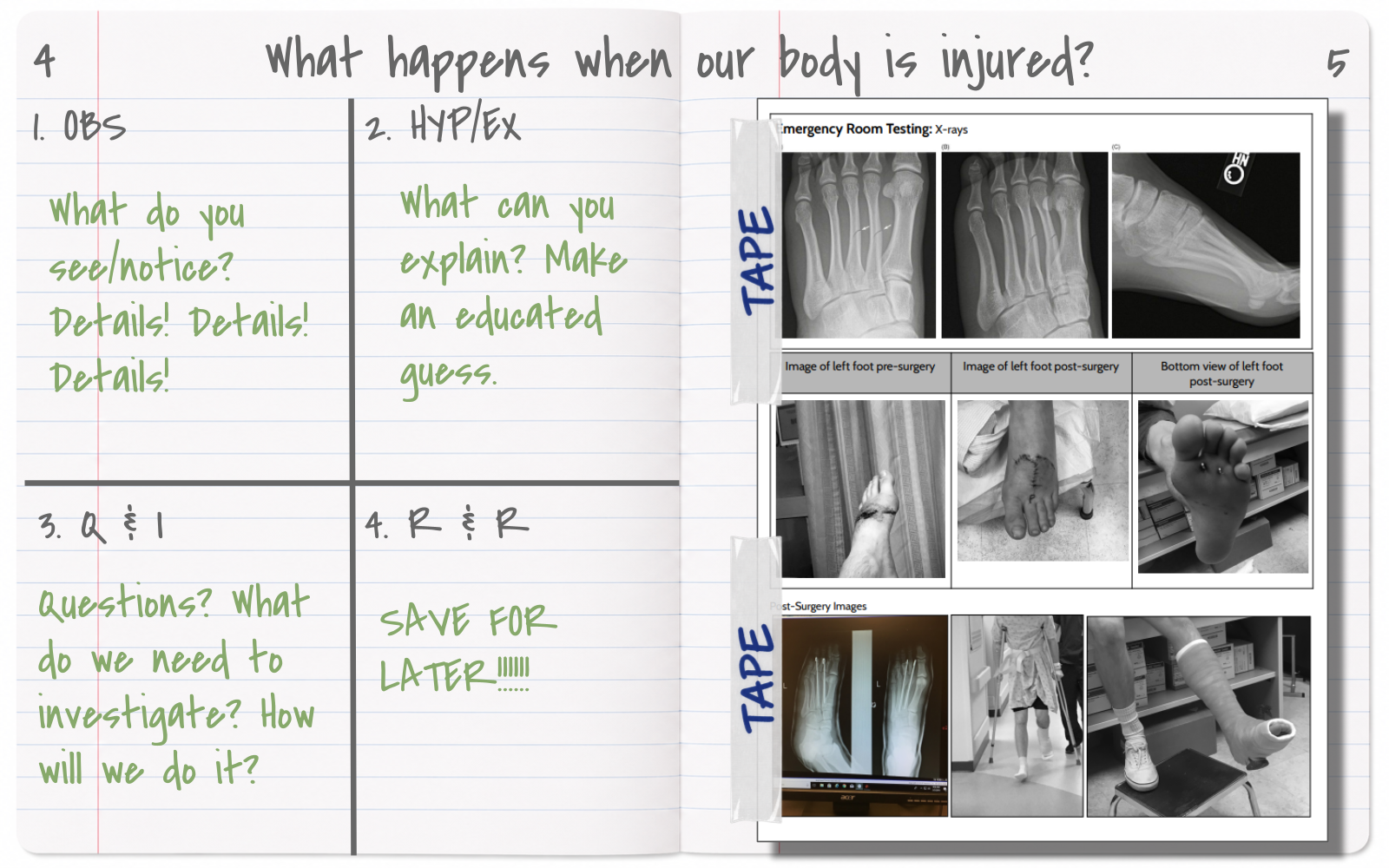
The procedure connects to the familiar See, Think, Wonder routine from Project Zero. My classroom version uses four categories: Observe; Hypothesize, Explain, or Predict; Question or Investigate; and Revise or Refine. I want the language to help students recognize the work an idea is doing. Are they describing something they can point to? Suggesting why it happened? Identifying something they need to find out? Returning to an explanation with new evidence?
The numbers make the boxes easy to find when I am giving directions. Students can move between them as their thinking develops. A new question might send them back to an image. A comparison might lead to another observation. An explanation can become more specific without being completely replaced. The same detail can connect several entries, which is something I want to keep modeling.
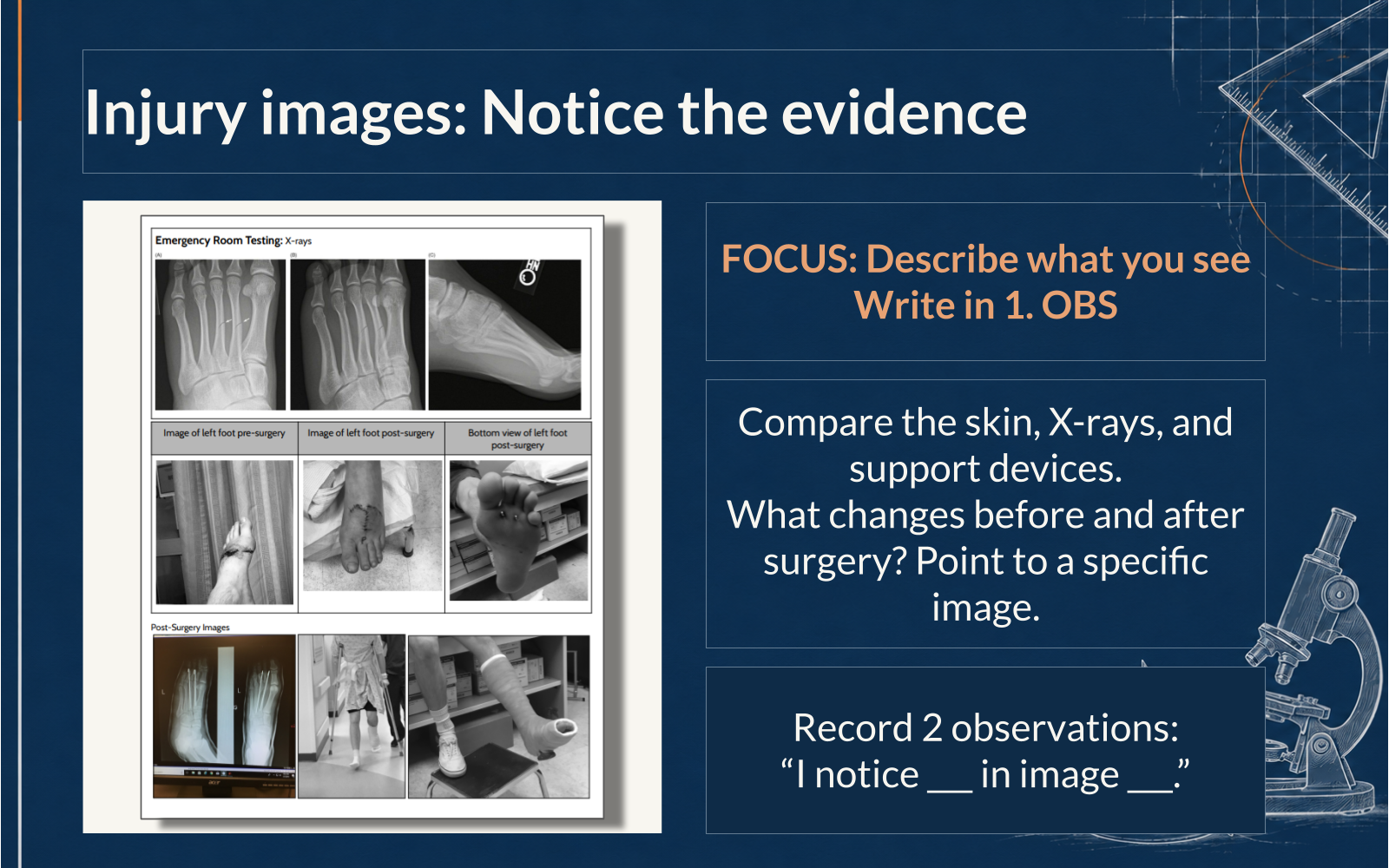
In our first lesson, the question is what happens when our bodies are injured. The photographs and X-rays give students plenty to look at, but plenty to look at can still feel overwhelming. The slide asks them to compare the skin, images of the bones, and support devices before and after surgery. It also gives them a frame: "I notice ___ in image ___." That last part matters. I want another person to be able to find the evidence they are describing.
A possible entry would be, "I notice stitches across the top of the foot in the picture after surgery." An explanation might follow: "I think the stitches help hold the cut edges together." Those sentences do different jobs, even though they refer to the same feature. That gives me something concrete to discuss with students when observation and explanation start getting mixed together.
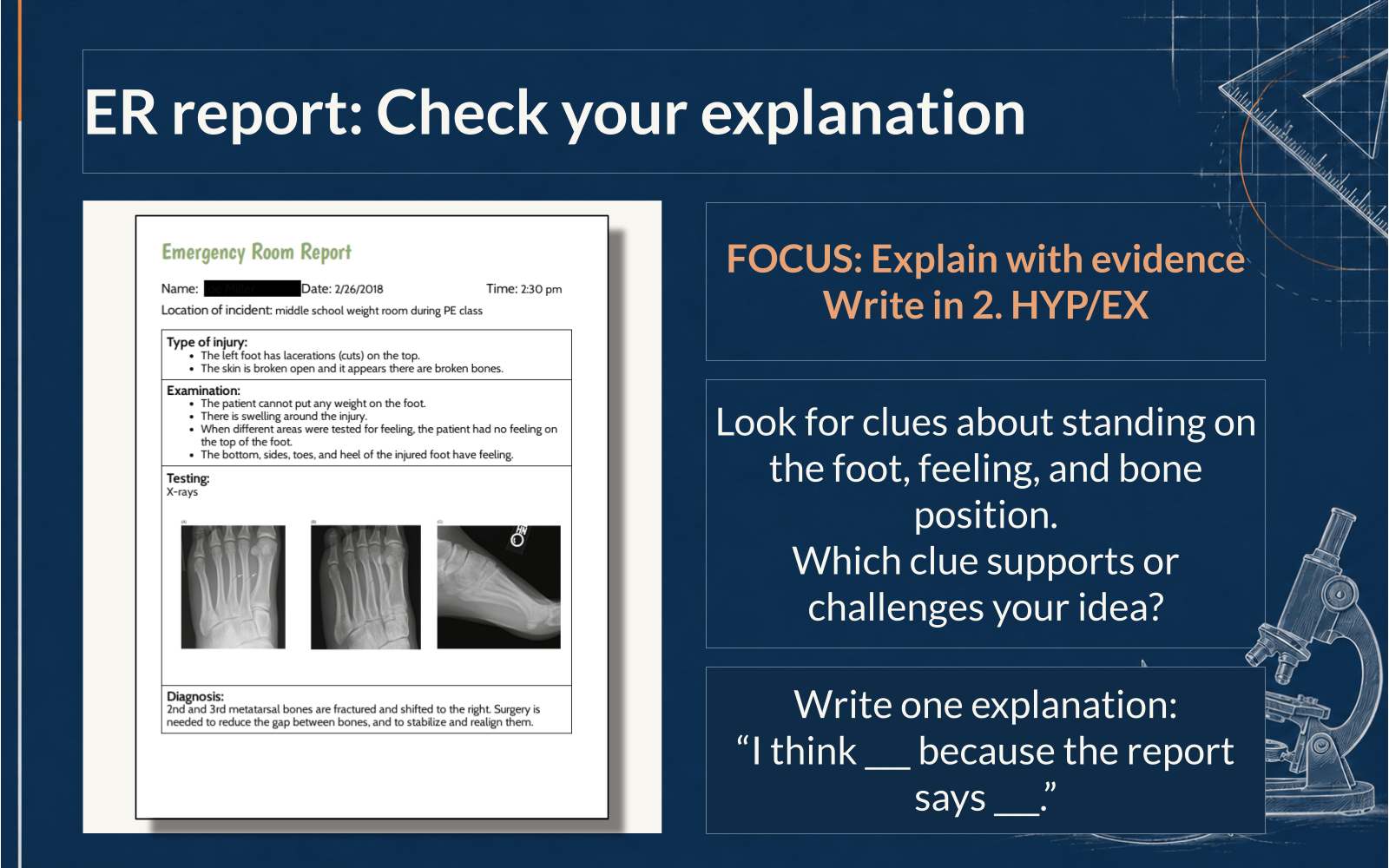
When we move to the emergency room report, students have written findings to compare with what they noticed in the images. The slide points them toward clues about standing on the foot, feeling, and bone position. A sample explanation could be, "I think more than the skin was injured because the report says two bones are fractured and the top of the foot has no feeling." At this point, there is still a great deal about the body for us to investigate. The immediate job is to connect an idea to something the report actually says.
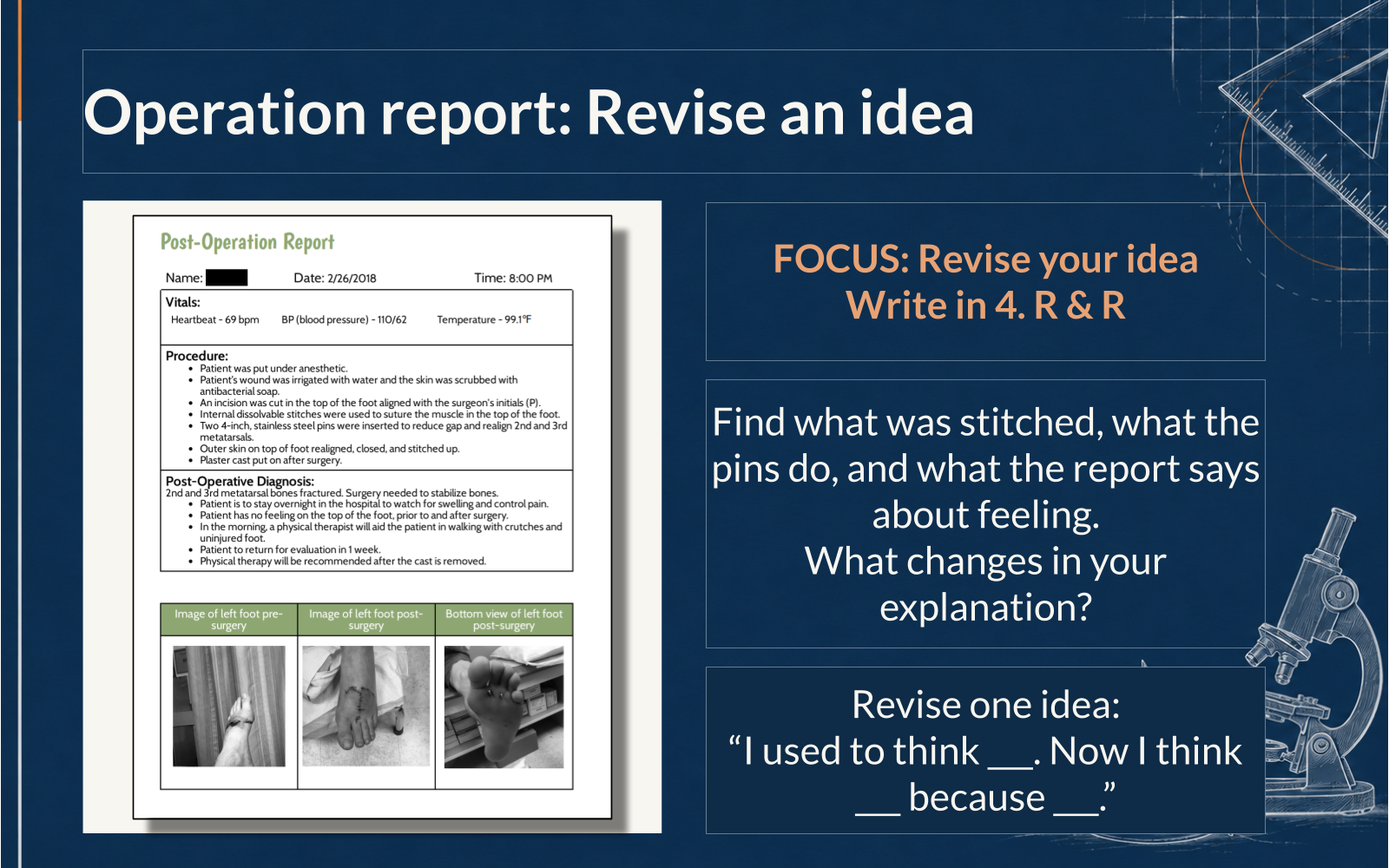
The operation report gives us a reason to return to the fourth box. For example, a student could write, "I used to think the stitches were only for the skin. Now I think the muscle was injured too because the operation report says the muscle needed stitches." That is a sample response I can use to show the connection between an earlier idea and new evidence. I also want students to understand that they can keep an idea and strengthen it: "I still think ___, and now I have evidence that ___." They do not have to pretend they were wrong to demonstrate that they learned something.
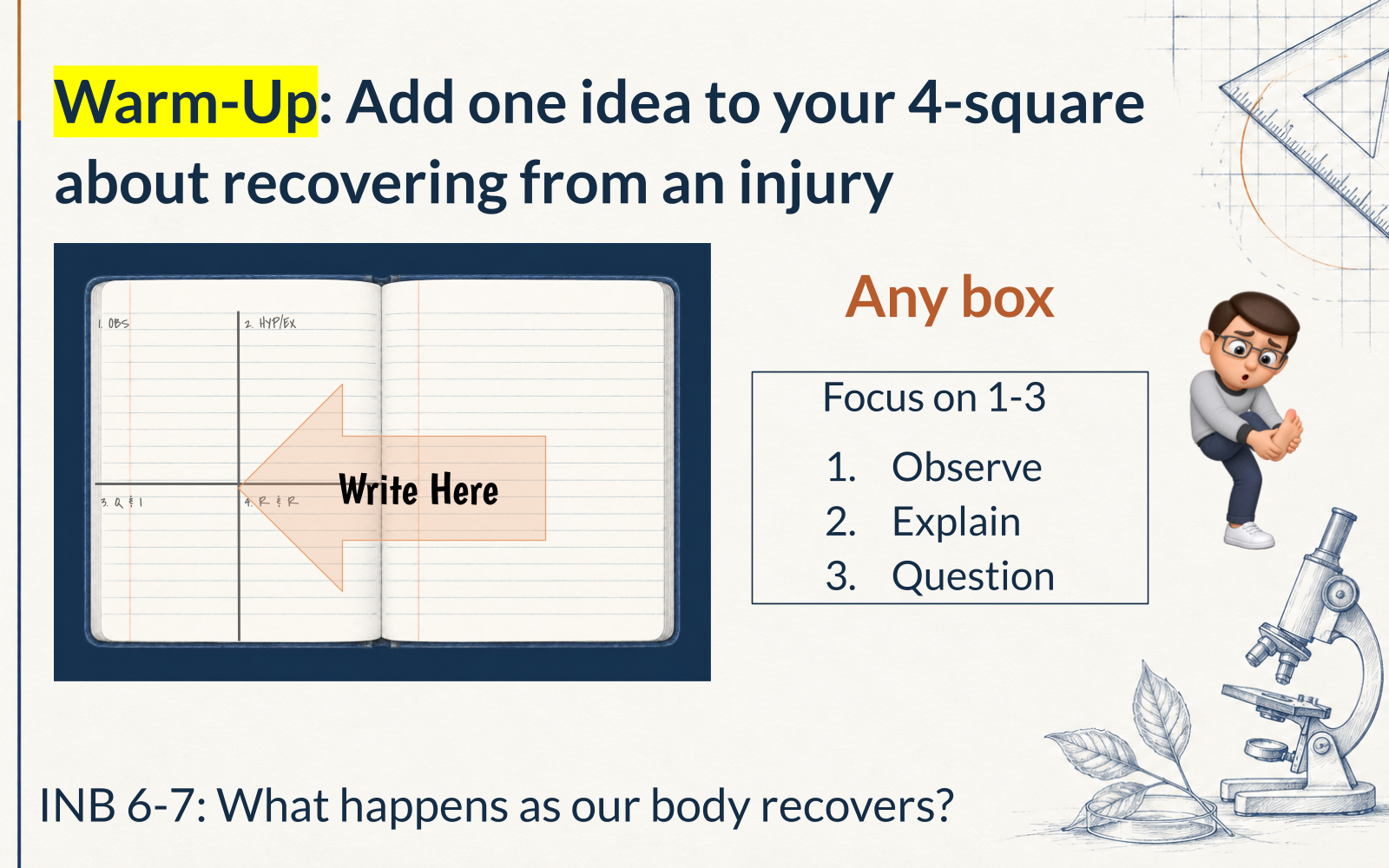
In the next lesson, we ask what happens as our body recovers. I like that students can use the same thinking categories even though the question and evidence have changed. They can start with an observation, an explanation they are considering, or a question they want to pursue. The warm-up gives them a small entry point before we work with the recovery reports.
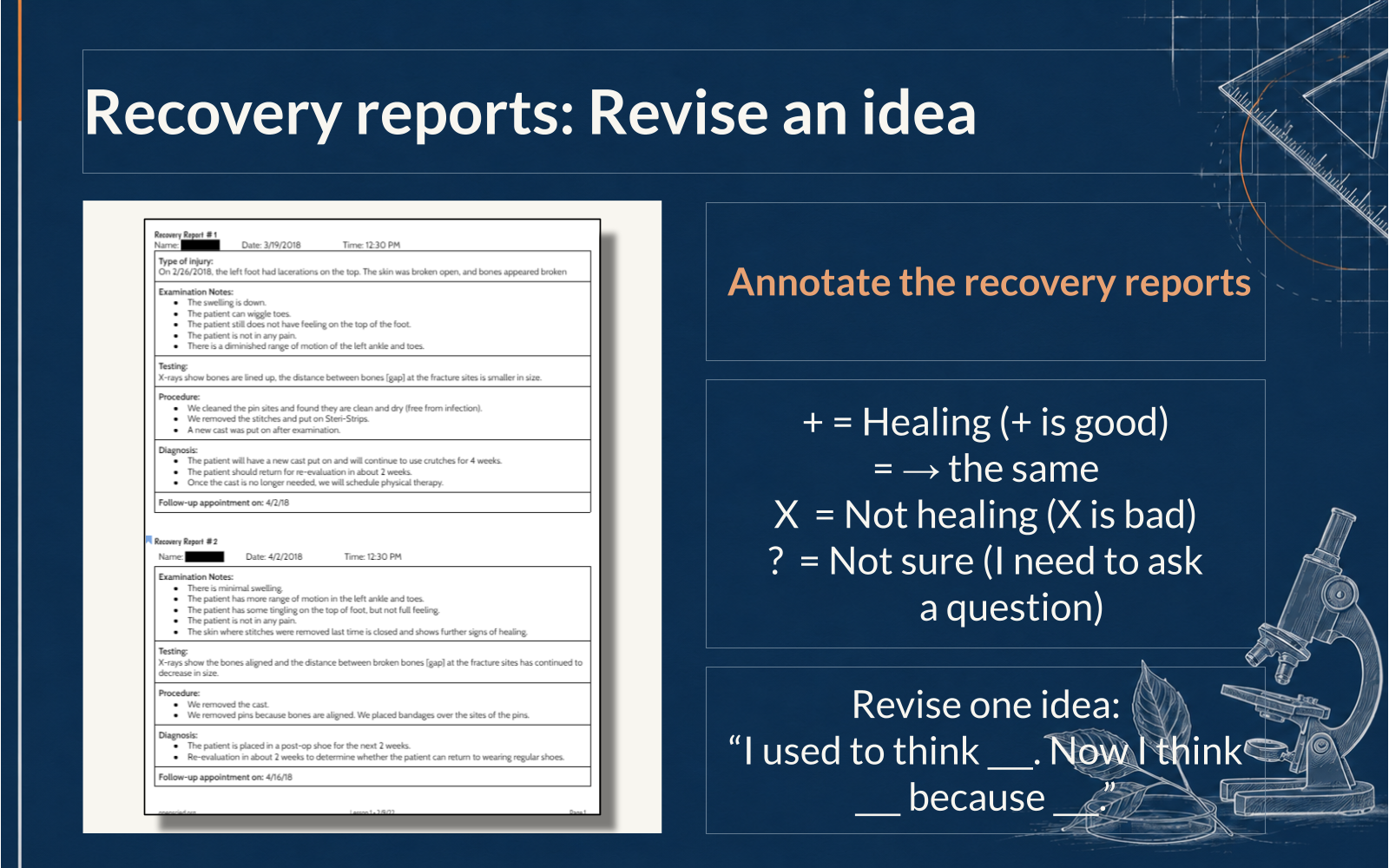
The recovery reports are especially useful because the details do not all change at once. In the first report, the student has no pain, but the fracture gaps are still present and feeling has not returned to the top of the foot. In the second, the skin is closed while the bone gaps continue to shrink. Those findings give us something to compare over time. They also give students a reason to question an initial idea such as "If it does not hurt, it must be healed."
I want to be careful with the shorthand in our annotations, too. A continuing problem deserves attention, but it does not prove that no healing is happening anywhere. A cast still being needed can go alongside other signs of improvement. That is exactly the kind of situation where the explanation or question box helps students say more than a symbol can.
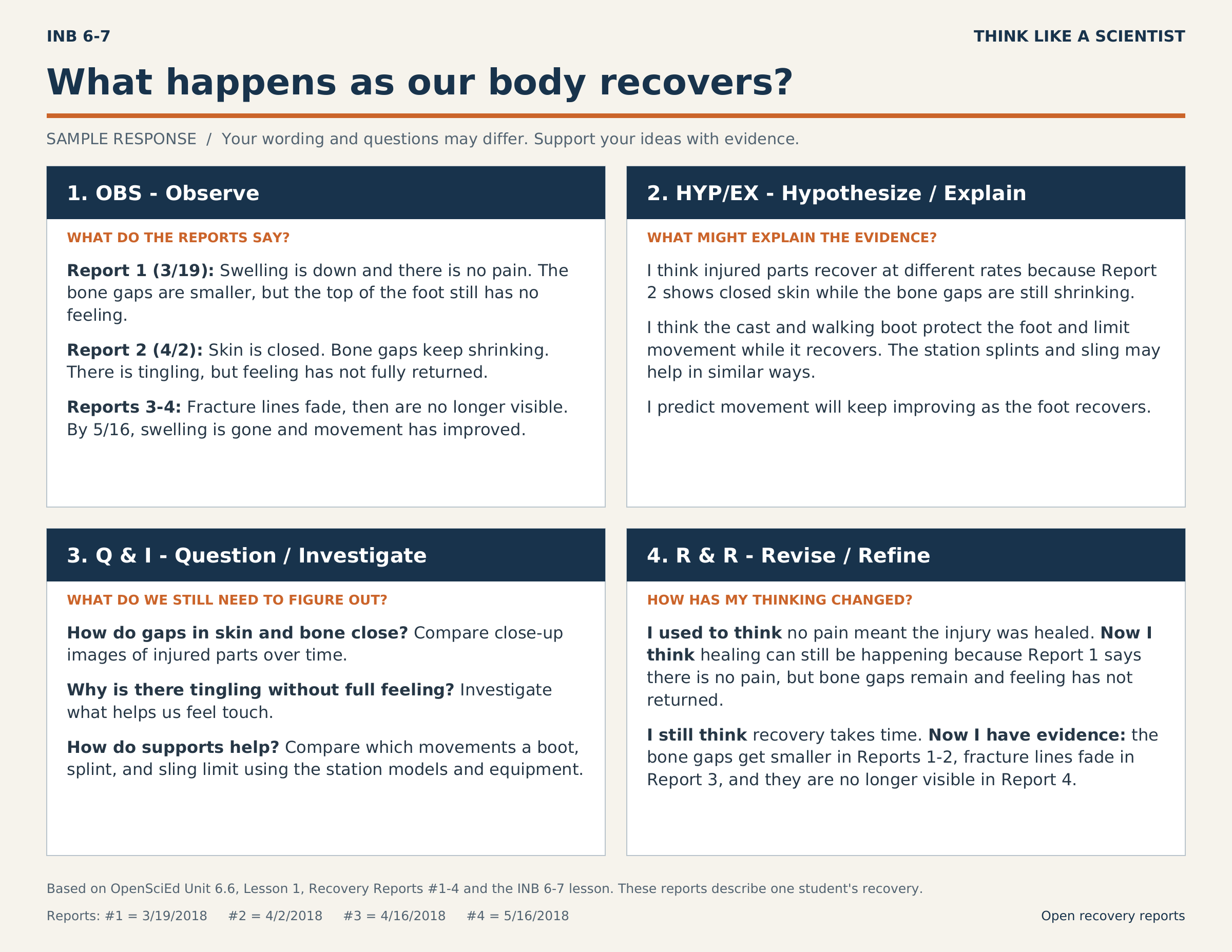
One sample revision says, "I used to think no pain meant the injury was healed. Now I think healing can still be happening because Report 1 says there is no pain, but bone gaps remain and feeling has not returned." The value is in the relationship between the claim and the evidence. Students can also ask how the gaps close, or why feeling returns differently from movement. We can keep those questions open while we gather the science ideas needed to answer them.
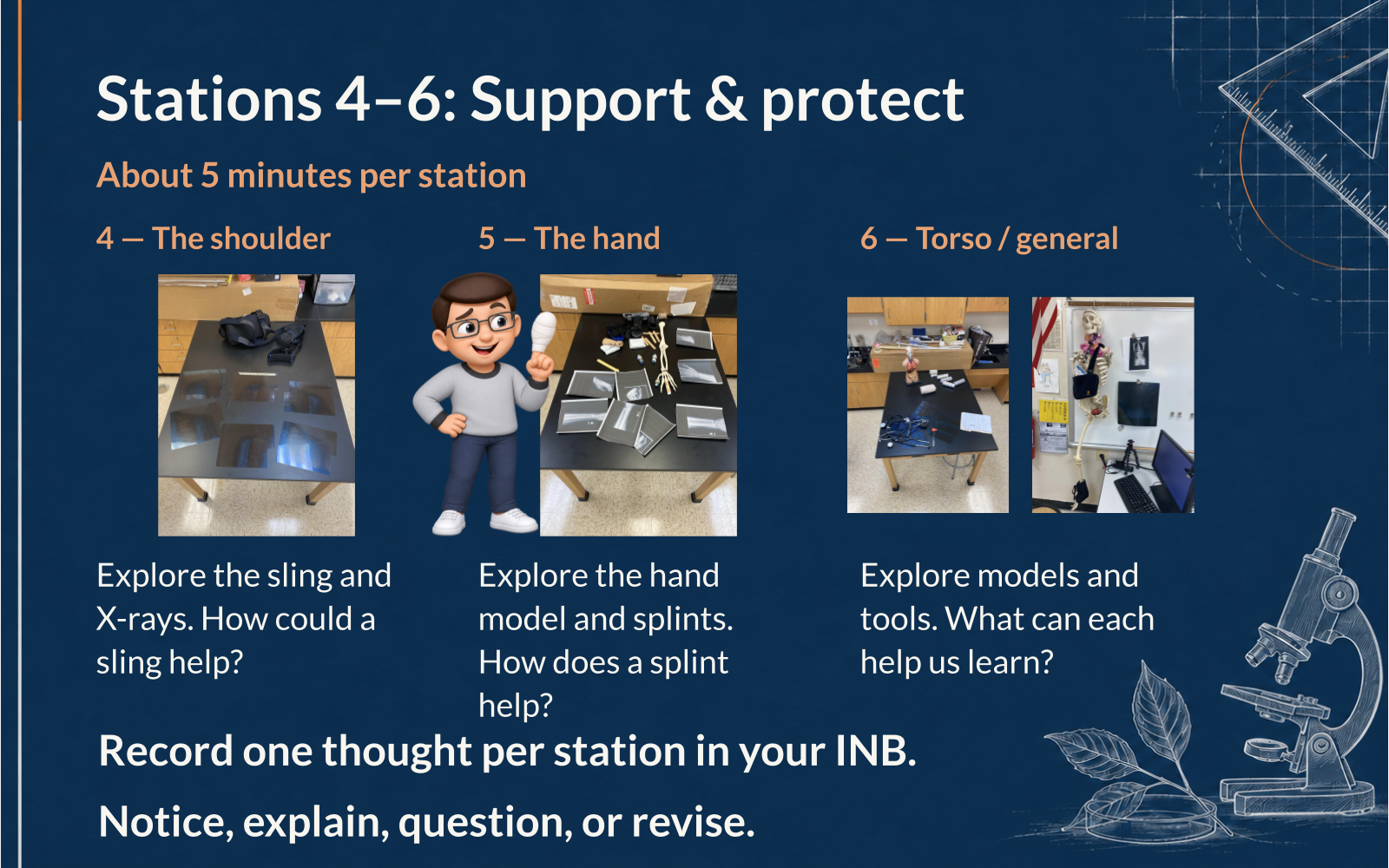
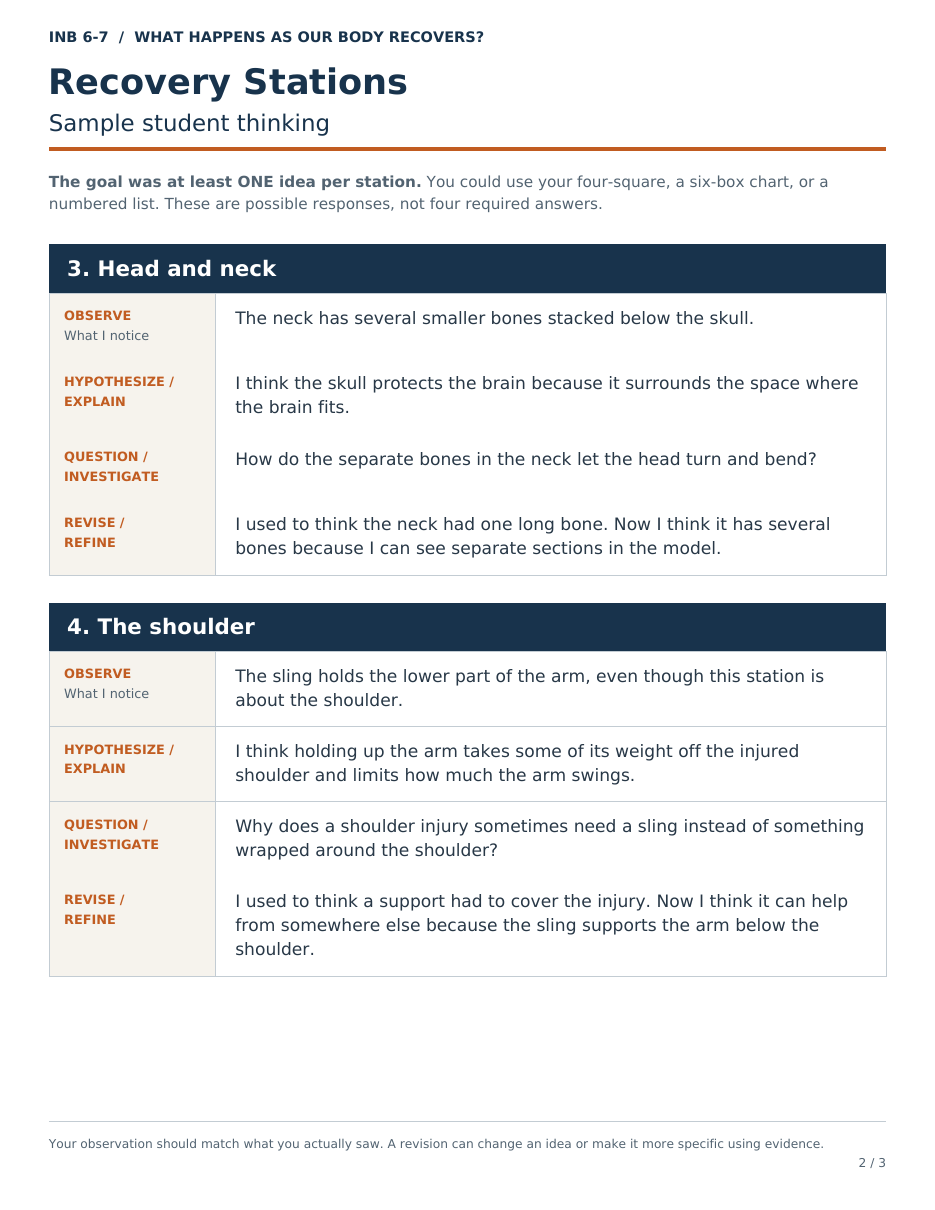
The six stations gave students another way to use the procedure. They explored materials related to the knee, lower leg, head and neck, shoulder, hand, and torso or general body structures. I asked for at least one idea per station. They could add to their four-square, draw a six-box chart, or make a numbered list from one through six. I wanted them to have a workable way to jot down something they were thinking while they explored.
At the shoulder station, for example, an observation could be that the sling holds the lower arm even though the injury being considered is at the shoulder. An explanation could suggest that holding up the arm supports the shoulder. A question could ask why the sling is used instead of something wrapped directly around the shoulder. A revision could recognize that a device can support an injury without covering the exact spot. Those are four possible directions for one station. The assignment only required one idea there.
This is where I see the next part of my teaching. A category gives an idea somewhere to go, but students also need help recognizing an opportunity to have that kind of idea. If a student is stuck, I can point them toward a comparison: What looks different in these two images? If they have a possible cause, I can ask which detail supports it. If they cannot explain something yet, I can help them turn that uncertainty into a question and a way to investigate.
Some sentence frames are already on the slides. I could do a better job of making them consistently available and connecting each one to a situation students can recognize. This is the kind of small reference I want them to be able to use:
| Thinking move | A moment to notice | A frame to try |
|---|---|---|
| Observe | You notice a detail, difference, or change. | I notice ___ in ___. Compared with ___, ___. |
| Hypothesize / Explain / Predict | You have a possible reason or an expectation you could check. | I think ___ because ___. If that idea fits, I predict ___. |
| Question / Investigate | You need more evidence or something does not make sense yet. | I wonder whether ___. To find out, I could compare, test, or observe ___. |
| Revise / Refine | New evidence changes an idea or helps you make it more specific. | I used to think ___. Now I think ___ because ___. Or: I still think ___, and now I have evidence that ___. |
The frame can help a student get started, and I still need to model how to complete it with a useful detail. "I think it is healing because it is getting better" needs more attention to the report. "I think the bone is healing because the gap is smaller in the next X-ray report" identifies evidence someone else can check. I want students to get better at making that connection, even when their first entry is a rough note.
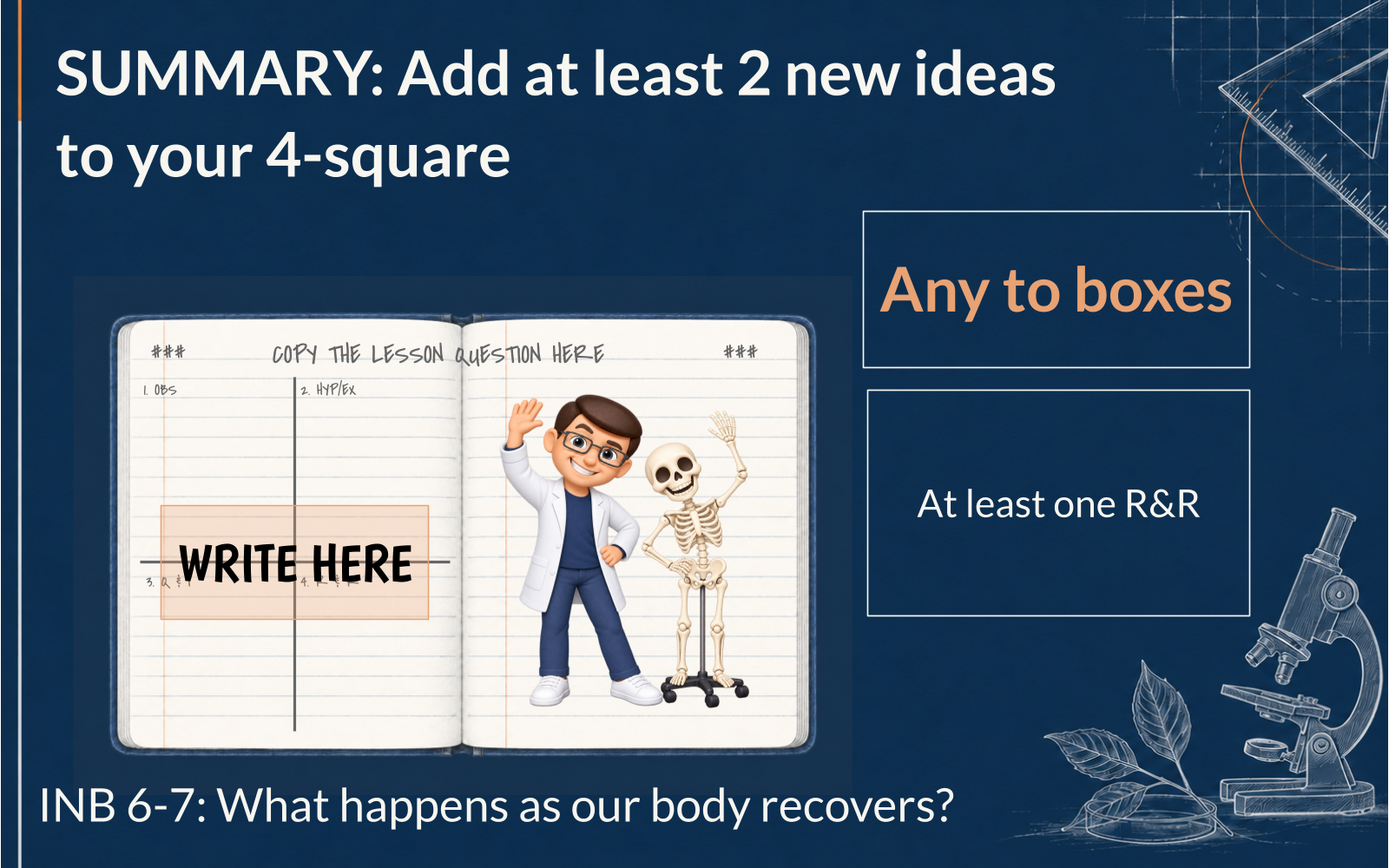
Overall, I am encouraged by how useful this has been. The procedure gives us a shared way to talk about thinking across an image, a medical report, and a table of things students can pick up and examine. I can see a place for almost any relevant idea they might want to record. My next job is to keep helping them notice those moments, choose a useful detail, and recognize when new evidence gives them a reason to return to what they wrote.