PIRL Experimental Education & Consulting
How I Teach It · Seventh-grade science
Teaching for Transfer
Before Assessing It
Why I changed the final assessment in Injuries & Healing and am building more practice into the next quarter.
I built a Salamander Limb Regeneration Virtual Lab to give students an opportunity to use what they had learned about injuries and healing in a new situation. It connects to a question I care about as a science teacher: Can students use the ideas from our unit when the phenomenon changes?
I did not use the lab with my students during this year’s Injuries & Healing unit. I ran out of time.
That changed my assessment plans. Without the opportunity to give students the practice transfer task, I was not comfortable giving them the transfer test at the end of the first quarter. I did not feel that I had adequately taught for transfer yet.
Instead, I gave a final assessment that asked students to explain the familiar storyline we had been studying. It made fewer demands on applying their knowledge in a new context, and I felt it was the fairer assessment of the work we had actually done.
I still want students to take on an unfamiliar transfer task. I already have one I feel good about for the end of the second quarter. The work now is to use the time between those assessments to prepare them more deliberately.
Why I changed the final assessment
In Injuries & Healing, students work toward explaining how the structures and processes they study contribute to an injury and its recovery. Bringing those ideas together to explain the original phenomenon is meaningful work.
A transfer assessment adds another demand: students have to recognize how those ideas apply when the situation is unfamiliar. That was the part of the work I did not feel I had given them enough opportunity to practice.
The timing mattered, too. We were at the end of the quarter. If that unfamiliar assessment went badly, students would not have had an opportunity to use the feedback, improve their understanding, and bring their grade back up before the quarter closed.
I wanted the final assessment to reflect the preparation I had provided. Asking students to explain our storyline was a more appropriate choice at that point.
The missing practice task also made me reconsider the larger instructional sequence. One practice experience would not have guaranteed readiness. I needed to make transfer a more regular part of learning, with time to see where students struggled and respond.
What students have to do when the situation changes
Transfer means using learning from one context in another. The National Research Council’s synthesis in How People Learn emphasizes that adequate initial learning matters, and that knowledge learned in only one context can be difficult to use elsewhere. Working across contexts can help learners identify the features and relationships that carry over. [1]
For my planning, that raises a question beyond whether students can explain an idea: Have they practiced deciding when that idea is useful?
Think about moving from the human injury in our unit to salamander limb regeneration. I can ask students which ideas about cells, tissues, blood, nerves, and interacting systems might help them understand the new phenomenon. But I also need them to explain why a particular idea belongs in their explanation.
A student who includes the words “cell division” has identified a possible connection. I still want to know which observation that idea explains, how it explains it, and what remains unresolved.
Those are decisions I can model and give students opportunities to practice.
What the research suggests about practice
One useful finding concerns comparison. In experiments with college students learning negotiation principles, Gentner, Loewenstein, and Thompson found that explicitly comparing cases improved transfer relative to studying the same cases separately. The learners benefited from working out the relationships the examples shared. [2]
My classroom application is to make comparison more deliberate. When I introduce a new phenomenon, I want students to identify what connects it to earlier learning and which differences might change their explanation.
Bransford and Schwartz offer another useful perspective: preparation for future learning. They argue that transfer can also be examined through how prior learning helps someone learn from new information and resources, alongside assessing what that person can solve independently. [3]
During practice, I can therefore look at how students use a model, a reading, a discussion, or feedback to improve an explanation of something unfamiliar. I can use what I learn about their thinking to plan the next opportunity.
Where the salamander lab fits
The Salamander Limb Regeneration Virtual Lab gives me a context for designing that kind of practice. The organism and phenomenon change, while students bring ideas from Injuries & Healing that may help them make sense of what they encounter.
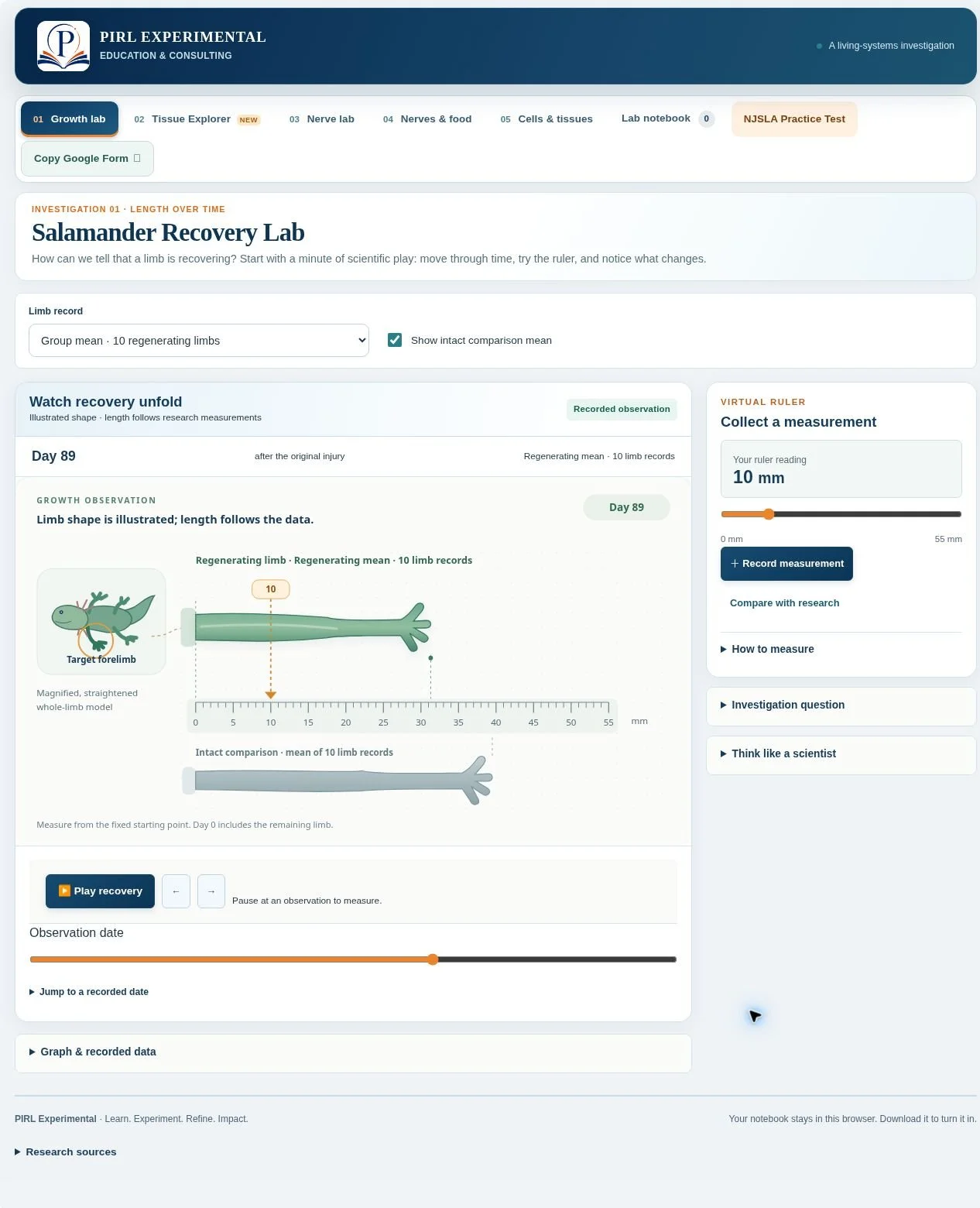
I would pair the lab with questions such as:
- What do you notice in this situation that connects to our injury storyline?
- Which science idea helps explain a specific observation?
- What is different, and how might that difference matter?
- What can our existing explanation account for?
- What additional information would we need?
I would also want to set a reasonable boundary around the task. Students should have the information they need about an unfamiliar phenomenon. The challenge is to use their prior science knowledge with that information and explain the connections they make.
For example, a useful discussion could begin with whether an explanation about producing additional cells is enough to account for everything students are trying to explain. What questions remain about the organization and function of the new structures? What evidence would help answer them?
Those questions would let me see where students can make a connection and where further instruction is needed.
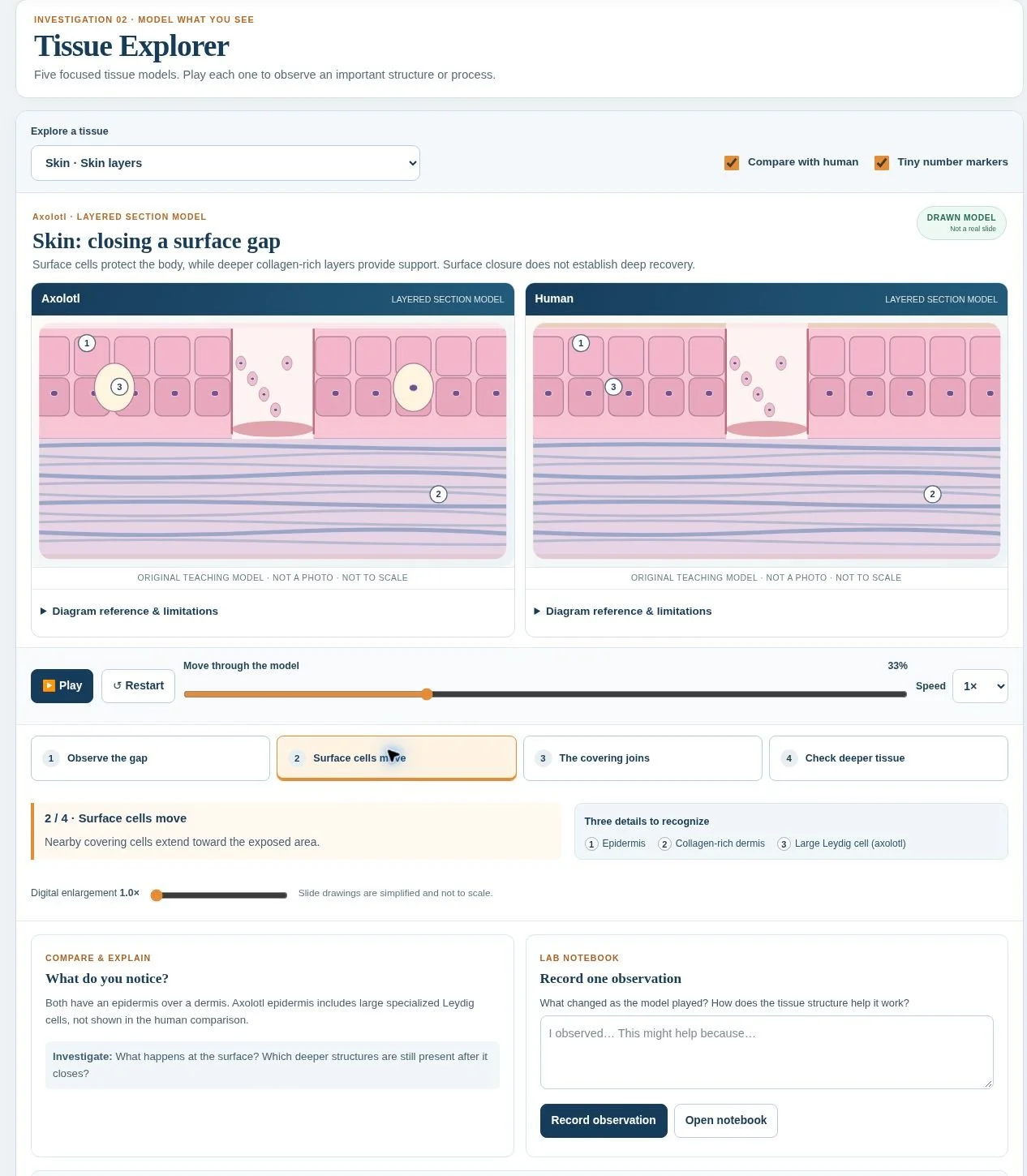
A toolkit for making the thinking visible
I also have an existing resource to support this work: Creator Tool 13, the Transfer Task Toolkit. It gives students a routine for approaching an unfamiliar phenomenon:
- Understand the phenomenon before trying to solve it.
- Connect the new situation to prior learning, including similarities and differences.
- Choose the science that belongs in the explanation.
- Connect evidence from the task to a science idea and explain the relationship.
- Use a strategy when the explanation stalls.
- Separate what can be explained from what remains unresolved.
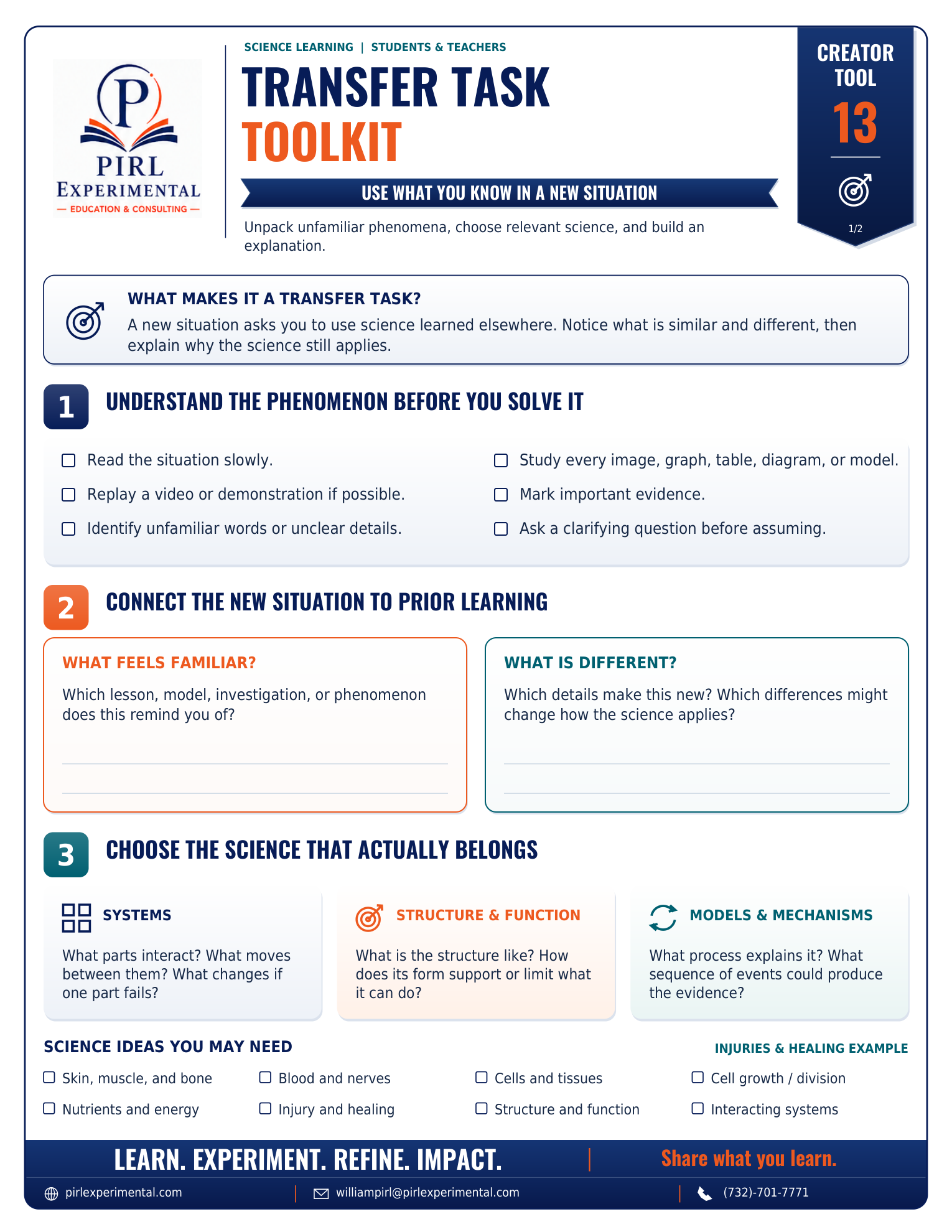
The toolkit already includes an Injuries & Healing example with possible science ideas students might use. Its explanation planner asks them to connect evidence, a relevant science idea, and an explanation of how the idea accounts for the evidence.
That last connection is the part I want to spend time teaching. Students need opportunities to explain their choices and revise connections that are incomplete.
I also like that the toolkit asks students to name what they still cannot explain. In a practice task, that gives us something specific to investigate or discuss next.
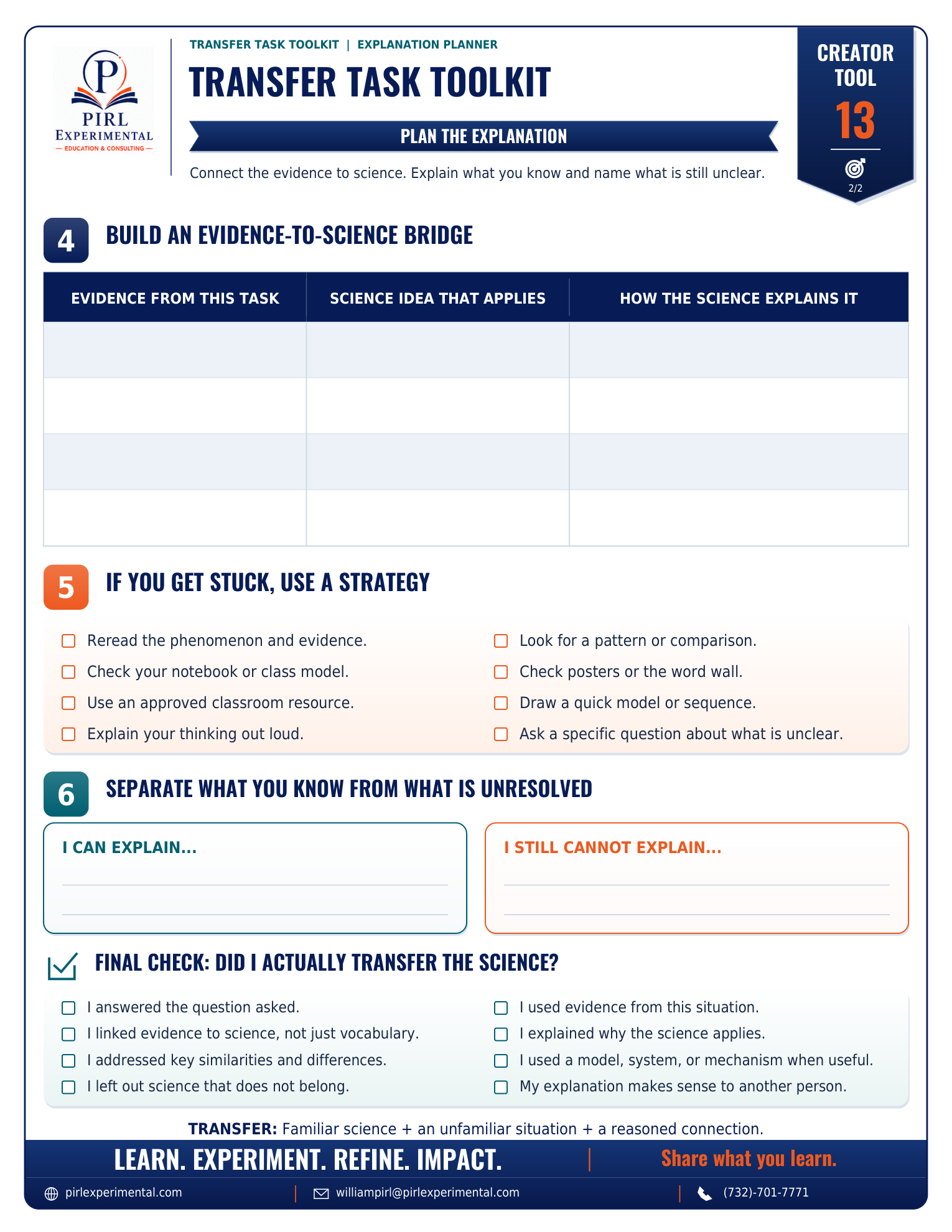
When students use the toolkit, I will interpret their work in light of the support it provides. Its prompts and concept bank help direct their attention. Later, if I want to see whether students can choose relevant ideas independently, I can reduce those content hints while keeping the reading and accessibility supports they need.
How I plan to use the second quarter
I already have a transfer task I want to use at the end of the second quarter, and the additional time gives me room to build toward it. I want that preparation to include repeated opportunities to make connections, receive feedback, and try again.
Here is the approach I want to take:
Include smaller applications during the unit.
A practice opportunity can be a short scenario, a new image, or a question about a changed condition. Students can work on explaining one connection before taking on a larger task.
Make comparison an explicit part of discussion.
I want students to explain what carries over from a familiar phenomenon and which differences matter. I can model that reasoning and then ask them to try it with a partner.
Give feedback on the connection itself.
I want to identify whether a student has misunderstood the evidence, chosen an idea that does not fit, or left a gap in the explanation. That gives the student a more specific next step than simply being told to add detail.
Provide time to revise and apply the feedback.
Practice needs to happen early enough that students can use what they learn from it. I want them to improve an explanation and then try making a connection in another situation.
Adjust support using their work.
I can begin with more guidance and use students’ explanations to decide when to reduce specific hints. I also need to notice when the barrier is understanding the science, reading the task, or expressing the reasoning, because those call for different responses.
The final task can still present an unfamiliar phenomenon. By then, I want the process of examining evidence, selecting useful knowledge, and explaining a connection to be something students have practiced repeatedly.
How parents can help students study for transfer
Parents and caregivers can help by giving students someone to explain their thinking to. Teaching the science and providing practice opportunities remain my responsibility. When families have time to study together, here is how I would translate the research into a short conversation at home.
Recall an idea, then use it.
Begin with something the student has already learned. Ask them to explain an idea briefly with the notebook closed, then try an application question from class. In an eighth-grade science study, repeated quizzes with feedback that included application questions improved performance on different application questions. Practicing definitions alone did not produce that same benefit. The researchers described this as transfer to related problems, so I would be careful about assuming the practice prepares students for every unfamiliar situation. [4]
For home study, that could mean following “What does this term mean?” with “How does that idea help explain this observation?” The student needs opportunities to practice both remembering the science and deciding how to use it.
Ask for the explanation behind the answer.
Try “How does that happen?” or “What connects that evidence to your explanation?” In a small study of eighth graders learning about the circulatory system, Chi and colleagues found that students prompted to explain what they were reading made greater gains in understanding, including on complex questions, than students who reread the text without those prompts. [5]
A parent can invite the student to talk through a process or explain a sketch. If the answer is only a science word, a useful follow-up is, “What does that process do in this particular situation?”
Compare two examples.
Use examples or models supplied by the teacher, so the student has the information needed to reason about them. Ask, “What is similar? What is different? Which science idea helps with both, and where might the explanation need to change?” This is my home-study adaptation of the comparison research discussed earlier. [2]
For Injuries & Healing, a family could look at the familiar injury storyline alongside a model from the salamander lab. The useful conversation is about which observations the student can explain using prior learning and what additional information they still need.
Check the explanation and let the student revise it.
After the initial attempt, open the notebook, class model, or teacher-provided reading together. Ask, “What matches? What should we change?” Parents can use those resources to check the science without needing to know every answer themselves.
If the student gets stuck, offer a small cue, such as asking which lesson might help. Then let them consult a diagram or review the relevant idea and try again. If neither person can resolve a question, write it down for class. The Transfer Task Toolkit’s evidence → science idea → explanation structure can help organize this conversation.
Return to the idea on another day.
Spacing research shows that the timing of review matters for later recall. Cepeda and colleagues’ study of factual learning in adults found that useful review intervals depended on how long the information needed to be remembered. That evidence concerns retention; my recommendation for transfer is to combine revisiting the science with another opportunity to apply it. [6]
A practical approach is to choose one important idea, discuss one example, and check the explanation together. On a later day, return to that idea with a different class example. There is no single research-established schedule for this particular home routine.
Keep the student involved in the decisions.
Ask whether they would like to explain aloud, write, or talk through a drawing. Listen to their approach and ask what help would be useful. Research on parental autonomy support links this kind of support for children’s choices and perspectives with stronger academic and motivational outcomes. Those studies were correlational, so they do not establish that a particular parenting technique causes better transfer. [7]
The role I would suggest for a parent is a curious listener who helps the student check their thinking and decide what to try next. Any unresolved questions give us something specific to work on back in class.
What I want the next assessment to reflect
I want students to leave a science unit able to use what they know beyond the situation in which they first learned it. That remains the goal.
The Salamander Limb Regeneration Virtual Lab and the Transfer Task Toolkit are resources I can use to build toward that goal. The next step is to make room for the instruction, practice, and feedback around them.
When students reach the transfer task at the end of the second quarter, I want them to have had meaningful opportunities to practice the thinking it asks them to do.
Explore the resources
- Salamander Limb Regeneration Virtual Lab
- PIRL Experimental Creator Tools, including the Transfer Task Toolkit
Research referenced
- National Research Council. (2000). Learning and Transfer. In How People Learn: Brain, Mind, Experience, and School: Expanded Edition. National Academies Press.
- Gentner, D., Loewenstein, J., & Thompson, L. (2003). Learning and Transfer: A General Role for Analogical Encoding. Journal of Educational Psychology, 95(2), 393–408.
- Bransford, J. D., & Schwartz, D. L. (1999). Rethinking Transfer: A Simple Proposal With Multiple Implications. Review of Research in Education, 24, 61–100.
- McDaniel, M. A., Thomas, R. C., Agarwal, P. K., McDermott, K. B., & Roediger, H. L. (2013). Quizzing in Middle-School Science: Successful Transfer Performance on Classroom Exams. Applied Cognitive Psychology, 27, 360–372.
- Chi, M. T. H., de Leeuw, N., Chiu, M.-H., & LaVancher, C. (1994). Eliciting Self-Explanations Improves Understanding. Cognitive Science, 18, 439–477.
- Cepeda, N. J., Vul, E., Rohrer, D., Wixted, J. T., & Pashler, H. (2008). Spacing Effects in Learning: A Temporal Ridgeline of Optimal Retention. Psychological Science, 19, 1095–1102.
- Vasquez, A. C., Patall, E. A., Fong, C. J., Corrigan, A. S., & Pine, L. (2016). Parent Autonomy Support, Academic Achievement, and Psychosocial Functioning: A Meta-analysis of Research. Educational Psychology Review, 28, 605–644.