Fifteen Years In, Starting Over Again
On curriculum changes, first-day routines, AI, and keeping expertise from becoming rigidity.
I believe this is year 15 for me. I still don’t have a standard process for starting a school year. That’s weird because I’m a very organized teacher. It is also probably why I’m still interested in the work.
Three Weeks Until School
It’s August 16. We have about three weeks left of summer. We start on September 8 this year. I’ve seen my class rosters. My schedule is pretty sweet. So, right now, I’m feeling pretty motivated to get after the school year. As I think about gearing up, though, I realize something surprising: I still don’t have a standard process for starting a school year. That’s weird because I am a very organized teacher. I love teaching. I love researching teaching, thinking about teaching, talking about teaching, and tinkering with teaching. Like some of the best teachers—and probably some of the most annoying ones—I’m always on the quest for the perfect start to school, the perfect unit, the perfect lesson, the perfect assessment. No, I’m not insane. I understand none of those things actually exist. But I am also not someone who is good at leaving well enough alone.
I consider myself highly reflective. I am constantly trying to improve things. I almost never teach something exactly the same way twice, and I certainly don’t start every school year the same way. Some of that is for my own sanity. My dictation software originally heard vanity, though, and honestly, there’s probably a little of that too. And some of it is for my students.
There are obviously things I do every year. I teach 7th-grade science, and over the past few years I’ve made it a goal to communicate a little more like an elementary school teacher. I send lots of communication. Lots of summaries. Lots of updates. I share calendars and pacing guides with parents so they have some idea of what is coming. Part of my philosophy could be described as a no-secrets classroom. You could also describe parts of it as: I told you so. Or: No excuses. Those sound harsher than I actually mean them. The idea is that I want students and families to know what to expect. I want to make the expectations explicit. I want to explain how the class works, what is coming, what students need to do, and what resources are available. Then, eventually, I want students to take some responsibility for using that information. No secrets. No excuses. “I told you so.” High transparency first; student responsibility follows.
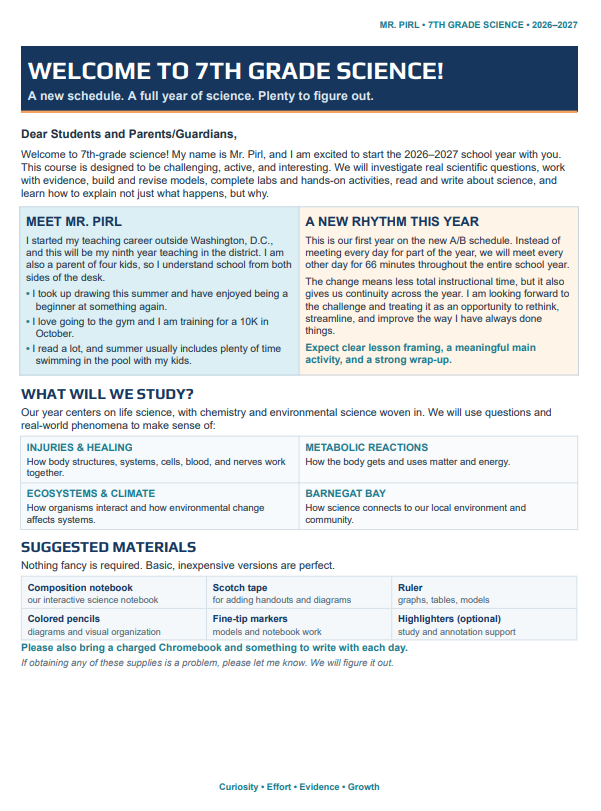
Every year I send students and parents a letter introducing myself and giving them a rundown of the course, supplies, expectations, and general structure. I wouldn’t exactly call it a syllabus, but it serves a similar purpose. This year will be the first time I also send out a pacing guide for the entire year. Historically, I have created calendars for each marking period and shared those with students and parents. This year is different.
The Schedule Changed… a Lot
We had a major schedule shift. Previously, I taught students every day for 78 minutes, but only during alternating quarters. Now, we are moving to an A-day/B-day schedule. I will see students every other day for 66 minutes, but I will see them throughout the entire school year. There are pros and cons. We are losing instructional time overall, which obviously isn’t ideal. But students will now have science throughout the year instead of having these massive gaps where they don’t have science at all. That part could be a major improvement. Either way, it requires a pretty significant change in timing and instructional approach. We were already short of the amount of instructional time OpenSciEd assumes teachers have available. Now we’re even shorter. Luckily, we’re already accustomed to paring back the curriculum. We just have to pare it back a little more.
We knew this schedule change was coming last year, so I spent some time experimenting. I tried to see what I could realistically accomplish in 66 minutes. One obvious change is that I used to allow students to use some class time to work on homework. There simply isn’t enough time for that anymore. That work will have to go home. I’m actually not particularly intimidated by the change. It should be fine. In some ways, it is going to force me back toward my roots. Most lessons will probably need three very clear segments: frame the lesson, do the main thing, and make sense of what we did. I’m good at that. I can do that. I know what I’m doing. The challenge is mostly going to be figuring out how much I can realistically accomplish in the reduced amount of time.
Fortunately, the curriculum leaves plenty of places to condense. There will probably be a little more literal direct instruction. Actually, there will probably be an overreliance on direct instruction at first. Then, after I try things a few times, I imagine it will settle into something more appropriate. And that’s okay. Curriculum experts sometimes talk about full implementation taking around five years. This isn’t a complete curriculum reboot, but it is certainly a major enough structural change that I think expecting instant perfection would be ridiculous. If I were in charge, I would probably consider this a two- to three-year implementation process. I’ll probably figure out a lot by the end of this year. Other pieces may take longer. That’s normal.
So right now, I’m noodling around with the first and second class meetings. And that brings me to one of my oldest beginning-of-school activities.
Rethinking the First-Day “Resume”
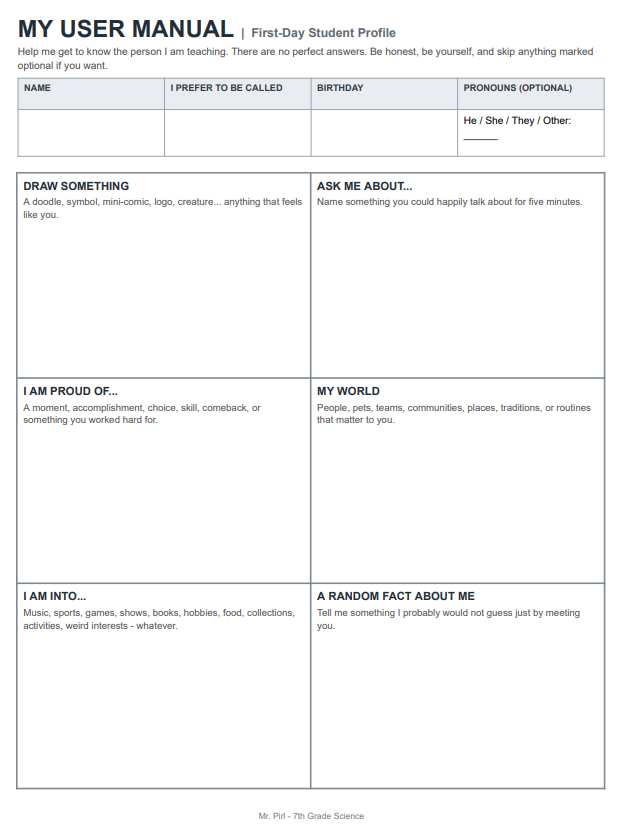
I have always started class with something I call a resume. When I was first introduced to the activity, someone called it a getting-to-know-you calling card. The original was half a sheet of cardstock. Each side had four boxes with four questions—eight questions total. Students answered the questions and handed the card to the teacher. Then the teacher could use the stack as a random calling strategy. Grab a card. Call on that student. But because their answers are right there in front of you, you can also read something they wrote and ask a follow-up question. So you’re randomly calling on students while simultaneously learning something about them. I loved that.
Eventually, though, I wanted more information. I realized I could make it a full sheet of paper, front and back, get considerably more information from students, and still use it almost as easily as I could use the little cardstock cards. That’s basically what I’ve done ever since. I tell students why we start with this activity. I tell them that I think one of the most important things I can do at the beginning of the year is get to know them, and this is the fastest way I know to start doing that. It doesn’t tell me everything. Obviously. But it immediately gives me little openings: sports, hobbies, family, favorite classes, things they dislike, things they’re nervous about, things they’re proud of. And sometimes their answers give me a reason to talk to a kid whom I might otherwise not connect with for another week. That’s valuable.
The other day, I was at school taking care of some classroom obligations and planned to reprint the resume. There was no paper in the copy room. The copier appeared to work. Just…no paper. I didn’t bother getting upset about it. I’ve become accustomed to the copy machine not working for one reason or another. So I walked away and figured I’d deal with it eventually. I still want paper copies. But the situation made me wonder about a digital version. I could assign the resume through Google Classroom and have students type their responses. It would probably be faster. It would definitely be neater. There are some interesting possibilities there too.
One of the questions on my current resume asks students to draw something. I like that question. Partially, I want to see who considers themselves an artist. We do a lot of drawing and modeling in science, so it is genuinely useful for me to know who enjoys drawing, who is comfortable with it, and who immediately thinks: I can’t draw. I also just like seeing what they make. It makes me happy. It gives me a tiny window into their personality. A digital version could create a different opportunity. Students could include photos, clip art, images from the internet, things that represent their interests, places they love, sports, hobbies, pets—whatever.
Still, I resist immediately putting them in front of Chromebooks. For someone who uses AI as much as I do, my classroom is actually pretty low-screen-time. We do a lot by hand. We draw constantly. We model things. We use physical notebooks. For much of what I teach, pencil and paper are simply easier. There are also fewer distractions to manage: games, websites, email, messaging, selfie cameras, whatever else seventh graders discover they can do instead of what they’re supposed to be doing. Paper is also incredibly flexible. Internet goes down? Fine. Power goes out? Fine. I didn’t make copies? Fine. Open your notebook. Draw this. Write this. Let’s go. Over the years I’ve gotten much better at rolling with the punches when something doesn’t go according to plan. So I still lean heavily toward paper. But the copier incident got me thinking. And when I start thinking about whether an old teaching activity could be better, nowadays I have another tool available.
So I Asked AI to Critique It
One way to maximize your before-school planning time is pretty simple: Ask AI. I fed ChatGPT my standard resume document and basically said: How can I update this? Spice it up? Modernize it? Generally improve upon it? I usually print this piece of paper out and have students fill it out by hand on the first day of school. I then use it as a random calling strategy, but as I call on them, I will talk. I will read over their responses and maybe ask them a question about their responses. I feel like it really helps me get to know them. I also have been doing the same thing for X number of years and would like to improve upon it if possible. I don’t want to assume it is the best strategy.
ChatGPT gave me a bunch of actionable suggestions. I started reading through them and mentally sorting things into categories: Yeah, I’ll steal that. No, I’m keeping mine. That’s better wording. Maybe I could add that. Then I realized: Why am I doing this manually? I can just ask ChatGPT to make the revised document. Instead of trying to marry its suggestions to my original version myself, I could let it build the thing and then edit whatever I didn’t like afterward. So that’s what I did. And as I looked through the result, I thought: Yeah. This is at least fine. Probably better than fine.
One thing genuinely surprised me. People complain that ChatGPT is overly agreeable. It flatters you. It tells you what you want to hear—especially if you’re polite to it. Which I am, by the way. I say thank you to ChatGPT all the time. Occasionally I tell it I love it because it makes my life significantly easier. But it wasn’t particularly flattering about my document. At one point it essentially told me that if it were rebuilding the activity, it would retain only about 50–60% of the original questions, add five or six better prompts, tighten the language, and redesign it. Ouch, ChatGPT. But thanks for being honest. The funny thing was that its criticism lined up pretty closely with things I’d already noticed. It identified some of the exact questions that routinely produce crappy, unhelpful responses from kids. That gave me more confidence in its recommendations.
One thing ChatGPT pointed out was that several of my prompts leaned toward a deficit mindset. I appreciated that. It wasn’t something I had intentionally built into the activity, but when I saw it pointed out, I could see it. It suggested replacement questions that were more useful and less focused on asking students to define their weaknesses. It also challenged some questions I had designed to understand students’ academic identities. Middle schoolers, it pointed out, aren’t always particularly good at accurately estimating those things. Fair.
There was a reason I asked those questions, though. I wanted something I could return to later. For example: You said at the beginning of the year that you always complete your homework. I’ve noticed you’ve missed several assignments lately. Is something going on? Or: You told me you wanted an A in this class. Looking at your effort right now, do you think what you’re doing is going to get you there? Those conversations can be useful. The problem is…I don’t actually revisit the sheets that consistently. I read them frequently at the beginning. I use them as calling cards. Eventually, I feel like I know the student. Then the sheets tend to disappear into the background. If I’m not actually returning to those particular answers throughout the year, then I’m wasting space on the paper, my time reading them, and the student’s time answering them. That’s useful to admit.
I could still ask those academic identity questions. They may simply belong somewhere else. Maybe I make them an entrance ticket on an index card during the second week of school when we actually begin academics. Or maybe they belong in the second class meeting. Technically that second meeting will happen on the third or fourth day of school because of the A/B schedule. And my plan for that day is increasingly becoming: Teach students how this class works. Not just rules. Not just where the pencils go. I mean the actual structure and philosophy of the course. What should students expect? Why do we do different kinds of activities? What are they supposed to do when they don’t understand? What does responsibility look like? Why am I sometimes going to give them information directly and sometimes make them figure something out? How does the new schedule affect the way we learn? And again, I thought: I should ask ChatGPT.
Meeting #2: Learning How the Classroom Works
I used to be much more explicit about teaching rules, routines, procedures, expectations, classroom philosophy, and how the course operates. Over the last few years I’ve let some of that fall by the wayside. Part of that is probably experience. I’ve found that instead of frontloading every procedure in September, I can usually explain something immediately before we need it, let students try it, coach them, and watch the routine improve over time. That works. But this year I’m considering swinging back toward being much more explicit at the beginning. I haven’t taught the beginning of the year this way in a while. And I don’t particularly feel like digging through ancient folders trying to find whatever I used ten years ago. Even if I found it, there’s a decent chance it would feel outdated. So once again: Ask ChatGPT.
I asked: “Based on everything that you know about me, can you create a lesson for the second meeting of class that helps students understand my philosophy, the structure of class, and the routines they’ll be engaging in?” The prompt also explained that I wanted some kind of product students could take home and review with a parent or guardian, that the lesson should reflect my no-secrets/no-excuses/“I told you so” philosophy, and that I was open to stations, direct instruction, notes, and practice with the actual routines of class.
I entered that prompt into an existing ChatGPT project. That matters. When it became clear that our school schedule was changing, I’d already had several major conversations with ChatGPT about what the new schedule meant. I had explained our old schedule, our new schedule, how much instructional time we were losing, how the OpenSciEd curriculum currently worked, how I had already modified it, what I value instructionally, and what I was worried about. We had approached the problem from both a philosophical perspective and then from a nuts-and-bolts curriculum perspective. So when I asked it to design this lesson, I wasn’t really asking a blank AI: Give me a second-day science activity. I was asking it to draw from an existing knowledge base about me, my course, my schedule, my curriculum, and my instructional philosophy. That makes a significant difference.
ChatGPT produced a stations activity. And it fits me extremely well. Maybe too well. I use stations throughout the year, so introducing that structure early is useful. It gets students out of the normal classroom configuration where everyone sits at a desk facing the teacher. It also gives me an early opportunity to see what a class looks like when the normal structure breaks down a little. Who leads? Who follows? Who talks? Who disappears? Who pushes boundaries? Which two kids immediately reveal the bromance that’s going to require strategic seating arrangements for the next ten months? Useful information.
The lesson is good. Honestly, it’s enough. It would work. Everyone would survive. And there is no perfect lesson anyway. No matter how long I obsess over it, some things will go well and some things won’t. My classes are not going to perfect classroom routines in 66 minutes. So why worry about perfecting this lesson? Which obviously means…I worried about perfecting the lesson.
I think I may have a relatively easy year this year. That’s not the same thing as saying teaching will be easy. But my schedule looks good, my class sizes are manageable, I know my curriculum, and I have enough experience to deal with the new schedule. So I’ve been thinking: Maybe this is a good year to push the envelope a little. Stretch myself. Try some things that aren’t immediately comfortable. The first lesson ChatGPT designed was firmly inside my comfort zone. So I asked it to make me uncomfortable: “Can you come up with a different version of this lesson that is completely different from this one—and maybe even one that you think might not be my style?”
ChatGPT created an inquiry-based lesson. Students examine four fictional students with different habits, behaviors, strengths, weaknesses, and outcomes. They have to determine which behaviors are most likely to make someone successful in this science class. There are additional curveball cases later in the lesson. Students gradually infer the classroom philosophy rather than simply having me tell it to them. I like the extension activity quite a bit. The whole thing stretches my comfort zone without completely departing from how I teach. And there’s something very appealing about introducing the year by having students figure something out. They are going to do a lot of figuring out in science. Why not establish that expectation immediately in a low-risk situation? I like this lesson enough that part of me wants to do both. Stations during Meeting 2. Case study during Meeting 3. Maybe that’s overkill. Maybe it isn’t. I’m still noodling.

The Bigger Question: Am I Becoming a Salty Veteran?
This entire process brought me to something bigger. Over the last few years, I’ve occasionally caught myself wondering: Am I becoming that teacher? The mid- to late-career educator who is pissed off all the time because: These kids can’t _____. These kids don’t _____. These kids won’t _____. These kids this. These kids that.
Earlier in my career, I used to shut those conversations down. I hated the phrase: These kids… Because almost nobody ever follows it with: These kids rock! Or: These kids absolutely crushed it! Ninety-nine percent of the time, “these kids” is followed by something negative. At its worst, toxic. I used to loathe that. Now? Sometimes I just…nothing it. And that bothers me.
I’ve caught myself acting like that teacher sometimes over the past few years. Am I losing my mojo? Am I becoming the thing I used to hate? I hope not. But hoping isn’t particularly useful. So this year, I want to actively battle it and see what happens. What if “these kids” aren’t the problem? What if the problem is an educator—or a system—that failed to evolve? What if the pissed-off veteran teacher is sometimes basically a Neanderthal wandering around in the age of AI, furious that the world isn’t behaving like it did when he learned how to teach?
That’s intentionally harsh. And obviously sometimes kids actually do make terrible choices. Sometimes parents are difficult. Sometimes systems are ridiculous. Sometimes expectations are unreasonable. But blaming the generation is incredibly convenient. It also requires almost nothing from us.

Beginner’s Mind, Expertise, and AI
I’m not religious or spiritual. I identify with some ideas associated with Buddhism, although I would not call myself Buddhist. If somebody forced me to pick something, that might be the closest fit. Fortunately, nobody is forcing me to pick. One idea I particularly identify with is beginner’s mind.
“In the beginner’s mind there are many possibilities, but in the expert’s there are few.” — Shunryū Suzuki
That one stings a little. Because I used to think I had a pretty strong beginner’s mindset. I’m not sure I do anymore. I have fifteen years of experience now. That’s useful. I’ve seen a lot. I’ve tried a lot. I know what tends to work. I know what tends not to work. I can walk into a classroom situation and recognize patterns that a first-year teacher can’t see yet. That’s expertise. It’s valuable. But expertise has a dark side. Eventually: I’ve tried that before becomes: That doesn’t work. And: This is what I’ve found works best quietly becomes: This is the way it should be done. The range of possibilities gets narrower. SHIT.
So I will not become a salty veteran. Well…at least not this year. That’s the goal. I don’t need to pretend I’m a beginner. I’m not. I also don’t need to throw out fifteen years of experience and chase every educational trend that wanders past. That’s stupid too. But I can deliberately put some pressure on my own assumptions. I can ask: Why do I do this? Is this still useful? Would I design it this way if I were starting from scratch? Is this actually better, or am I just comfortable with it? What would someone who disagrees with me say?
And this is one place where AI is ridiculously useful. Tell AI what you’re thinking. Give it your actual material so it understands what you currently do. Then ask: Update this. Ask: What isn’t working? Ask it to be gentle. Then ask it to be harsh. I’ve gotten into the habit of asking for both. Ask: What would a supportive colleague say? Then: What would a critic say? Ask: Give me something inside my comfort zone. Then: Give me something that stretches me. Then: Now do a 180 and give me something I would never design myself.
You obviously don’t have to accept what it gives you. That’s not the point. The point is that it can very quickly put possibilities back on the table. Maybe that’s one of the better uses of AI in education: not replacing expertise, but keeping expertise from becoming rigidity.
And maybe that’s what I need right now. Not a machine that tells me how to teach. A machine that makes it harder for fifteen years of experience to convince me that I’ve already seen every possibility.