PIRL EXPERIMENTAL • CREATOR TOOLS

Beyond See–Think–Wonder

A four-part routine for moving students from noticing to explanation, investigation, and revision.

PDFs open in a new tab so you can save or print a copy.

The idea in one sentence See–Think–Wonder is a strong launch. This version keeps the accessibility of that routine but deliberately adds the next moves: explain what might be happening, identify what needs to be investigated, and revise thinking when new evidence arrives.

I Like See–Think–Wonder. I Just Want It to Go Further.

I have used See–Think–Wonder for years, and there is a lot I still like about it. It slows students down. It makes observation visible. It gives them permission to be curious before the teacher supplies an answer.

But over time, I started to feel like some of my middle-school students were almost blowing the routine off. That is my classroom impression, not a claim about the routine itself. To me, the language of see, think, wonder sometimes seemed almost too simple for what I wanted students to believe they were doing.

I wanted the work to feel more mature and more recognizably scientific. I did not want students simply making a quick observation, tossing out a thought, adding a random question, and moving on. I wanted them to experience observation as the beginning of a longer line of reasoning.

That became the impetus for a four-part progression: Observe → Hypothesize/Explain → Question/Investigate → Revise/Refine.

Fewer random responses. Deeper trains of thought.

The Four Moves

1

Observe

What is actually there?
Students separate evidence from interpretation and record concrete, visible details.

2

Hypothesize / Explain

What could be causing this?
Students use prior knowledge to offer a tentative explanation, mechanism, or prediction.

3

Question / Investigate

What do I need to learn more about?
Students identify gaps, ask productive questions, and consider what evidence could help.

4

Revise / Refine

What is my new understanding?
Students return to their original thinking and improve it in light of evidence or new learning.

One Observation. One Coherent Train of Thought.

One of the things I am experimenting with this year is asking students to follow the same thought through all four boxes.

In the past, a student's See–Think–Wonder page might contain several unrelated observations, a few disconnected thoughts, and questions that had little to do with either one. There was nothing inherently wrong with generating lots of ideas, but I began wondering whether I was rewarding breadth at the expense of depth.

THE THREAD I WANT STUDENTS TO FOLLOW
Observe one detail
→
Explain that detail
→
Ask what evidence is needed
→
Revise the explanation

The goal is to get students to spend more time with one observation. Rather than bouncing from observation to observation to random thought to random question, they can take a single piece of evidence and worry it for a while. What might it mean? What could cause it? What would I need to know to test that explanation? What do I think now?

I do not yet know whether this will produce better student thinking. That is exactly why I want to try it.

Tool 1: The Student Template

The first version is intentionally open. Each quadrant gives students a purpose, a short prompt, and a guiding question, but most of the page is reserved for their thinking.

Pirl Experimental four-square student organizer with Observe, Hypothesize or Explain, Question or Investigate, and Revise or Refine sections.
Student Template. Four large thinking spaces with a visible Observe → Hypothesize → Investigate → Revise progression.

I would use this version when students already understand the routine, when I want to see what they can produce with relatively little support, or when the organizer is becoming a familiar thinking structure rather than a one-time worksheet.

Best fit Repeated use after the routine has been taught, relatively independent writers, formative assessment, or classes where I want to see more unaided student thinking.

Tool 2: The Student Guide With Sentence Frames

The second version keeps the same intellectual sequence but makes the language of each move visible. Instead of simply telling a student to hypothesize, investigate, or revise, it gives them several ways to begin.

Pirl Experimental student guide version of the four-square thinking organizer with sentence frames in each section.
Student Guide. The same four-part routine with sentence frames embedded directly into each quadrant.

Observe can begin with “I see…” or “I notice….” Hypothesize/Explain shifts students toward “I think…,” “I predict…,” and causal reasoning. Question/Investigate helps them say what they wonder and how they might find out. Revise/Refine makes changing one's mind explicit with stems such as “Now I think…” and “My thinking changed because….”

The scaffold changes the amount of language support, not the cognitive target. Students are still observing, explaining, questioning, investigating, and revising.

Keep the Guide Visible All Year

One way I am considering using this version is to print one copy for every student and have them attach it inside the front of their science notebook.

I may actually have students tape it in backwards as a fold-out. When they open the flap to the right, the guide would face them while they work on whatever notebook page they are using. That turns the sentence frames into a permanent reference instead of a worksheet they see once and lose.

Early in the year, students could rely heavily on the guide. As the routine becomes familiar, I can gradually fade the scaffold.

Differentiation without changing the goal The blank student template and the sentence-frame guide can exist in the same classroom. The thinking remains the same while the amount of language support changes.

Tool 3: The Teacher Guide

The third version is the teacher-facing companion. It preserves the student language so I can model or prompt it, but it also adds facilitation advice for each phase of the routine.
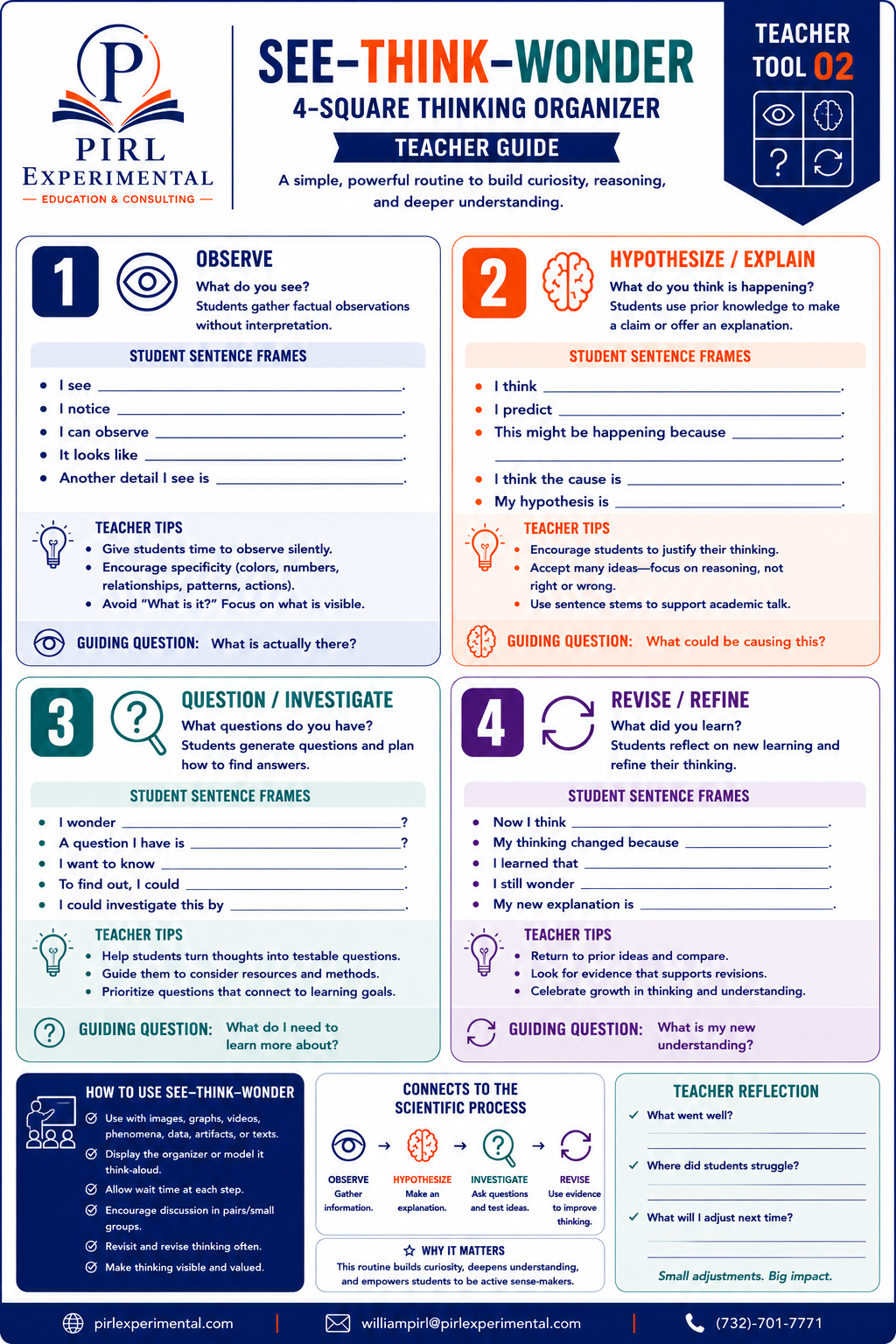
Pirl Experimental teacher guide for the four-square thinking routine with teacher tips, student sentence frames, guiding questions, and reflection prompts.
Teacher Guide. Student language, facilitation tips, guiding questions, classroom-use suggestions, and teacher reflection in one reference page.

The Observe section reminds me to allow silent noticing time, press for specificity, and resist turning observations into interpretations too quickly. Hypothesize/Explain emphasizes justification rather than a single right answer. Question/Investigate asks me to help students turn curiosity into questions that could actually be explored. Revise/Refine deliberately sends students back to their earlier thinking.

That last move matters. Revision should become evidence of learning, rather than evidence that a student was “wrong.”

One Routine, Three Levels of Support

Version What Students See Teacher Role When I Would Reach for It
Student Template Prompts + open writing space Model the routine, then step back Independent thinking; familiar routine
Student Guide Prompts + sentence frames Select, model, or fade scaffolds as needed Language support; emerging writers; first exposures
Teacher Guide Frames + facilitation moves + reflection Plan questioning, pacing, discussion, and revision Teacher planning; PLCs; coaching; consistent implementation

How I Would Use the Routine in a Lesson

  1. Start with something worth noticing. An image, phenomenon, graph, short video, model, specimen, demonstration, student work sample, or piece of data works better than a prompt with only one obvious observation.
  2. Protect observation time. Give students a brief period when interpretation is not yet the goal. The distinction between “I see…” and “I think…” is part of the learning.
  3. Choose a thread and follow it. Ask students to select one important observation and carry that same idea into the next box rather than starting over with an unrelated thought.
  4. Let explanations be provisional. Students should be able to make a reasonable first explanation without fearing that an early idea will be graded as a final answer.
  5. Use questions to determine the next evidence needed. The Question/Investigate box can help identify what to investigate, read, measure, model, discuss, or look at next.
  6. Require the return trip. Students revisit the same explanation and state what changed, why it changed, and what they now think.

What This Is — and What It Is Not

This is not an attempt to turn every observation into a formal laboratory investigation, and it is not meant to present science as one rigid “scientific method.” The four boxes are thinking moves.

Depending on the lesson, Question/Investigate might mean designing a test, examining data, reading a source, looking at a model, discussing competing explanations, or simply identifying the next piece of information students need.

Likewise, Hypothesize/Explain does not have to mean a formal hypothesis every time. Students may be predicting, proposing a mechanism, or simply explaining what they think is happening and why. The important shift is from noticing to reasoning.

Why the Revision Box Matters Most

If I had to protect only one addition to the traditional routine, it would be Revise/Refine. Students can easily come to believe that good learners know the answer quickly and that changing an answer means they failed the first time.

Science asks for almost the opposite habit: make the best explanation you can with the evidence available, test it, and improve it when you learn more.

Changing your thinking because of evidence is not backtracking.
It is the work.

A Tool I Want to Keep Experimenting With

I do not see this organizer as a finished replacement for every See–Think–Wonder moment. Sometimes the original three prompts are exactly enough. The four-square version is for moments when I want students to move beyond curiosity into explanation, evidence-seeking, and revision.

The three versions also give me room to experiment with scaffolding. I can begin with the sentence-frame guide, move students toward the open template, and use the teacher guide to keep my own facilitation consistent.

Over time, the paper itself should matter less because the thinking pattern has become familiar.

That is the larger goal of Pirl Experimental: not to find the one perfect organizer, but to build useful tools, try them with real students, notice what they make possible, and refine them.

Teaching Is Experimental.

Good tools should help us notice more, reason more deeply, and improve what we do next.

Learn. Experiment. Refine. Impact.