Voices in Education
Back to School Night in Eight Minutes
How I help families see the classroom before problems begin
Back-to-School Night gives me about eight minutes with each group of families.
Eight minutes is not enough time to explain an entire science course. It is not enough time to walk through every policy, demonstrate every resource, answer every question, or recreate what students experience during a 66-minute class period.
But eight minutes is enough time to do something more useful: show families how to see what is happening in the class after they leave my room.
That is the real goal of my presentation. I am not trying to deliver a smaller version of the syllabus. I am trying to begin a working relationship before anyone needs it.
Start with evidence parents can actually use
I usually begin by showing families examples of interactive science notebooks from previous years. Not perfect notebooks. Not Pinterest notebooks. Real ones.
Some are neat. Some are crowded. Some have careful diagrams, color-coded thinking, corrections, Post-it notes, and evidence that the student returned to an idea more than once. Others tell a different story.
That is precisely why I show them.
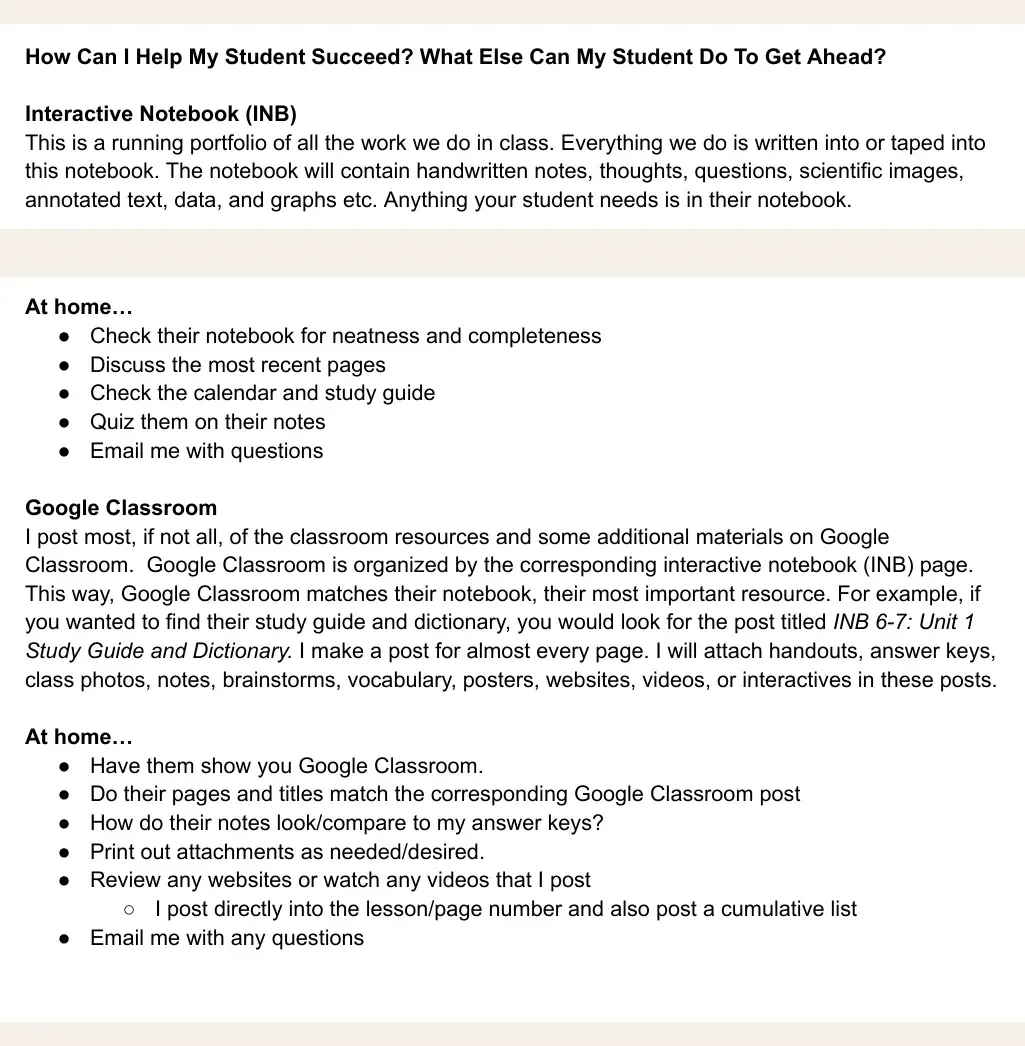
I tell parents to ask their student to bring the science notebook home and open it. The notebook will tell a story about the student's effort. It shows whether work is present, whether ideas have been revised, whether class explanations were recorded, whether missing pieces were corrected, and whether the student has been using the notebook as a tool or merely carrying it from room to room.
A notebook is not the learning itself, and neatness is not the same as understanding. I am not asking parents to grade handwriting or inspect every piece of tape. The notebook is infrastructure. It gives a student a place to collect evidence, organize thinking, build and revise models, and return to ideas over time.
It also gives a family something more reliable than, “I think I am caught up.”
Ask the student to give the Google Classroom tour
The physical notebook is only half of the system. Google Classroom holds the digital half: assignment directions, replacement copies, answer keys, notebook photographs, class charts, videos, simulations, and materials for students who were absent.
These two systems do not compete. The notebook is better for drawing, annotating, modeling, and seeing how thinking changes. Google Classroom is better for searching, duplicating, linking, checking, and getting access from home.
At Back-to-School Night, I show families what our Classroom looks like. More importantly, I ask them not to take my tour as the final one. Their student should provide the next tour.
The student should control the computer and explain the system. That matters. A parent does not need to become a second teacher or manage the class from home. The goal is to see whether the student can locate the information and describe what to do with it.
Middle school students are not always trying to mislead adults. Sometimes they are unsure. Sometimes they remember only part of the story. Sometimes “we did nothing” means “we did several things, but I do not know how to explain them.” Sometimes “there is no homework” means “nothing is due tomorrow,” even though a long-term study guide is waiting.
Trust is important. So is checking the evidence together.
Ten minutes tonight is more valuable than an hour the night before
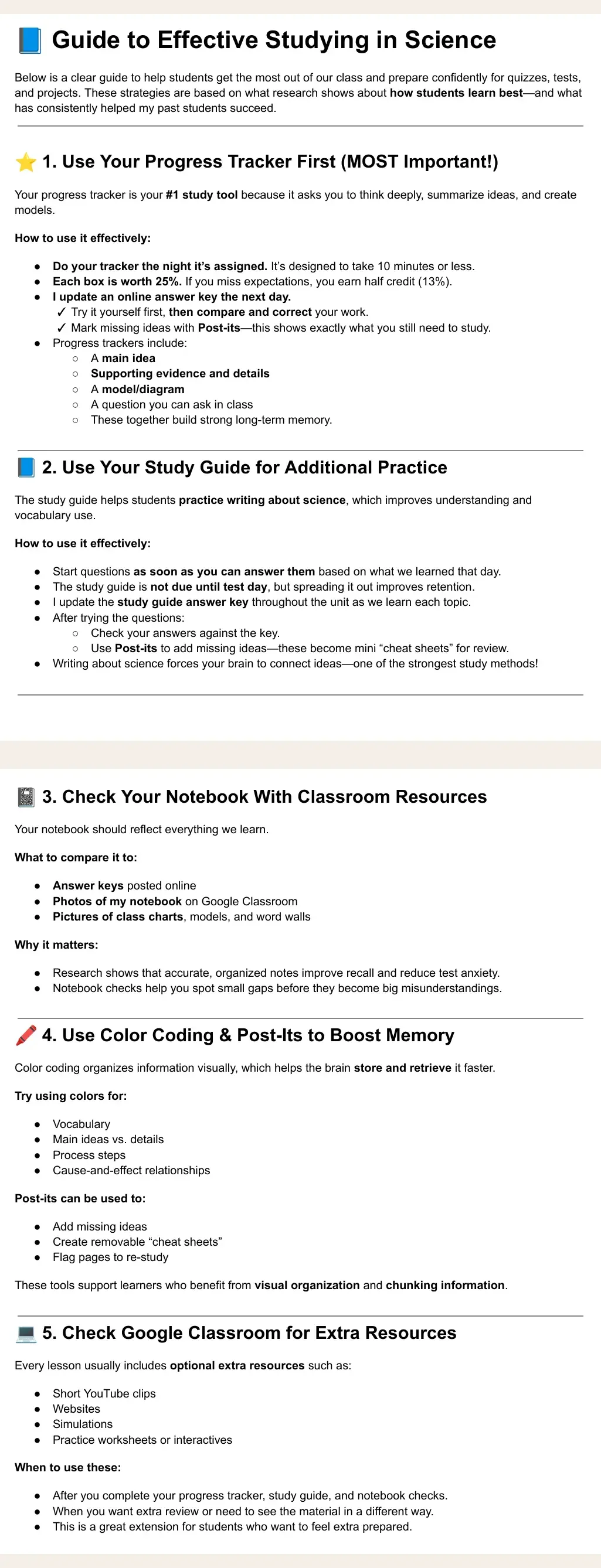
I bang the drum for studying every night for 10 to 15 minutes.
That does not mean rereading the same page until the words blur. It means doing something small and active: complete part of the study guide, summarize the lesson, answer a progress-tracker question, correct the notebook using a posted key, explain a model aloud, or identify one question to bring to class.
Students often hear “study” as a vague instruction. Then the night before a test arrives, they sit down with an entire unit and no clear starting point. The problem is not always motivation. Sometimes nobody has made the process concrete enough.
My homework is designed, in part, to force that healthier rhythm. A short lesson summary or tracker asks students to revisit the day's thinking while it is still fresh. The longer-term study guide encourages them to build preparation across the unit instead of manufacturing it in one anxious evening.
I know that homework can create tension at home. The goal is not to give parents another nightly battle. The goal is to make the work predictable enough that a family can ask a useful question: “Show me what you reviewed for science tonight.”
That question is very different from “Did you study?”
Every family recognizes one of the case studies
At the beginning of the year, my students analyze six fictional science students.
Maya participates, notices gaps, uses resources, and asks questions before a quiz. Jordan loves labs but checks out during the explanation, then remembers the activity without being able to explain the science. Alex is organized and memorizes vocabulary but freezes when asked to use an idea in a new situation. Sam has a rough start, becomes overwhelmed, and eventually learns how to recover. Taylor accepts an 82 as “just the grade I got.” Chris earns the same 82, studies the errors, and discovers that most of the misunderstanding comes from one concept.
No case is simply the good student or the bad student. Each one contains strengths, habits, blind spots, and a possible next step.
I would love to have parents complete the entire lesson at Back-to-School Night. It is worth doing. It also will not fit honestly into eight minutes.
This year, I am leaning toward a compressed version: briefly describe the six cases and ask one private question—“Do you recognize your student anywhere?”
Most parents will. I do, too. Depending on the day, most adults can recognize themselves somewhere in the set.
The point is not to assign a child a permanent category. The point is to give students, parents, and teachers shared language. Instead of saying, “You need to try harder,” we can ask whether the student is participating only in the hands-on portion, avoiding unfamiliar problems, waiting too long to ask a question, or treating a grade as a verdict instead of information.
Specific problems allow for specific next steps.
No Secrets No Excuses and I Told You So
The case studies lead to three ideas I share directly with students and families.
No Secrets
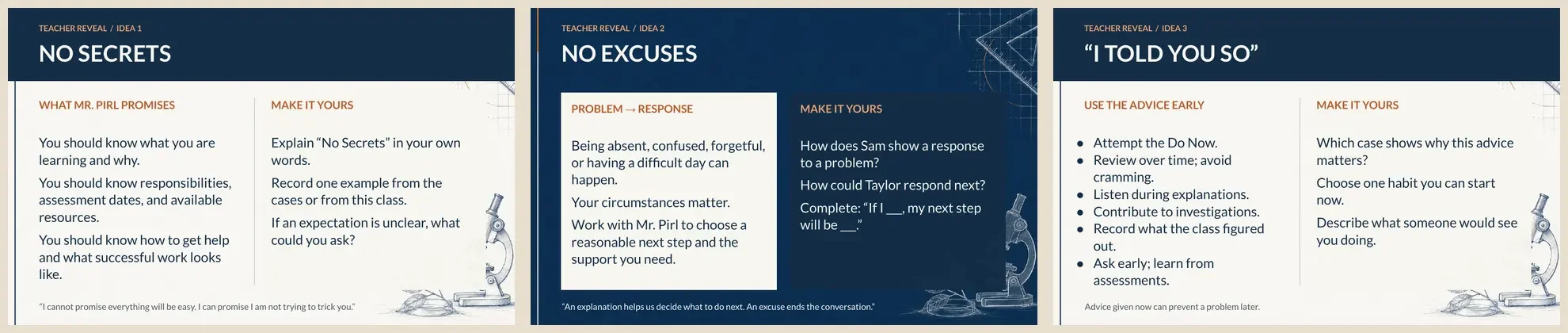
My promise: Students should know what they are learning, what is expected, what is coming, what resources exist, and how to get help.
No Excuses
Our response: Circumstances matter. An explanation helps us choose support and a reasonable next step. An excuse ends the conversation.
I Told You So
The early advice: Participate, listen, record the learning, review over time, ask early, and use assessments as information.
“I told you so” is not meant as a victory lap after a child struggles. It means I am giving the advice early, clearly, and repeatedly. Advice given now can prevent a problem later.
Together, the three ideas create a fair exchange. I owe students clarity, access, support, and honest feedback. Students owe themselves active participation and a response when something is not working. Families do not have to guess what either side should be doing.
Parents do not need to become the homework police
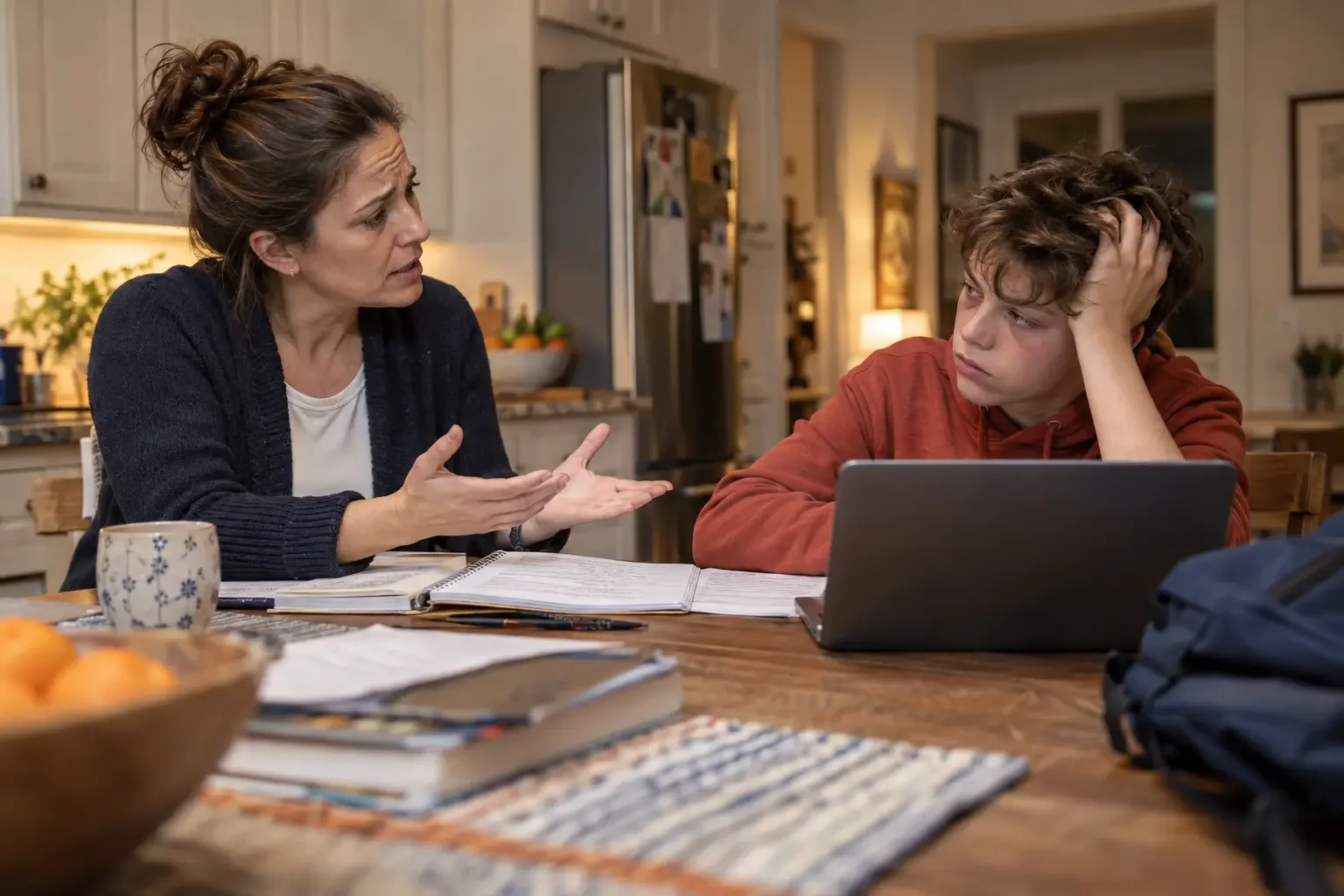
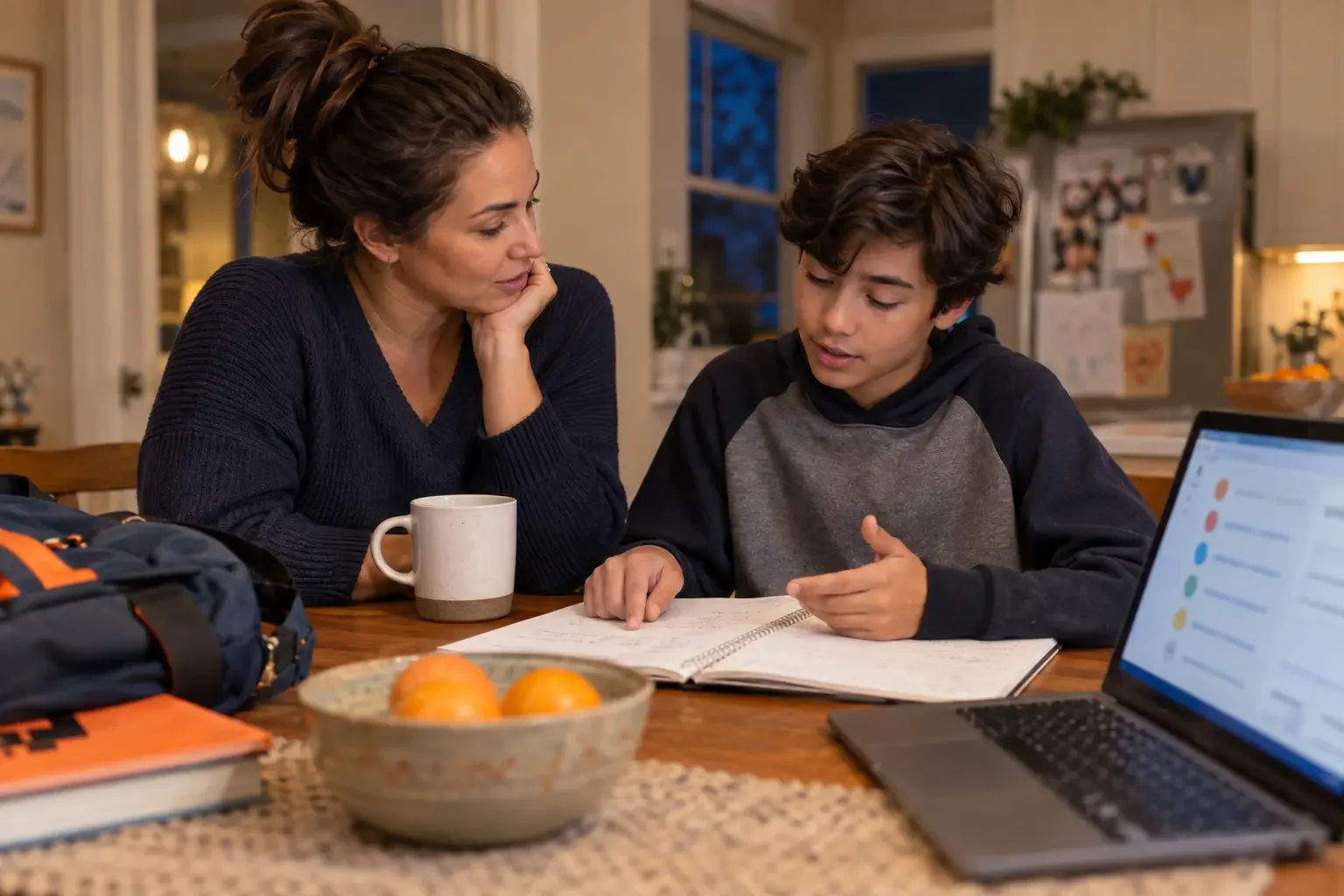
The most productive family support is not hovering over every assignment or turning the kitchen table into a second classroom. It is helping a student build the habit of opening the evidence and talking about it.
Ask for the notebook. Ask for the Google Classroom tour. Ask what the student reviewed for 10 minutes. After an assessment, ask what the result revealed and what the next step will be.
Then listen.
If the notebook is incomplete, the conversation can be about a plan. If the student cannot locate a resource, the conversation can be about learning the system. If the student has been working consistently but still does not understand, that is important information for me. It means we may need a different explanation, more practice, a new model, or a conversation at school.
The point of transparency is not surveillance. It is earlier, calmer, more accurate communication.
What I hope families leave with
When the timer ends, families will not know everything about my course. I do not need them to.
I want them to leave knowing where the learning lives, what steady preparation looks like, what I promise their student, and what their student can do when something goes wrong.
Most of all, I want them to know that communication does not have to begin with a missing assignment, a disappointing grade, or an argument at the kitchen table.
Eight minutes is not enough to explain a year. It is enough to show families how we can work together through it.